Research
AI Points to a New Way to Understand Brain Diseases
After parsing more than 50,000 brain scans, a machine learning model discovered surprising patterns across common brain disorders.
For doctors and patients, diseases like Alzheimer’s, schizophrenia, autism spectrum disorder, or late-life depression are defined by the symptoms. But what if that clinical understanding doesn’t provide the full picture?
For computational neuroscientist Junhao Wen, recent advances in AI point toward a new way of understanding brain diseases that affect tens of millions of people across the world.
In a new study published in June in Nature Biomedical Engineering, Wen, affiliated faculty in the Department of Biomedical Engineering at Columbia Engineering, and co-author Christos Davatzikos, report that these four major brain disorders may have more in common than previously thought. The research points to newly appreciated similarities both in how diseases appear in the brain and in the genetics that underlie these conditions.
“Across these disorders, we’d seen overlap in imaging patterns across these brain disorders before,” said Wen, who has a primary appointment in radiological sciences at Columbia’s Vagelos College of Physicians and Surgeons and also directs imaging genetics research at the Center for Innovation in Imaging Biomarkers and Integrated Diagnostics.
“In this research, I wanted to ask, ‘What are the underlying genetic variants and biological pathways that can potentially shape such imaging similarities across these disorders?’”
Casting doubt on conventional thinking
To answer these questions, the researchers turned to advanced artificial intelligence tools originally developed to study each disease on its own. They trained their models to detect cross-diagnostic signatures. That is, to find patterns in brain scans of people who were diagnosed with different disorders. This led to evidence that certain brain imaging phenotypes (and the genetic variants associated with them) appear across disorders once thought to be relatively distinct.
The findings suggest that a shared biological architecture underpins what medicine has long treated as separate diseases. For Wen, this points to the possible existence of “pan-brain disorders,” which are conditions that don’t entirely follow the conventional lines drawn in neurology and psychiatry, and complement conventional clinical diagnoses.
Unlike traditional studies that depend on clearly defined diagnostic labels, Wen’s approach emphasizes continuity and the co-expression of multiple imaging patterns. His team used weakly supervised AI models to let patterns emerge from the data. Unlike other forms of unsupervised machine learning, weakly supervised models allow the AI to find imaging subtypes guided by disease pathology and trajectories from healthy control stages to disease stages. Their analysis drew from clinical imaging datasets and general population data, including the UK Biobank, to better capture the variability seen in real-world settings.
A full-body approach
Wen’s broader research agenda includes developing AI methods to study aging across organ systems, not just in the brain. In a companion study, his team found that individuals with signatures of pan-brain disease also showed signs of systemic aging in other organs, including the heart and liver. This suggests a deeper, body-wide basis for these disorders.
“Ultimately, many diseases surpass the organ boundaries we use in medicine,” Wen said. “So our models shouldn’t either.”
Still, challenges remain.
“The big issue is population diversity,” he said. “We trained on clinical data and tested on broader samples, but we need to validate these findings across more diverse groups.”
Even so, the clinical implications are striking. If disorders as different as autism and Alzheimer’s share underlying biology to a certain extent, new biomarkers could help clinicians make earlier diagnoses and choose more effective treatments.
“I think we’re just beginning to see what’s possible,” Wen said. “This is about building a new language for brain disease that’s driven by computation and grounded in biology.”
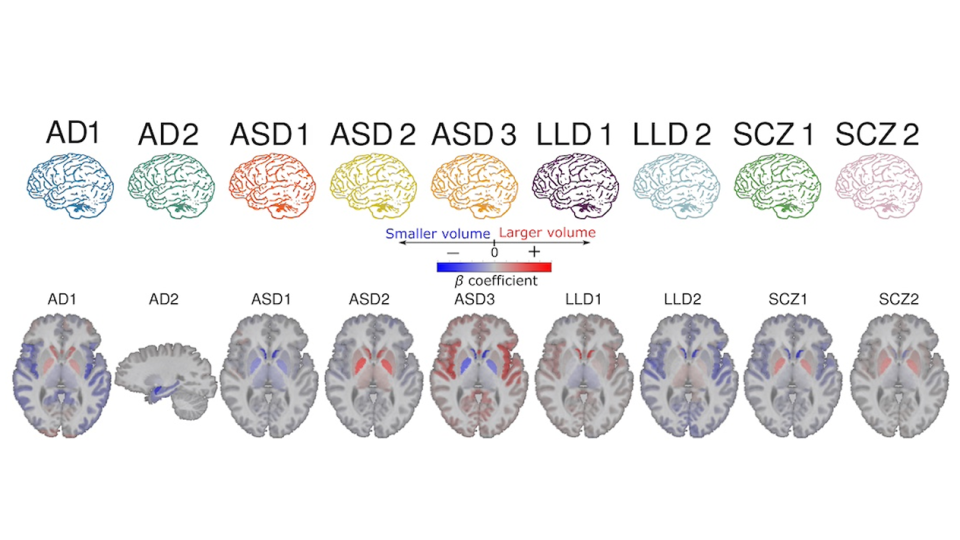
Lead Photo Caption: These heatmaps show brain regions where gray matter volume correlates with nine disorders, revealing shared patterns in clinical and general populations across 40,000+ MRI scans.
Lead Photo Credit: Wen Lab
About the Study
Journal: Nature Biomedical Engineering
Title: Neuroimaging endophenotypes reveal underlying mechanisms and genetic factors contributing to progression and development of four brain disorders
Authors: Junhao Wen, Ioanna Skampardoni, Ye Ella Tian, Zhijian Yang, Yuhan Cui, Guray Erus, Gyujoon Hwang, Erdem Varol, Aleix Boquet-Pujadas, Ganesh B. Chand, Ilya M. Nasrallah, Theodore D. Satterthwaite, Haochang Shou, Li Shen, Arthur W. Toga, Andrew Zalesky & Christos Davatzikos
Funding/Acknowledgments: This study used the UK Biobank resource under application numbers 35148 (C.D.) and 60698 (A.Z.). J.W. leads the MULTI consortium under UK Biobank Application number 647044; J.W. and the Laboratory of AI and Biomedical Science (LABS) are supported by the start-up funding from Columbia University. We also gratefully acknowledge the support of the imaging-based SysTem for AGing and NeurodeGenerative diseases (iSTAGING) consortium, funded by the National Institute on Aging through grant RF1 AG054409 at the University of Pennsylvania (C.D.). In addition, we acknowledge the funding program from the Rebecca L. Cooper Foundation at the University of Melbourne (A.Z.). Y.E.T. is supported by a National Health and Medical Research Council Investigator Grant (APP2026413).