
Research
Angela McNeal's Blueprint for Trustworthy AI
At this year's first innovation Forum, Thread AI’s Angela McNeal BS'16 traces her career in machine learning to entrepreneurship, sharing what drove her to build her own startup.
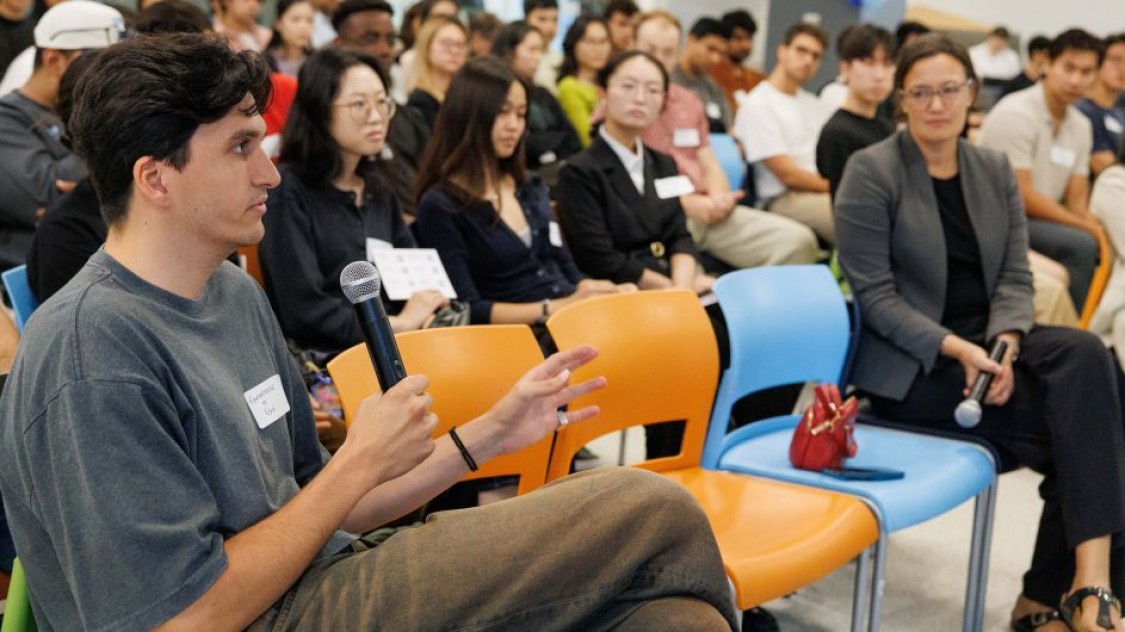
Columbia Engineering welcomed Angela McNeal BS'16, founder and CEO of the AI infrastructure company Thread AI, as the featured speaker at this year's Innovation Forum, held Sept. 17 in Carleton Commons. The event marks the beginning of the entrepreneurship season for the academic year.
Hosted by Columbia Engineering's Innovation, Design, and Entrepreneurship program, the Innovation Forum invites a speaker each month, and encourages opportunities for students to network, form startup teams, and discover resources that support their entrepreneurial goals.
In her talk, McNeal discussed how her time as a Palantir employee and her fears that AI could be used without explicit guardrails in business infrastructure led her to found Thread AI – a governance and control platform that builds secure AI workflows and agents for organizations that use AI in important, high-stakes operations.
Building frameworks that keep AI in check
After graduating from Columbia Engineering with a degree in computer science, McNeal worked at Goldman Sachs, where she spent a year on a high-risk portfolio that required machine-learning applications to generate investment decisions. Following Goldman Sachs, she joined Palantir, where she worked for the next six years.
At Palantir, McNeal helped large institutions navigate the growing role of AI in their operations. As these systems became more capable, McNeal saw an opportunity – infrastructure hadn't yet caught up to help organizations track, explain, and govern their models' operation.
As large language models entered the picture, McNeal saw industries increasingly treat these systems like human colleagues rather than engineered components — a shift she believes makes the handoff of judgment between people and machines harder to track. "When you embed a model into a system as a component, you engineer it like a component – bounded inputs, tested failure modes, strict networking policies," said McNeal. "But when you embed it as a colleague, you skip all of those things. The critical decision then gets outsourced because nothing in the system ever shows where that judgment actually occurred."
This gap shaped the design philosophy that centers the work on Thread AI, where best practices and accountability are encoded into the institutional infrastructure rather than being optional behavior. Co-founded by McNeal in 2023, the company builds an AI infrastructure layer that helps organizations deploy AI reliably and mitigate accountability gaps.
Thread AI's platform is built around two critical distinctions: when a model should stop if it encounters ambiguity, versus when an organization must mitigate that risk. “That boundary has to be explicit, it has to be owned by people, and it has to live in a place you can go back and inspect,” she said.
Advice for aspiring entrepreneurs
McNeal also offered some advice for the future leaders in the audience. She shared that entrepreneurial success relies on having humility and conviction. In terms of humility, she stressed the importance of taking responsibility for the company's pitfalls and successes. “If you hire the wrong person or make the wrong decision, that is your responsibility,” she said. “Companies start to blow up when founders look for someone else to blame." The smart route is to be open to feedback from others.
“You need to be willing to be wrong, to listen, to keep learning from your team and your users.”
Persistence, she added, and the belief that an entrepreneurial idea will work are just as important to reaching success in a company. “You need conviction that your idea is meaningful, important, will get you money and customers, and transform something,” she said.
McNeal urged students not to wait until they feel ready to take on a hard problem. "Opportunities often arrive dressed as problems no one else wants to solve. Take those on before you feel ready – before someone else decides to solve them."