Campus
Breaking Barriers in Bandwidth and Energy Use
The Center for Ubiquitous Connectivity (CUbiC) deepens its system-level mission to reimagine energy-efficient communication—from next-gen wireless to AI data center infrastructure.
At its third annual review held June 25–26 at Columbia University, the Center for Ubiquitous Connectivity (CUbiC) convened academic and industry leaders to share research breakthroughs, new testbeds, and collaborative roadmaps for next-generation connectivity.
Backed by $35 million in funding through the JUMP 2.0 initiative, CUbiC brings together 22 principal investigators across 14 institutions and more than 130 scholars. The center is committed to tackling critical challenges in communication systems—ranging from high-speed data center interconnects to scalable wireless networks at the edge.

In her opening remarks, CUbiC Director Keren Bergman set the tone with a candid assessment of today’s communication bottlenecks and energy crises. “CUbiC has identified two major challenges for communication systems,” said Bergman, Charles Batchelor Professor of Electrical Engineering at Columbia Engineering. “One is at the wireless edge, where we must increase capacity and reliability at low cost. The second is within AI data centers, where we’re working to close the communication-computation gap without increasing energy consumption.”
She added, “CUbiC is unique in how we integrate the entire stack—from photonics and chip design to system architecture. There’s no other research center that enables this level of vertical collaboration.”

Columbia Engineering’s Dean Shih-Fu Chang delivered the opening remarks, emphasizing the School’s commitment to collaboration and interdisciplinary research as the key to driving innovation.
“At Columbia Engineering, we truly believe that collaboration and interdisciplinary research are critical to innovation and finding solutions,” he said, setting the tone for a day of forward-looking discussions on data transport and energy-efficient systems. His remarks reflected the School’s broader vision of “Engineering for Humanity” and the urgent need to address the mounting energy demands driven by AI technologies. “The need to reduce energy consumption in our information infrastructure is a critical need for our time,” he added. “The rise of generative AI has only made this more important than ever.”
Powerful posters, big ideas
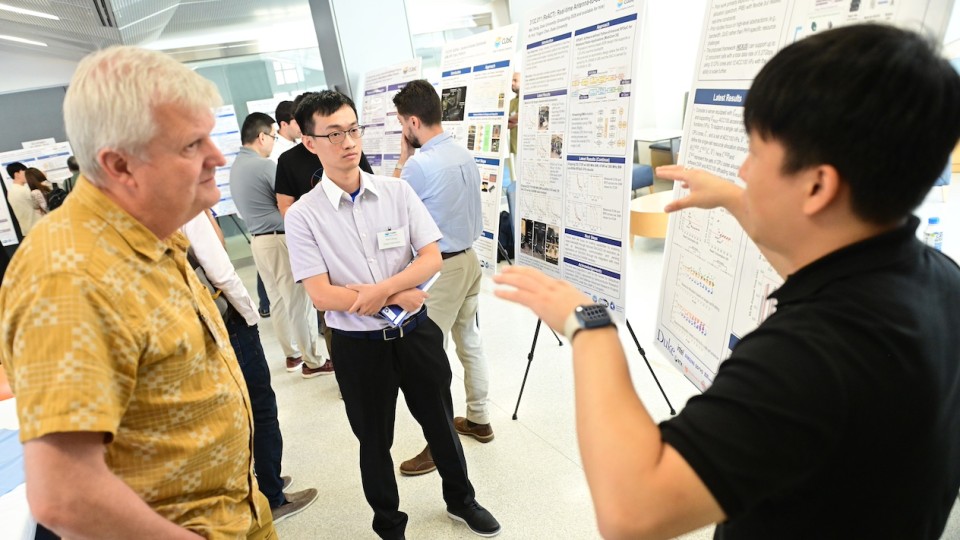
In a series of presentations, poster sessions, lab visits, and discussions, CUbiC scholars shared updates on innovative projects spanning the center’s three research themes: wireless circuits and technology; wireline and lightwave interconnects; and connectivity networks and systems.
Among the standout student presentations was Oregon State University’s Xiaohui Lin, a CUbiC student researcher, who presented “Machine Learning Inspired Cross-talk Compensation in Wireline Links.” The project demonstrated a supervised learning technique for cross-talk mitigation in high-speed data lanes using a 16nm FinFET transceiver. Lin, advised by Tejasvi Anand at Oregon State University, recently completed an internship at Intel.

“My experience of applying machine learning to address crosstalk issues in high-speed interconnects has provided a strong foundation for my work at Intel Labs, both in terms of system-level implementation and identifying root causes of performance challenges,” said Lin.
Columbia Electrical Engineering PhD students Zhenguo (Brian) Wu and Phong Nguyen also presented research on AI networking architectures and Scalable D-band TX and RX Phased-Array Systems. "Designing efficient networks is essential for scaling the performance of large-scale AI systems, and optically-enabled reconfigurable networks offer a promising solution to meet these demands," said Wu. Nguyen emphasized the social impact of the work: “I want to achieve something that can impact society on a large scale while aligning with my interest in physics and engineering.”
Record-setting wireless
Among CUbiC’s most celebrated accomplishments this year was a breakthrough in energy-efficient wireless systems. Hesham Beshary, a CUbiC student researcher from UC Berkeley advised by Ali Niknejad, shared his team’s latest result: “We’ve achieved the first ultra energy-efficient wireless link at 140 GHz—using less than one picojoule per bit—and reached a record-breaking data rate of 138 Gb/s,” said Beshary. “By using built-in antennas on a low-cost chip, we were able to simplify the system and cut costs. This brings us closer to making the next generation of wireless—like future mobile networks and smart sensing—both faster and more scalable.”
From CUbiC scholar to faculty leader
Yuyang Wang, a postdoctoral research scientist at Columbia Engineering, reflected on CUbiC’s transformative role in shaping his career. “CUbiC has given me a rare opportunity to engage in a large, collaborative center involving both academia and industry,” he said. “This experience has profoundly shaped my perspective and prepared me for my upcoming faculty role at the University of Connecticut.” Wang’s research explores hardware-software co-design to maximize the impact of optical interconnects.
Wang will join the University of Connecticut's Department of Electrical and Computer Engineering as an assistant professor in August, where he plans to continue his work on silicon photonics and bring new talent into the field.
Driving toward scalable AI
In her keynote, Bergman underscored the broader implications of CUbiC’s mission: “Energy does not scale,” she said. “Yet AI systems are growing exponentially in demand and size. If we can connect resources flexibly, only when needed, we can make these systems faster, more energy-efficient, and ultimately more sustainable.”
Michal Lipson, Eugene Higgins Professor of Electrical Engineering, agrees.“This research has the potential to enable unprecedented bandwidth while using only a handful of lasers,” she said.
Poster Awards Recognition
After a competitive judging session, six standout posters were selected for awards: Anirban Banik and Ruiyi Shen from Theme 1; Gene Lee and Changhao Han from Theme 2; and Tanmay Chavan and Yuya Nemoto from Theme 3. The Undergraduate Research Excellence award went to Ryan Fu from the University of Illinois Urbana-Champaign and Cooper Xie from Columbia Engineering.
In addition, eight scholar leaders—Yuyang Wang, Chung-Hsuan Tung, Zhihui Gao, Han-Mo Ou, Oliver Liu Wang, Phong Nguyen, Mostafa Toubar, and Matthew Guidry—representing Columbia University, Duke University, University of Illinois Urbana-Champaign, University of Southern California, and University of California, Santa Barbara, were honored at the award ceremony.
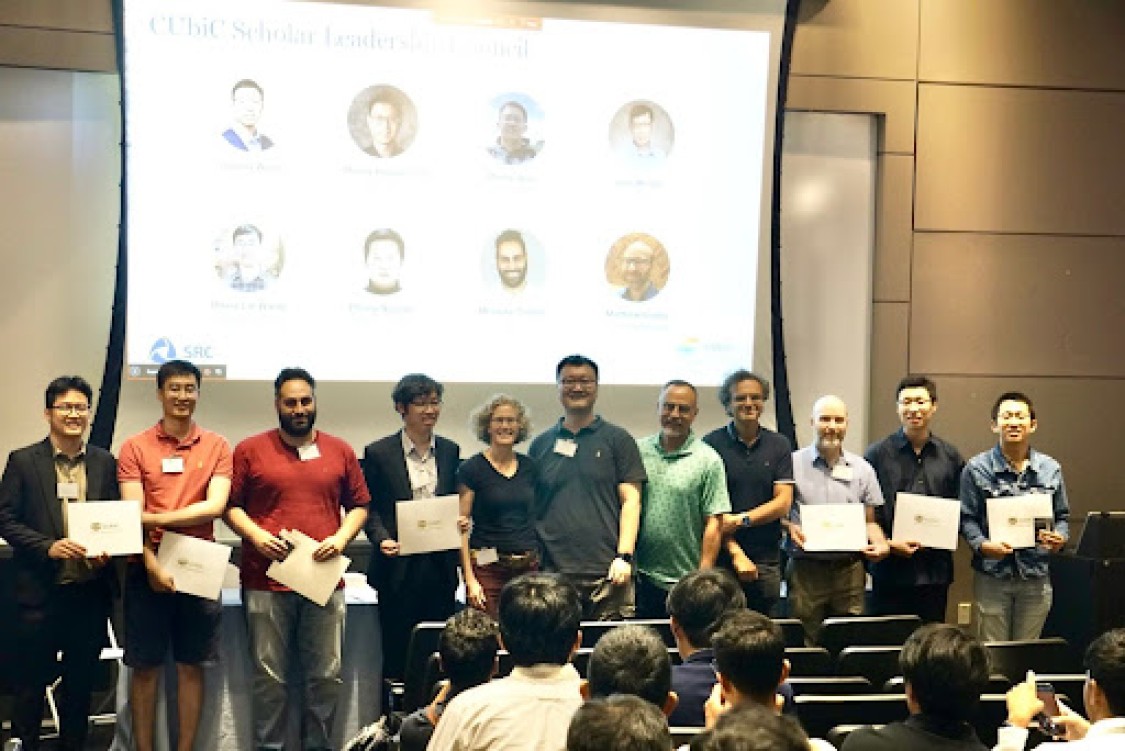
As the CUbiC symposium wrapped up, its goals remain clear: reduce the energy footprint of communications, build scalable systems, and train the next generation of engineers who will lead the future of ubiquitous connectivity.
Lead Photo Caption: The Center for Ubiquitous Connectivity (CUbiC) held its annual symposium June 25-26 at Columbia’s Morningside campus.
Lead Photo Credit: Chris Taggart