Research
Breakthrough Nanosensor Research Earns Columbia Engineer Blavatnik Regional Award for Young Scientists
Natalie Fardian-Melamed is honored for discovering how tiny crystals can detect minute forces, with potential applications from medicine to robotics.
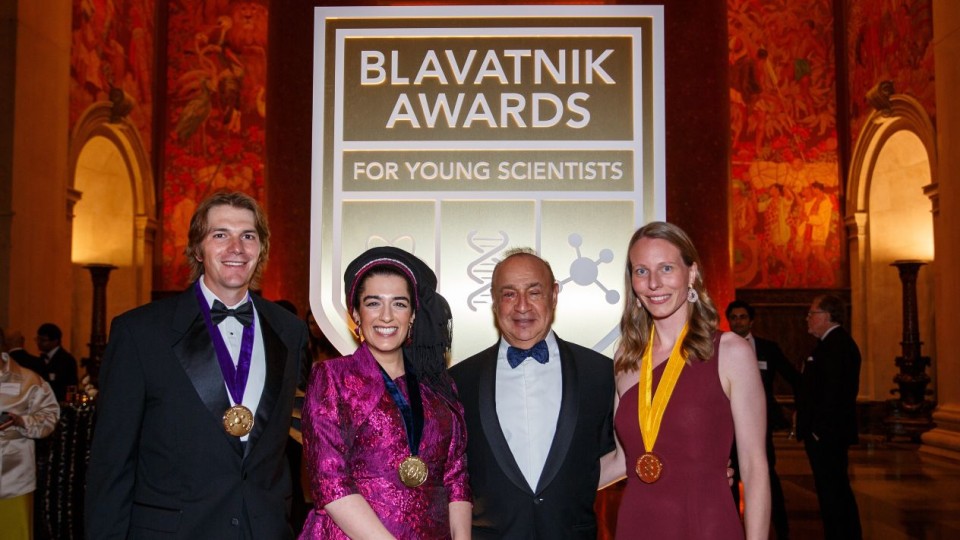
Natalie Fardian-Melamed was honored at the Blavatnik Awards Ceremony, held Oct. 6 at the American Museum of Natural History in New York. Fardian-Melamed, who is now an associate research scientist at Columbia Engineering, is the 2026 Blavatnik Regional Awards for Young Scientists Laureate in Physical Sciences & Engineering. She was joined at the ceremony by Columbia University President Jennifer Mnookin and Columbia Engineering Dean Shih-Fu Chang.
Given by the Blavatnik Foundation and administered by the New York Academy of Sciences, the Blavatnik Regional Awards for Young Scientists are awarded to young scientists whose postdoctoral research exemplifies the extraordinary scientific excellence found across the Tri-State area of New York, New Jersey, and Connecticut. As Laureate, Fardian-Melamed will receive a $30,000 unrestricted award.Two finalists from Columbia, former postdocs Zhihao Cui and Itai Linial, will each receive $10,000; Samuel Sternberg, associate professor of biochemistry and molecular biophysics, was recognized as a finalist for the Blavatnik National Awards for Young Scientists, which honors faculty-rank researchers.
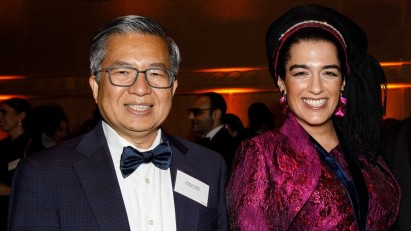
“We’re thrilled to see Natalie recognized by the Blavatnik Regional Awards for Young Scientists,” said Dean of Columbia Engineering Shih-Fu Chang. “Her work in nanosensors is paving the way for future breakthroughs in health, quantum, robotics, and many applications that will affect our everyday lives. We look forward to seeing how her research will impact society.”
Fardian-Melamed was recognized for work she began as a postdoctoral fellow with Jim Schuck, professor of mechanical engineering at Columbia. Using a phenomenon called photon avalanching, Fardian-Melamed helped develop a light-based way to detect mechanical force at nanometer scales; that work was published in Nature in 2025.
Photon avalanching is a unique, optical chain reaction that occurs in crystals containing rare metallic elements called lanthanides. In 2021, Schuck’s lab and their collaborators first observed this reaction in nanocrystals, where a few pulses of infrared light can trigger the release of many higher-energy photons—an avalanche of light, essentially—from a tiny crystal.
Fardian-Melamed joined Schuck’s lab that same year as a Fulbright Scholar, after completing her PhD in physical chemistry at Hebrew University. At Columbia, she observed that applying a small amount of pressure can also set off a photon avalanche. That discovery opens the door to using avalanching nanoparticles as nanoscopic sensors that can remotely detect minute changes in mechanical force in areas including medicine, batteries, robotics, and quantum technologies.
“The beauty of photon avalanching is that it's both fundamentally fascinating and real-world-application interesting,” said Fardian-Melamed. “There is still so much to unravel, and every day in the lab brings with it so many discoveries; it's pure fun to just explore! And from a practical point of view, now that we figured out the mechano-optics of photon avalanches, we're harnessing it to engineer real-world sensing systems and devices, such as thin, large-area tactile ‘robotic skin’ with ultrahigh spatial and force resolution. I'm incredibly grateful to have the work I so enjoy doing recognized in this way.”
Shuck, her advisor, also praised her research. "This is an amazing recognition for young scientists. Natalie’s discovery of the mechanisms behind environmental sensitivity in nanoparticles will have far-reaching impacts in the fields of information technology, energy, medicine, and beyond. In addition to her technical achievements, her tireless dedication to her work makes this award very well deserved."
Fardian-Melamed has also received a Marie Sklodowska-Curie Individual Global Fellowship, joined Nobel Laureates at the 2024 Lindau Nobel Laureates meeting, and won the Falling Walls Lab Pitch Competition last year. When she’s not applying pressure to nanocrystals, she is raising a new generation of curious minds at home with her five children.