Research
Celebrating Five Years of Industry-Academia Partnership in AI
At the fifth annual CAIT symposium, researchers shared their progress and outlined the future of this rapidly advancing technology.
More than 100 researchers, technologists, and industry leaders gathered in Morningside Heights on April 30, 2025, for the fifth annual Columbia Center of AI Technology (CAIT) Spring Symposium. Founded in collaboration with Amazon, CAIT aims to better society through the development and adoption of advanced AI technologies.
“When we started the center in 2020, the AI transition was just beginning,” said Shih-Fu Chang, Dean of Columbia Engineering and director of CAIT. “In 2022, we focused on large language models. Now we’re looking at AI agents and multi-agent collaboration.”
In its five years, CAIT has funded projects that advance the foundational theory and architecture of AI and explore applications of this fast-moving technology in fields such as health care and finance.
Industry insight
The day opened with a keynote by Serdar Tasiran, principal applied scientist at Amazon Web Services, who described how generative AI and automated reasoning can work together to improve how developers build and manage web services. He walked attendees through three high-impact use cases: building applications that rely on web APIs, managing infrastructure using code, and migrating legacy software to modern cloud environments.
“In all of these settings, there is some tedious but critical programming that needs to be done, and GenAI helps with that — but it also makes risks materialize more quickly,” he said. “Without some sort of guardrails, serious issues of correctness, security, privacy, and data integrity are quite probable.”
Each scenario, he argued, benefits from AI systems that not only generate code but can use formal methods to reason about domain-specific constraints, detect subtle errors, and support developers in making more effective decisions.
Five years of innovation
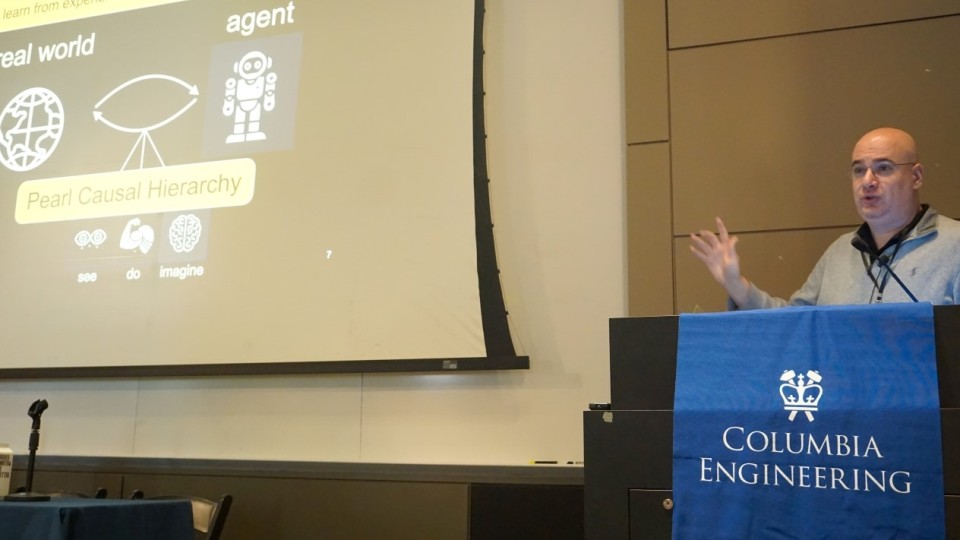
The morning continued with CAIT faculty research talks, including a cross-disciplinary project from Maryam Zolnoori of Columbia Nursing and electrical engineer Zoran Kostic, a professor of professional practice, who are using speech and language models to flag homecare patients at risk of hospitalization. Junfeng Yang, professor of computer science, introduced EDITGUARDIAN, a universal framework for safe, semantic-preserving code editing, while Elias Bareinboim presented new work on the theory and design of causal AI systems.
Afternoon sessions spotlighted student research and new applications of AI. In back-to-back lightning talks, CAIT PhD fellows Zach Horvitz and Kevin Xia shared early-stage work. Later, Columbia Engineering Professors Matei Ciocarlie from mechanical engineering and Ioannis Kymissis from electrical engineering demonstrated a low-cost approach to robotic manipulation using force/torque sensing, while Henry and Gertrude Rothschild Professor of Computer Science Kathleen McKeown and YM Associate Professor of Computer Science Carl Vondrick showed how neural networks can analyze and interpret works of art. Computer scientist Eugene Wu and Rachel Cummings from industrial engineering and operations research closed the faculty talks with a joint project on how to build more effective dataset search tools to support AI development workflows.
Looking ahead
A panel on AI agents brought together Columbia researchers and Amazon scientists to discuss the opportunities and limitations of current agentic systems. Columbia Computer Science Professors Zhou Yu and Yunzhu Li joined Danielle Perszyk and Alex Williams of Amazon to reflect on what it will take to build general-purpose agents that work reliably across domains—and how cognitive science, interaction design, and systems evaluation must evolve to meet that goal.
The symposium concluded with a reception and poster session in Carleton Commons, where students presented work ranging from AI planning and medical imaging to interpretability and dataset design. Now five years in, CAIT continues to bring Columbia and Amazon researchers together to advance AI for the public good — and to train the next generation of scientists working at the heart of this technological shift.