Campus
From Columbia to Climate Week: Alexander Sarrigeorgiou on Insurance, AI, and Resilience
At a special Tech CEO ‘fireside chat’ during Climate Week NYC, alum Alexander Sarrigeorgiou shared how climate change, AI, and new career paths are reshaping insurance.
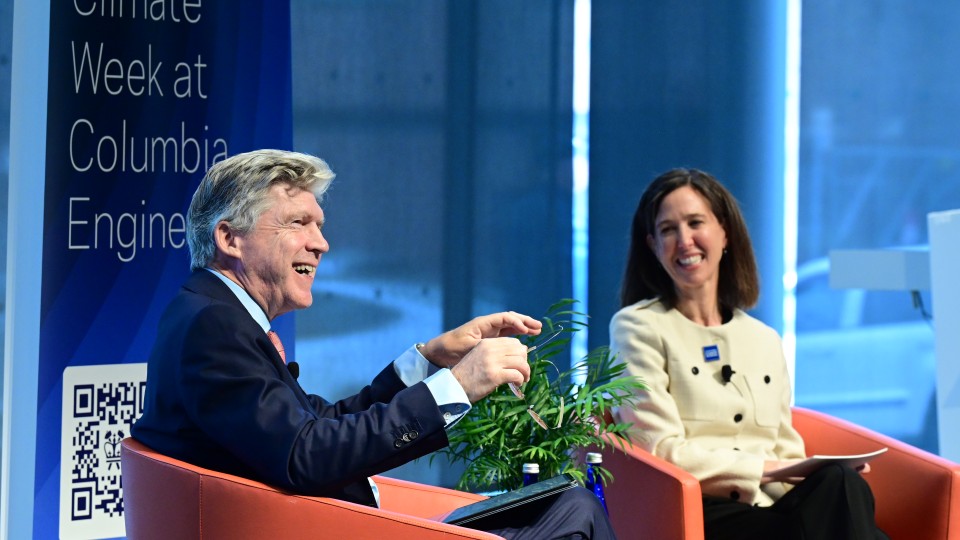
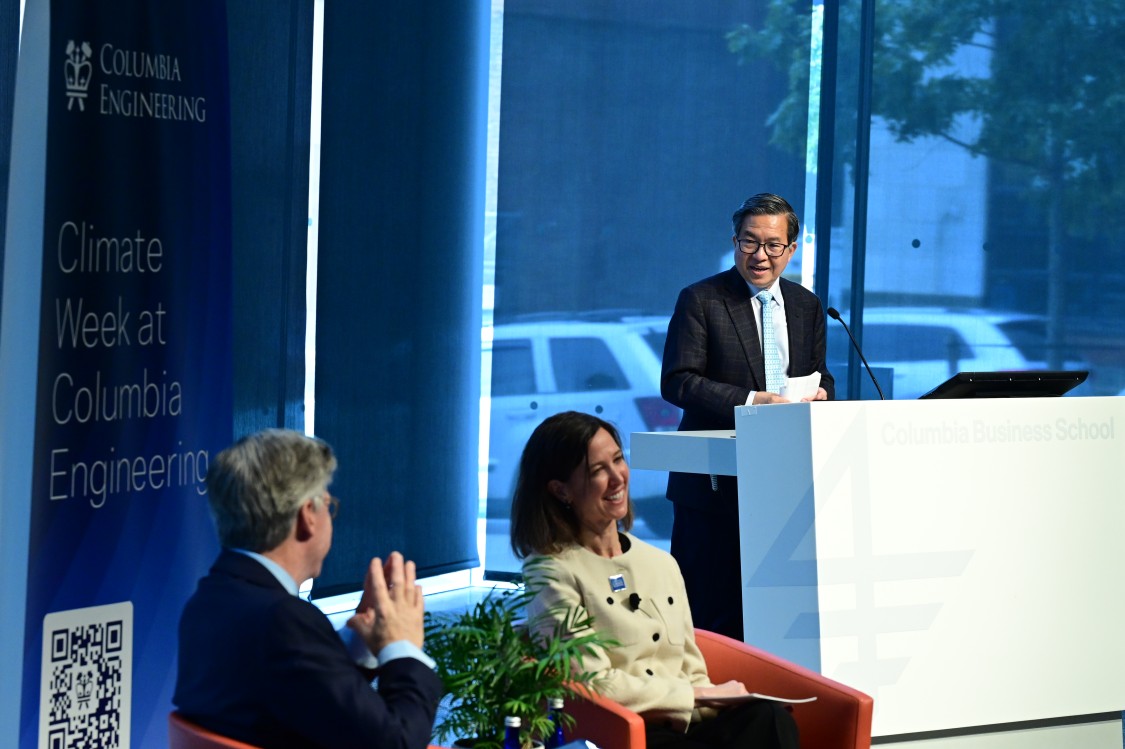
Columbia Engineering, the Climate School, and Columbia Business School kicked off Climate Week on Sept. 22 with a special Tech CEO lecture — a fireside chat featuring Engineering alumnus Alexander Sarrigeorgiou BS'79, MS'80, chairman and CEO of Eurolife FFH Insurance Group, chair of the Hellenic Association of Insurance Companies, and vice president at Insurance Europe.
In conversation with Climate School Dean Alexis Abramson, Sarrigeorgiou spoke about how climate change is reshaping insurance, the role of governments and markets, and why the industry is far more dynamic than its reputation suggests.
Sarrigeorgiou began by reflecting on his Columbia days and his circuitous career path.
“I landed here [in New York] on September 1st, 1976, a wide-eyed freshman, 18 years old,” he said to attendees in David Geffen Hall at Columbia’s Manhattanville campus.
He went on to get an MBA and wanted to be an asset manager upon graduation, but ended up in the insurance industry.
"I was always saying that the only reason I’m with an insurance company is because insurers have a lot of money to manage. Otherwise, it has nothing to do with insurance. Gradually, I fell in love with insurance. It can happen to you too,” he said.
Climate risk and the protection gap
When asked about climate change and its impact on his field, Sarrigeorgiou was blunt.
“It presents a huge challenge to societies, not only economies, and challenges to insurers, and opportunities for insurers,” he said. “Only 25 percent of areas are insured for natural disasters in Europe. So yes, it’s gone up from 20 to 25 between 1980 and 2022, but 75 percent of economic risk is uninsured.”
He pointed to Storm Daniel in Greece as a telling example.
“The estimates are that the economic cost of Daniel was 2.5 billion euros. The insurance industry paid 370 million. The man on the street got 50 million out of 2.5 total billion lost. That is extremely difficult to recover from,” he said.
According to Sarrigeorgiou, part of the problem is what the industry calls “charity hazard.” The idea is that people often count on government aid after disasters rather than buying coverage themselves, because political promises feel easier and cheaper than paying premiums.
“And you tend to only rely on politicians, depending also on the culture of the country. And so you leave yourself to the mercy of the politician. To me, it’s one of the biggest pain points,” he said.
Regulation, he argued, is another sticking point. “In the U.S., you need 30 percent less capital to start an insurance company than you need in Europe because of regulation,” he said. “Moreover, if you regulate or intervene in prices, companies may leave because capital requirements become very high.”
AI and the future of insurance
Sarrigeorgiou also discussed how artificial intelligence (AI) is reshaping insurance, and added that bringing AI into the insurance sector is reshaping how risks are priced and managed.
For mid-sized carriers like Eurolife, he said, the technology makes advanced tools more accessible.
“AI is democratizing access to high-end technology that in the past you would need specialized departments to have access to,” he said.
His company has already started applying AI to customer service, pricing, and fraud detection. “The better you can work on bigger sets of data, the more accurate the model, the lower the price because you need less risk premium,” he said. More accurate pricing, in turn, could help close the protection gap by making insurance more affordable.
Still, he acknowledged the limits. Access to data is often constrained by privacy rules, and compliance slows down innovation. “There’s always the lawyers,” he joked, referring to GDPR and other regulatory hurdles.
Advice for the next generation
Looking ahead, Sarrigeorgiou predicted big changes in how insurance is bought and delivered.
“The ability to buy insurance on your phone through Apple, Google, Facebook is coming,” he said. “The capital behind insurance will still be there, but I think with the help of AI and other technologies this could be very different. I think the industry is going to change.”
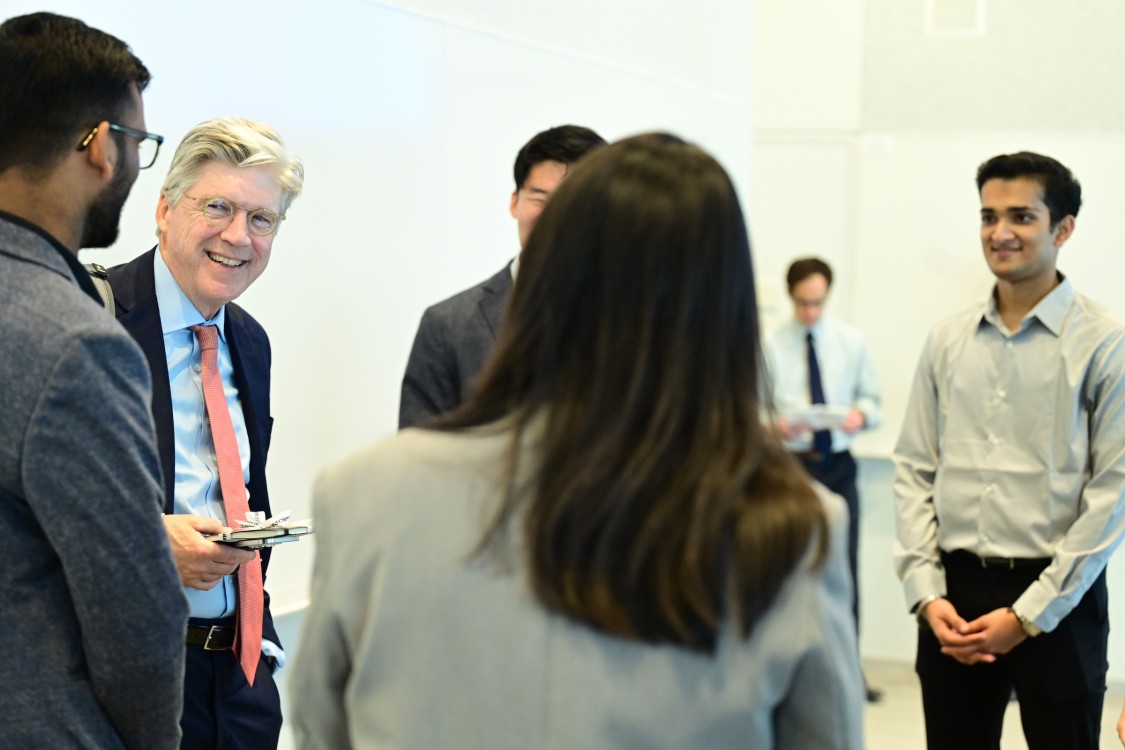
He closed by encouraging students to keep an open mind about their career paths and the industries they choose to enter.
This is really changing,” Sarrigeorgiou said of insurance. “Students often want to go work for Google and Apple or startups. I think you should consider the insurance industry, for sure, as it offers many opportunities not usually associated with insurance, from digital marketing to AI implementation. This is the important point where you’re the cool kids on the block now.
Lead Photo Caption: Alexander Sarrigeorgiou (left) in conversation with Climate School Dean Alexis Abramson at the Tech CEO ‘fireside chat’
Lead Photo Credit: Chris Taggart/Columbia Engineering