Columbia Electrochemical Energy Center Partners with Argonne National Laboratory in $62.5M DOE Grant
Team includes world-renowned researchers from three national labs and 12 universities who will create a national energy storage innovation hub
The Columbia Electrochemical Energy Center (CEEC) is part of a team led by Argonne National Laboratory (ANL) that has won a five-year $62.5 million grant from the U.S. Department of Energy (DOE) to build a national energy storage innovation hub. The Energy Storage Research Alliance (ESRA) brings together nearly 50 world-class researchers from three national laboratories and 12 universities to address the nation’s most pressing battery challenges, including the creation of high-energy batteries that never catch fire, provide days of long-duration storage, have multiple decades of life, and are made from inexpensive, abundant materials. ESRA's primary aim is to push the boundaries of energy storage science to drive technological innovation and strengthen U.S. economic competitiveness.
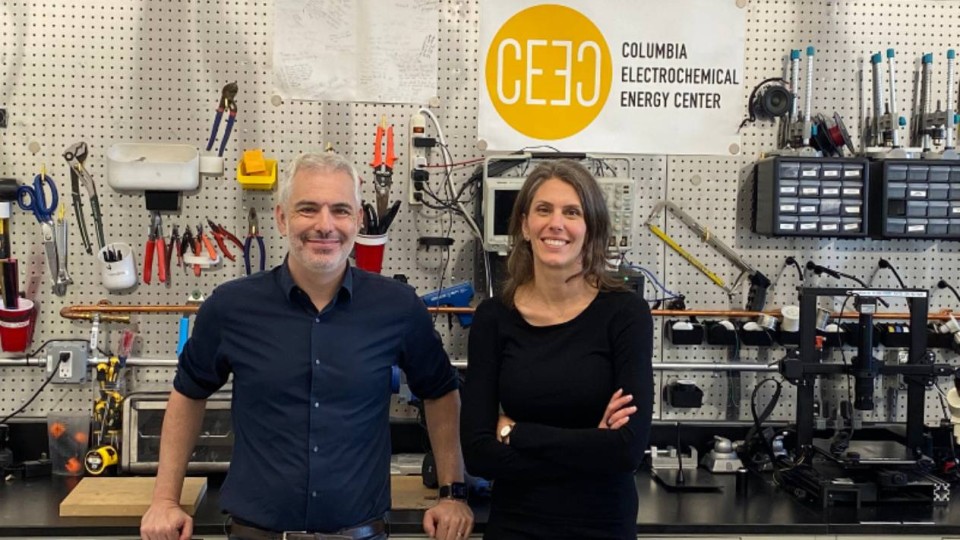
The Columbia Engineering team is led by Chemical Engineering Professors Dan Steingart and Lauren Marbella. Together with colleagues at MIT, the group is leading a third of the ESRA project to develop new electrolyte designs and generate new chemical states to build novel electrolyte materials that will improve the energy storage of batteries.
New class of electrolytes
Electrolyte salt solutions are ubiquitous in natural and engineered systems, where ion transport is a central component of energetic and biological activity. In this new thrust, the team led by Columbia and MIT scientists, which includes researchers from University of Michigan, University of Houston, UC San Diego, ANL, Lawrence Berkeley National Laboratory (Berkeley Lab), and Pacific Northwest National Laboratory (PNNL), will work together to make new classes of electrolytes that allow for batteries made from non-constrained resources that can last longer while charging faster over a broad range of temperatures.
The Columbia/MIT team is focused on exploring electrolyte theory and determining the properties of ions in their solvated state, which arises when the electrolyte salt dissolves in the liquid. In conventional batteries, dissolved lithium ions are surrounded by solvent molecules in the electrolyte and the structures that they make dictate everything about performance–from battery lifetime to charging rate. Past efforts have tried to rearrange the solvation structure by selectively swapping the type of solvent molecule that interacts with the lithium ion or changing the interaction strength.
“Instead of this previous approach, our method for electrolyte development removes nearly all the solvent molecules from the lithium ion itself–an entirely new, and poorly understood chemical state,” said Marbella, associate professor of chemical engineering and core faculty at CEEC. “Explorations of this desolvated state could have far-reaching applications, such as incredibly fast charging rates.”
Steingart and Marbella posit that the free energy of working ions in an electrolyte can be fine-tuned by this unique restructuring of its solvation environment. The new chemical state accessed by stripping an ion of its solvent molecules could expose previously unseen ion transport as well as behaviors that will enable the creation of new electrolyte materials.
“We expect our research will deepen our understanding of ion dynamics at the nanoscale level,” said Steingart, who is the CEEC co-director and the Stanley-Thompson Professor of Chemical Metallurgy at Columbia Engineering. “These systems have not been extensively studied in transport and potential environments required for electrochemical energy storage. We plan to first examine the impact of nano-confinement on transport properties and then identify how these electrolytes can alter the surface chemistry of battery electrodes, potentially enabling longer battery lifetimes and fast charging applications.”
An innovation ecosystem to enable discoveries in materials chemistry
Led by ANL in partnership with Lawrence Berkeley National Laboratory (Berkeley Lab) and Pacific Northwest National Laboratory (PNNL), ESRA is one of two new Energy Innovation Hubs funded by DOE; the second hub was awarded to SLAC/Stanford University. ESRA aims to create an innovation ecosystem with the mission of enabling transformative discoveries in materials chemistry, gaining a fundamental understanding of electrochemical phenomena, and laying scientific foundations for breakthroughs in energy-storage technologies.
Central to ESRA’s mission is training and empowering a diverse, next-generation battery workforce for future manufacturing needs through innovative training programs with industry, academia, and government. ESRA will advance scientists’ ability to control ion-matter interactions to direct exceptional transport, kinetics, and reversibility in emerging energy-storage materials. ESRA proposes a revolutionary and integrated strategy to establish new frontiers for basic science and capabilities at leading-edge scientific facilities that advance electrical energy storage to meet urgent needs in electrifying heavy transport and stationary storage for long-duration use cases.
ESRA co-leads Berkeley Lab and PNNL are DOE national laboratories that bring expertise that spans the energy storage landscape. Their state-of-the-art capabilities in energy storage technology discovery, modeling and simulation, and materials synthesis and characterization complement those of Argonne and together these national laboratories will help reshape the future of energy storage.
Argonne is joined in the collaboration by 14 partners that are embedded in all aspects of ESRA: participation in each of the scientific thrusts, governance, and development of the hub strategy, and training of the next generation of battery scientists and researchers. The collaboration among national laboratories and universities is crucial to discovering new materials, accelerating technology development, and commercializing new energy storage technologies. The ESRA partners are:
- Argonne National Laboratory
- Columbia University
- Duke University
- Lawrence Berkeley National Laboratory
- Massachusetts Institute of Technology
- Pacific Northwest National Laboratory
- Princeton University
- University of California San Diego
- The University of Chicago
- University of Houston
- University of Illinois Chicago
- University of Illinois Urbana-Champaign
- University of Michigan
- Utah State University
- Xavier University of Louisiana
About the Columbia Electrochemical Energy Center (CEEC)
The CEEC was founded in 2018 by Columbia Engineering Professors Dan Steingart and Alan West to accelerate the transition to large-scale electrochemical energy storage with a focus on batteries and electrofuel products (H2, NH3, etc.). The Center, which has 11 core faculty from five departments within Columbia’s engineering school and approximately 60 PhD students, was designed from the ground up to engage and foster industry-academia collaborations. CEEC draws faculty and researchers from across Columbia Engineering who study electrochemical energy with interests ranging from electrons to devices to systems.
Photo Caption: Dan Steingart (left) and Lauren Marbella are co-leading a research team as part of the DOE's Energy Storage Research Alliance (ESRA), focused on addressing the nation’s most pressing battery challenges. Credit: Courtesy of CEEC