Research
Columbia Engineers Prototype New 2D Qubit
Atom-thin materials expand the options for constructing quantum computer chips while simultaneously shrinking their size.
Crystals are coming for quantum computers, according to researchers at Columbia Engineering. In a recent paper published in the journal Physical Review Applied, Columbia Engineering postdoctoral fellow Jesse Balgley and his colleagues debuted a prototype quantum bit, or “qubit”, constructed with atomically thin crystalline materials. Their crystalline qubit is more modular and smaller than ever before, and it opens up a new world of materials that researchers can now consider for creating these fundamental units of quantum computers.
“Aside from being atomically thin and having very few defects, the diverse library of 2D crystalline materials we work with can be combined in countless ways, opening new doors for quantum devices with novel capabilities,” said Balgley.
Balgley works with James Hone, Wang Fong-Jen Professor of Mechanical Engineering, whose lab creates and studies devices made from atom-thin materials as a means to shrink electronics and optical devices. Their current work focuses on a class of quantum bits called transmon qubits, one of the leading approaches to constructing quantum computers. These transmon qubits are built with sandwiched structures called Josephson junctions, whose quantum properties were recognized by the 2025 Nobel Prize in Physics.
Individual state-of-the-art transmon qubits may only be around a square millimeter in size, but thousands, if not tens of thousands, will be needed to take full advantage of the quantum mechanical properties that will give quantum computers the edge over their classical counterparts. By introducing an atom-thin crystal, Balgley and his colleagues have created a prototype with a footprint that is 10,000 times smaller. The semiconducting crystal, tungsten diselenide (WSe2), eliminates the need for a separate capacitor typically used in transmons to reduce the qubit’s sensitivity to electrical noise, and allows the team to stack the component materials in structures that are much more compact than typical transmon geometries.
In the current work, they characterized the electronic properties of 24 samples ranging in thickness from 3 to 18 atomic layers. They observed an unexpected crossover: in the thinnest devices, WSe2 acted like a metal between two superconducting electrodes, but it became electrically insulating with additional layers. That has notable implications for making qubits with different crystalline combinations. “We need to be mindful of both thickness and choice of materials, and we need to consider electronic properties of those materials in ways that we haven’t had to before,” said Balgley.
How electrons move at the interfaces between different materials is at the heart of classical electronics, noted Hone, but these effects haven’t really been considered before for quantum computing applications. Now is the time to start thinking about them.
“The number of materials actually used in quantum circuits and electronics is small—maybe two or three types of superconductors, an insulator, sitting on silicon or sapphire. But there’s a much bigger space to play around in,” said Hone. “We’re in the earliest stages, but some of our lab curiosities will translate and scale into real devices.”
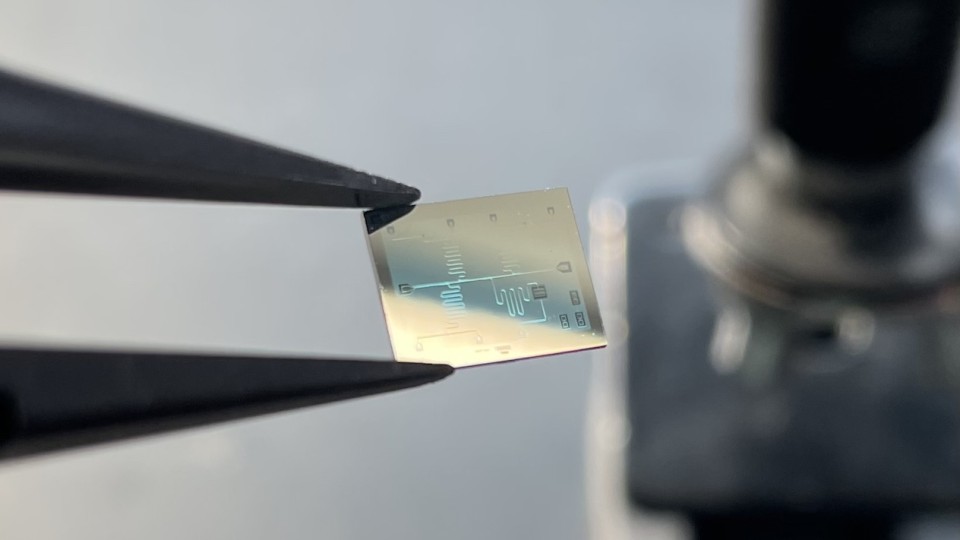
Lead Photo Caption: A 1-centimeter-wide test chip with superconducting microwave-frequency circuitry to probe 2D material qubits.
Lead Photo Credit: Jesse Balgley
About The Study
Journal: Physical Review Applied
Title: Crystalline superconductor-semiconductor Josephson junctions for compact superconducting qubits
Authors: Jesse Balgley, Jinho Park, Xuanjing Chu, Ethan G. Arnault, Martin V. Gustafsson, Leonardo Ranzani, Madisen Holbrook, Yangchen He, Kenji Watanabe, Takashi Taniguchi, Daniel Rhodes, Vasili Perebeinos, James Hone, and Kin Chung Fong.
Funding/Acknowledgments: This work is primarily part of the SuperVan project, sponsored by the Army Research Office and the National Security Agency’s Laboratory for Physical Sciences (LPS) Qubit Collaboratory and co-led by James Hone at Columbia Engineering and Kin Chung Fong at BBN Technologies.