Students
Designing Photonic Multi-Chip Modules to Break Data Bottlenecks
PhD student Michael Cullen develops light-based systems to improve data center performance and efficiency.
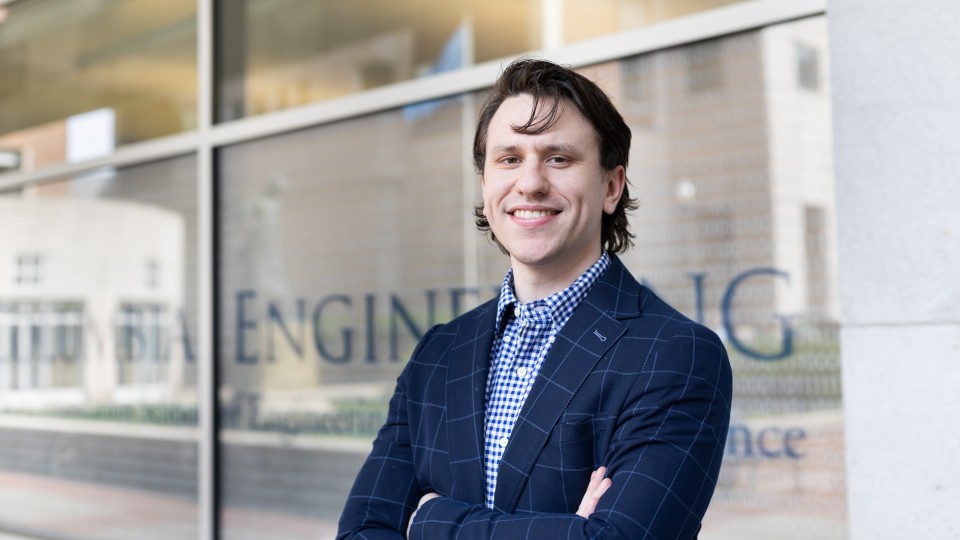
Michael Cullen is working to make computing significantly faster and more energy efficient. A fourth-year PhD student in electrical engineering, Cullen designs systems that transfer data using light, rather than electrons.
Cullen works under the guidance of Keren Bergman, Charles Batchelor Professor of Electrical Engineering at Columbia, faculty director of the Columbia Nano Initiative, and director of the Center for Ubiquitous Connectivity (CUbiC). Cullen is a CUbiC scholar.
“What stands out is how interdisciplinary the work is,” Cullen says. “It combines physics, materials science, electrical engineering, and computer systems.”
Working closely with partners from the semiconductor industry, Cullen and his colleagues in CUbiC bring academic rigor to some of the most important problems in computing.
“You’re not just designing a component, you’re thinking about how it fits into a data center, how it affects AI workloads, and how it scales,” he said.
Advancing Photonics
Today, the computers at the heart of data centers are able to process data much faster than they can communicate with each other. These connections typically send signals using electrons, which create heat and interference. This limits bandwidth and consumes enormous amounts of energy.
Bergman and Cullen work in a field called photonics, which uses photons to transfer data. This allows for higher rates of data transmission using less energy per bit and creating less heat. Cullen’s work is on multi-chip modules.
“It’s an approach called co-packaged optics,” Cullen says. “We bond a photonic chip directly to an electronic chip. There are a lot of benefits from having the circuitry so close to the photonics, and the advantages compound when you scale up the system and run many of these chips simultaneously.”
Cullen divides his time between his office, where he codes and simulates photonic devices during design phases, and the lab, where he tests chips full-time among circuits, 3D printers, and cables.
“People think that PhD life is only about research,” he says. “In reality, you become a graphic designer, a software developer, a public speaker, a grant writer, and you travel for conferences, build connections, give lab tours, and mentor younger students.”
Cullen says his PhD experience has also led him to develop his problem-solving skills. For example, when he increased the laser power and accidentally burned a key component on the chip, he had to learn how to pivot, redesign the experiment, and push forward.
From the Rink to the Lab
Cullen’s path to photonics was not linear. At Dartmouth, his advisor suggested the field because it combines optics and electronics. But his interest in science started earlier.
“In high school, I was drawn to physics because it was hard,” Cullen says. “Physics felt like the most fundamental way to understand the world. If you understand the underlying principles—the behavior of particles—you can build up to chemistry and biology.”
He later realized he preferred something more tangible. His earlier research in physics focused on long-term experiments, questions that could take decades to answer. Engineering offered a more immediate impact. Photonics became a bridge between the two.
Cullen was born in England and raised in Canada. He began studying engineering at Queen's University before leaving to pursue hockey more seriously. He later enrolled at Amherst College, where he played college hockey and studied physics, before completing a dual-degree program in engineering at Dartmouth.
In total, he spent six and a half years across three undergraduate institutions. Hockey remains an important part of his life, as he still plays in a men’s league, but over time, academics became his primary focus.
“I see myself in photonics or the semiconductor industry. I’m open to both academia and industry, depending on opportunities.”
Cullen will soon begin an internship with CUbiC sponsor GlobalFoundries.