Alumni
Exploring Passions at Columbia Turned into a Career in AI Innovation at IBM
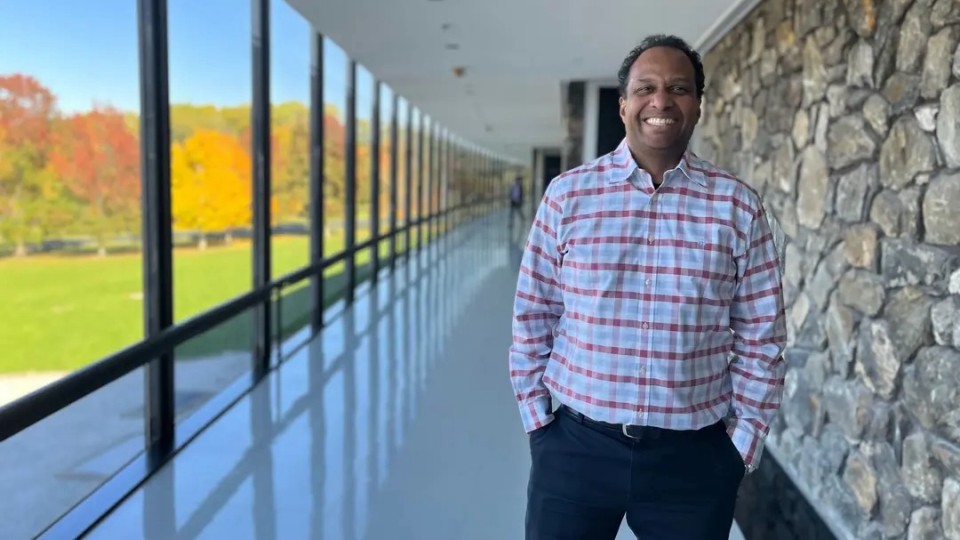
Nicholas Fuller PhD’02 traces his path from Columbia Engineering to AI innovation.
Nicholas C. M. Fuller was drawn to New York City for its culture and proximity to family, and chose Columbia for its rigorous academics.
Now as vice president of AI & Automation at IBM, Fuller leads the global innovation agenda for agentic AI and next-generation automation, supporting IBM’s multibillion-dollar automation software business and influencing emerging industry standards across IT operations, Industry 4.0, software engineering and business processes. He holds more than 75 patents, has authored more than 80 publications with over 3,700 citations, and his work has been featured by Forbes, The Deep View, TechRadar, IEEE Spectrum and international media. His work has had impact across AI, automation, edge computing, and semiconductor R&D.
We caught up with Fuller about his experience studying at Columbia Engineering and what advice he has for those looking to study and work in AI.
Why did you choose to attend Columbia?
When I visited the applied physics department that had accepted me, I got a very warm reception. I met graduate students, postdoctoral researchers and professors; and there were many prospective advisors with whom I could have worked. The existing collaborations with various institutions (Lucent Technologies, IBM, etc.) also helped to nudge me in the direction of Columbia. I was deciding between Columbia and a couple others, but Columbia emerged at the top.
Did you have a favorite professor, project or class?
When I started my graduate studies at Columbia, the technology world was deeply immersed in tackling the challenges posed by aggressive semiconductor device scaling (deep sub-micron) for traditional computing. In the applied physics program, I simply loved how each of the various faculty members delivered and shaped their content in a manner heavily focused on and aligned with this prevailing (and other major) technology trend(s) of that time. So, the combination of the rigor and passion that I had for the domains that I was pursuing, and last but not least, the application of it all to what was happening practically in the world was really remarkable. I enjoyed it tremendously.
How did studying at Columbia assist in your career path?
I would say two things from Columbia helped in that regard — one was the opportunity that I had through my advisor, Professor Irving P. Herman, now retired. Part of his work focused on utilizing laser technology to unravel the mechanism(s) of semiconductor device processing for various critical materials in low temperature plasma environments; I found this work quite novel, intellectually stimulating and of course very relevant for the semiconductor and microelectronics industries. Secondly, he (Professor Herman) had a collaboration with Vincent Donnelly, formerly of Bell Labs, Lucent Technologies, and core to their partnership was the exploration of a range of similar and other techniques to diagnose low temperature processing plasmas. For these two reasons, I got major insight into what I wanted to pursue for my PhD dissertation and overall career.
What were your peers like at Columbia?
The camaraderie that existed there certainly helped all of us, particularly during difficult times such as the 9/11 attacks. I forged strong bonds with fellow students with whom I matriculated, discussing our thesis topics and other matters, socializing and growing as young burgeoning scientists and engineers. Today we have a WhatsApp chat group and we use that to frequently check in on each other and we occasionally get together as well, though more so in the past for each other's weddings and other events. Additionally, the environment created in the applied physics department certainly helped to facilitate that support network that we all needed to become successful.
How did the curriculum at Columbia prepare you to work in AI?
I evolved my career from a semiconductor researcher who built next-generation microprocessors for IBM for 10 years into someone who is now driving AI innovation for our automation software business. That dynamism, that change, comes, in part, from me being constantly knowledge-seeking and passionate about new trends in science and technology, and in part from the technical rigor of the graduate degrees I pursued at Columbia. Secondarily, my advisor’s research lab on campus was in close proximity to students doing work in natural language processing, multimedia and other multidisciplinary areas. This co-location in the same building (CEPSR - Center for Engineering and Physical Science Research) made it easy to have discussions on other topics.
Do you have any advice for future students studying AI at Columbia?
Number one, maintain your passion. Do something for the right reason. Listen to that voice inside of you that makes you want to wake up and do something for 10 plus hours a day. When you find the thing that you can do passionately, it's not a job, it is a calling. Columbia is a great place to be. In my humble opinion, it is one of the best academic institutions to pursue your graduate studies.
In terms of AI specifically, the emergence of language language models (LLMs) a few years back has rapidly ushered in this new AI era where the rate and pace of innovation spanning LLMs, agentic AI and physical AI is simply unprecedented. It can seem daunting, however, I believe with the continued shrinking of our global village and the more keen awareness of our technical and non-technical challenges that the latter brings, there is probably no better time, than in this AI age, to be a graduate student. I believe the opportunities are boundless as we seek technical breakthroughs for societal benefit in many domains ranging from hyperautomation, the future of software engineering, energy-efficient accelerators, AI-driven algorithmic design, the intersection of AI and quantum computing and more. As our School motto says: in lumine tuo videbimus lumen (in thy light shall we see light).