Campus
Girls’ Science Day at Columbia Sparks STEM Curiosity for Middle School Girls
The student-led event brought middle school students to Columbia’s Morningside Heights campus for a day of mentorship, discovery, and hands-on experiments.
For these middle-schoolers, a Saturday exploring STEM was time well spent.
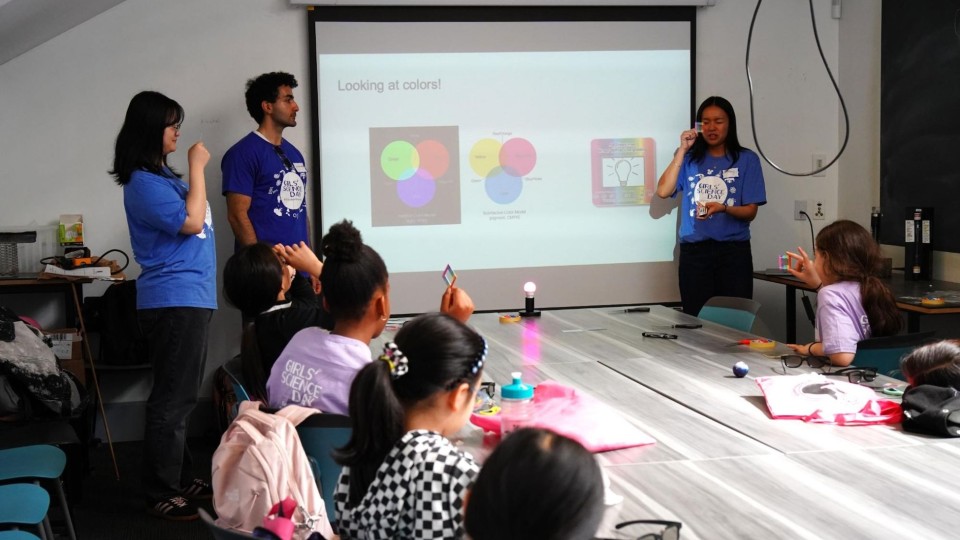
On April 18, middle school girls gathered at Columbia University for Girls’ Science Day, a hands-on outreach event designed to introduce young students to the possibilities of science through experiments, mentorship, and direct engagement with researchers.
Organized by Columbia students and co-sponsored by the Electrical Engineering Department, Girls’ Science Day offered participants a chance to rotate through interactive experiment stations led by faculty, graduate students, and undergraduates from across the university. The free program invited students across NYC to explore scientific concepts not just by watching, but by building, testing, and discovering for themselves.
“Girls’ Science Day is an engaging and rewarding journey,” said Guanqi Lu, finance chair of Girls’ Science Day of Columbia and a PhD candidate in biological sciences. “Over the past half year, we’ve seen this event grow from a date on the calendar and a few experiment ideas into a full day of discovery, powered by an incredible community of volunteers and students.”
Hands-on Science
This spring’s event featured eight experiments spanning biology, engineering, physics, and design. Activities included DIY Shrinkle Keychains to explore plastic properties, strawberry DNA extraction, protein-based experiments, light and electricity demonstrations, an electromagnetic motor activity, and a creative robotics challenge called SyringeBot. Across three experiment sessions, participants moved from station to station, learning scientific principles through hands-on play and problem-solving.
Beyond the experiments themselves, the event reflected months of planning by students and faculty who worked behind the scenes to coordinate volunteers, develop activities, and create a welcoming environment for participants. Their efforts helped transform classrooms and lab spaces into places where science felt exciting, accessible, and personal.
Electrical Engineering Assistant Professor Savannah Eisner, who has participated in Girls’ Science Day in previous years, said her students led an experiment inspired by her lab’s work.
Titled “Surviving the Extreme: Electronics in Harsh Environments,” the experiment invited students to build LED circuits and test how environmental conditions affect electronic components. Participants exposed an electronic component called a thermistor to heat and liquid nitrogen, changing its resistance and, in turn, the brightness of the LED.
“Girls’ Science Day is about giving students the confidence to see themselves as future scientists and engineers,” Eisner said. “When they can build something, test an idea, and ask their own questions under the mentorship of Columbia students, science becomes more than a collection of abstract topics they learn in the classroom. It becomes something personal and possible. Events like this help open the door to a lasting interest in STEM.”
Making Research a Reality
According to the U.S. Department of Labor’s Women’s Bureau, women made up 27 percent of STEM workers overall in 2019 and 15 percent of engineers. For many participants, the event offered an early glimpse of what a future in STEM might look like: asking questions, experimenting freely, and learning from scientists who once started in the same place. Through direct interaction with Columbia researchers and student mentors, the girls were able to imagine science not as something distant, but as something they could actively pursue.
The Columbia Electrical Engineering Department continues to support Girls’ Science Day as part of its broader commitment to STEM education and outreach. That support helps make programs like this possible and ensures more young students can experience a day of exploration, encouragement, and discovery on campus.