Research
Harnessing Quantum Properties to Create Single-Molecule Devices
Columbia team discovers 6nm-long single-molecule circuit with enormous on/off ratio due to quantum interference; finding could enable faster, smaller, and more energy-efficient devices.
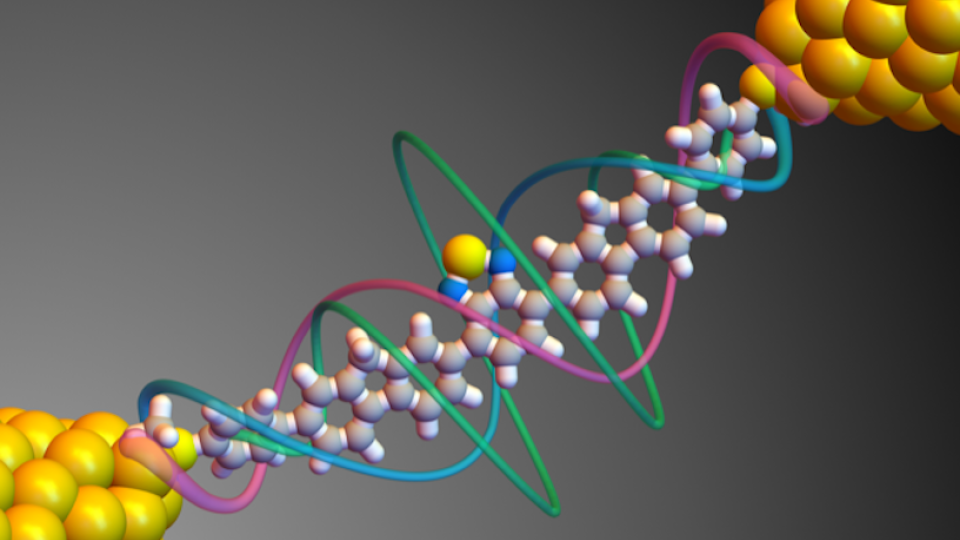
New York, NY—December 7, 2020—Researchers, led by Columbia Engineering Professor Latha Venkataraman, report today that they have discovered a new chemical design principle for exploiting destructive quantum interference. They used their approach to create a six-nanometer single-molecule switch where the on-state current is more than 10,000 times greater than the off-state current—the largest change in current achieved for a single-molecule circuit to date.
This new switch relies on a type of quantum interference that has not, up to now, been explored. The researchers used long molecules with a special central unit to enhance destructive quantum interference between different electronic energy levels. They demonstrated that their approach can be used to produce very stable and reproducible single-molecule switches at room temperature that can carry currents exceeding 0.1 microamps in the on-state. The length of the switch is similar to the size of the smallest computer chips currently on the market and its properties approach those of commercial switches. The study is published today in Nature Nanotechnology.
“We observed transport across a six-nanometer molecular wire, which is remarkable since transport across such long length scales is rarely observed,” said Venkataraman, Lawrence Gussman Professor of Applied Physics, professor of chemistry, and Vice Provost for Faculty Affairs. “In fact, this is the longest molecule we have ever measured in our lab.”
Over the last 45 years, steady decreases in transistor size have enabled dramatic improvements in computer processing and ever-shrinking device sizes. Today’s smartphones contain hundreds of millions of transistors made out of silicon. However, current methods of making transistors are rapidly approaching the size and performance limits of silicon. So, if computer processing is to advance, researchers need to develop switching mechanisms that can be used with new materials.
Venkataraman is at the forefront of molecular electronics. Her lab measures fundamental properties of single-molecule devices, seeking to understand the interplay of physics, chemistry, and engineering at the nanometer scale. She is particularly interested in gaining a deeper understanding of the fundamental physics of electron transport, while laying the groundwork for technological advances.
At the nanometer scale, electrons behave as waves rather than particles and electron transport occurs via tunneling. Like waves on the surface of water, electron waves can constructively interfere or destructively interfere. This results in nonlinear processes. For example, if two waves constructively interfere, the amplitude (or height) of the resulting wave is more than the sum of the two independent waves. Two waves can be completely cancelled out with destructive interference.
“The fact that electrons behave as waves is the essence of quantum mechanics,” Venkataraman noted.
At the molecular scale, quantum mechanical effects dominate electron transport. Researchers have long predicted that the nonlinear effects produced by quantum interference should enable single-molecule switches with large on/off ratios. If they could harness the quantum mechanical properties of molecules to make circuit elements, they could enable faster, smaller, and more energy-efficient devices, including switches.
Making transistors out of single molecules represents the ultimate limit in terms of miniaturization and has the potential to enable exponentially faster processing while decreasing power consumption.
Images by Julia Greenwald and Suman Gunasekaran/Columbia Engineering
ABOUT THE STUDY
The study is titled “Highly nonlinear transport across single-molecule junctions via destructive quantum interference.”
Authors are: Julia E. Greenwald 1, Joseph Cameron 2, Neil J. Findlay 2, Tianren Fu 1, Suman Gunasekaran 1, Peter J. Skabara 2, and Latha Venkataraman 1,3
1 Department of Chemistry, Columbia University
2 WestCHEM, School of Chemistry, University of Glasgow
3 Department of Applied Physics and Mathematics, Columbia Engineering
The study was supported by National Science Foundation (NSF) Graduate Research Fellowships DGE-1644869, NSF grants CHE-1764256, NSF DMR-1807580, Engineering and Physical Sciences Research Council (EPSRC) grants EP/P02744X/2 and EP/N035496/2.
The authors declare no financial or other conflicts of interest.