Faculty & Staff
Henning Schulzrinne Wins IEEE INFOCOM Achievement Award
Schulzrinne is honored for advancing the protocols and technologies behind modern internet communication
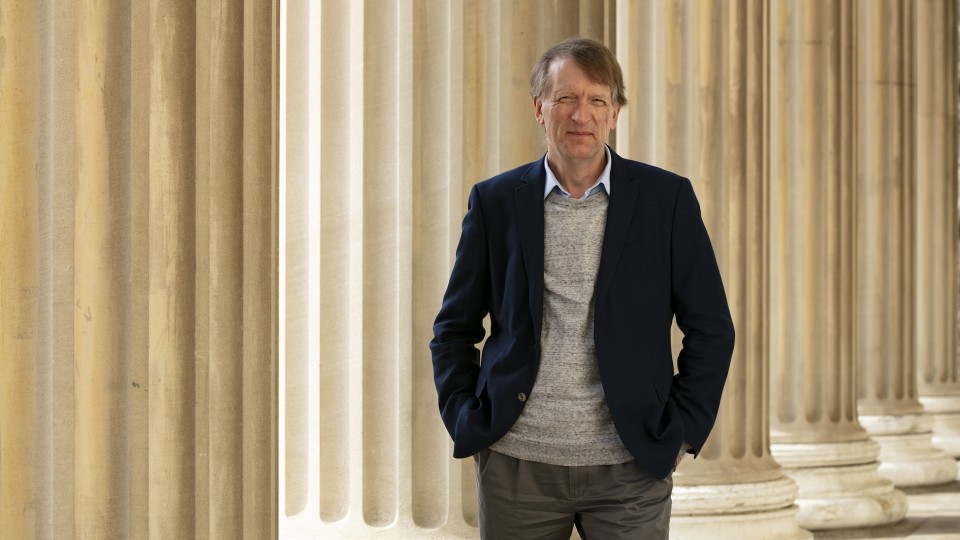
Henning Schulzrinne, Julian Clarence Levi Professor of Mathematical Methods and Computer Science and professor of electrical engineering, has received the 2026 IEEE INFOCOM Achievement Award, the highest honor presented by the INFOCOM community for outstanding contributions to the field of networking technologies and systems.
Schulzrinne was recognized for his pioneering contributions to internet multimedia communication, including the development of protocols and technologies that helped make Voice over IP (VoIP), multimedia streaming, and modern teleconferencing possible. He and his team developed the Session Initiation Protocol (SIP), the Real-Time Transport Protocol (RTP), and other multimedia signaling and support protocols now widely used in standards developed by 3GPP, CableLabs, NENA NG911 emergency systems, and other communication platforms. More recently, his research has focused on automating internet fault diagnostics, protecting the electric grid against cyberattacks, and scaling the Internet of Things.
Beyond academia, Schulzrinne has played a significant role in shaping U.S. communications policy and technology initiatives. From 2010 through 2019, he advised the U.S. Federal Communications Commission (FCC), including serving as FCC Chief Technologist, where he worked on public safety, accessibility, the Open Internet, cybersecurity, network measurements, and robocall prevention. From 2019 to 2020, he served as a Technology Fellow in the office of Senator Ron Wyden, supporting efforts related to broadband access, data privacy, and identity theft prevention. From December 2022 until 2024, he served as Broadband Advisor to the National Telecommunications and Information Administration (NTIA), focusing on broadband deployment for rural and low-income communities.
Schulzrinne received his undergraduate education from the Technical University of Darmstadt in Germany, earned his MSEE from the University of Cincinnati, and completed his PhD in electrical engineering at the University of Massachusetts Amherst in 1992. He joined Columbia Engineering in 1996, and has mentored 28 PhDs and hundreds of master's and undergraduate students over the years. He is a Fellow of both the IEEE and ACM.