Faculty & Staff
A Knight’s Tale
Soulaymane Kachani has been named a Knight of the Legion of Honor, the highest decoration in France.
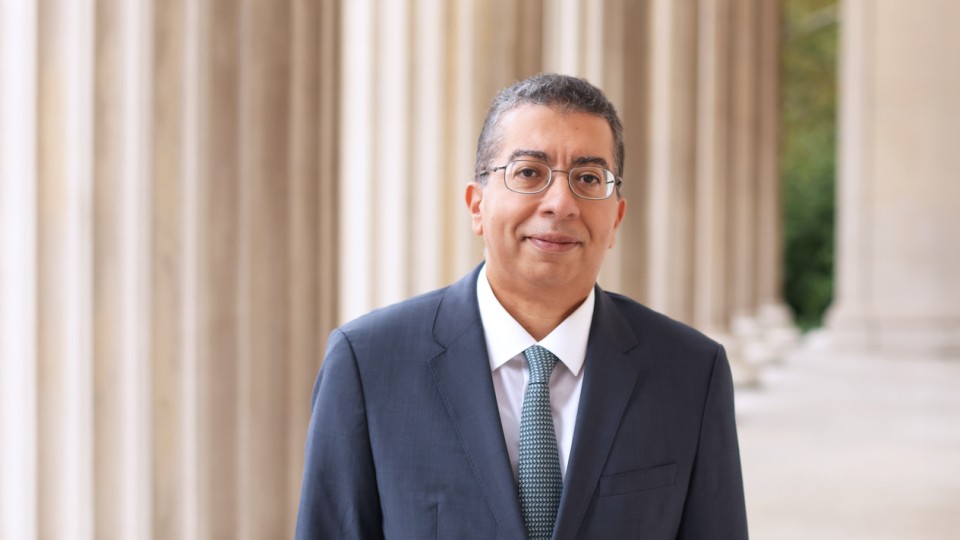
Soulaymane Kachani, senior vice provost at Columbia University and a professor at Columbia Engineering, has been named a Chevalier (Knight) of the Légion d’Honneur, the highest French distinction for military and civil accomplishment. This honor recognizes his longstanding commitment to scientific and academic excellence, as well as his dedication to international cultural dialogue. At Columbia, Kachani has worked to elevate the University’s global stature and strengthen its ties with France through initiatives such as the flagship Alliance Program.
The recognition also reflects Kachani’s personal journey. Born in Morocco and educated in Morocco, France, and the United States, he has seen how strength emerges from uniting diverse traditions. This honor embodies his belief that connecting cultures and encouraging dialogue pave the way for progress, impact, and new opportunities.
As part of his role as senior vice provost, Kachani leads Columbia’s strategies for teaching, learning, and educational innovation, collaborating closely with schools and departments. He has championed the expansion of online and hybrid education and launched Columbia+, the University’s platform to engage alumni and learners from around the world through non-credit courses, events, and podcasts. He chairs the Provost’s Working Group on Generative AI and recently co-authored Leveling the Learning Curve: Creating a More Inclusive and Connected University (with Bill Eimicke and Adam Stepan), a book that examines the evolving higher education landscape in the post-pandemic era.
At Columbia Engineering, Kachani is a longtime faculty member in the Department of Industrial Engineering and Operations Research. As senior vice dean, he oversaw for more than a decade undergraduate, graduate, executive, and online programs across the School.
We spoke with Kachani about the significance of receiving this top honor from France, the Columbia milestones that stand out most, and the thrill of sharing this incredible distinction with one of his film heroes–George Lucas.
Being named a Chevalier de la Légion d’Honneur (Knight of the Legion of Honor) is France’s highest distinction. What does this recognition mean to you professionally and personally?
This recognition is profoundly humbling on both a professional and personal level. Professionally, it reflects not just my efforts, but the collective dedication of colleagues, students, and institutional partners who have worked tirelessly to expand Columbia’s global reach. It affirms that our work in building bridges between France and the United States through academic collaboration, research, and dialogue has had a lasting impact. I view it less as a personal accolade and more as a shared achievement, a celebration of values such as innovation, dialogue, and international cooperation in higher education.
On a personal level, it resonates deeply with my own journey. Growing up between cultures, born in Morocco, educated in Morocco, France, and the United States, and having lived nearly three decades in the U.S., I have seen firsthand the strength that comes from weaving together multiple traditions. This honor recognizes a philosophy that has guided my life: that bridging cultures and fostering dialogue lead to progress and create something stronger and more impactful than any one tradition alone.
This honor highlights your contributions to advancing Columbia’s global stature and fostering strong ties with France. Looking back, what moments or initiatives stand out as especially meaningful in that work?
Several moments stand out. The launch and growth of the Alliance Program remains one of the most meaningful. To see Columbia, Sciences Po, École Polytechnique, and Paris 1 Panthéon-Sorbonne come together to create a pioneering model of transatlantic collaboration, which has led to joint degrees, research partnerships, and more than 1,500 academic events, is something I am immensely proud to be part of.
Equally significant are the dual-degree programs we established with France’s top Grandes Écoles, which have enabled thousands of students to benefit from the strengths of two academic systems and two countries. These programs go beyond exchange; they form leaders who are equally at home in Paris and New York, and who embody both the rigor of the French intellectual heritage and the spirit of American innovation.
Most meaningful of all, however, are the stories of students, alumni, faculty, and researchers, their journeys, their research, and their societal contributions, which remind me that the true legacy of these initiatives lies in people and their ability to transform the world.
Through the Alliance Program and other international initiatives, you’ve shaped opportunities for students and faculty across disciplines. How do you see these collaborations evolving in the years ahead?
The Alliance Program, now over two decades old, has already surpassed our expectations. And I believe its future is even brighter. The challenges we face are inherently global, and universities must play a central role in shaping solutions.
I see the future of the Alliance Program in three directions:
New frontiers of knowledge: Expanding joint degrees and research partnerships into emerging fields.
Greater accessibility: Using Columbia+ and digital platforms to ensure access to the benefits of these collaborations extends far beyond our campuses to learners around the globe.
Deeper student engagement: Offering more opportunities for immersive study, research, and international experiences that cultivate leaders who think and act with a global perspective.
Ultimately, the Alliance Program should not only connect institutions, but also serve as an incubator of solutions to global problems, empowering the next generation to carry knowledge and values across cultures and continents.
What advice would you give students who aspire to global leadership?
Global leadership begins with curiosity and humility. The best leaders are those who remain open to learning, actively seek out different perspectives, and are willing to challenge their own assumptions.
I encourage students to immerse themselves in new environments, study abroad, learn new languages, and build friendships across cultures. These experiences cultivate empathy, broaden perspective, and prepare you to address challenges that transcend geographies.
Leadership today is not defined by academic excellence alone, but by values: empathy, perspective, and courage. The courage to imagine solutions that cross boundaries, and the commitment to act on them. I remind students that their generation will inherit global challenges, and their ability to lead will depend as much on openness, respect, and collaboration as on knowledge.
Finally, you were honored alongside George Lucas, and we understand you are a big fan. How does that feel?
I am deeply grateful and thrilled! I have long been a huge Star Wars fan, so to share this recognition with George Lucas makes the moment even more special.
Lead Photo Caption: Soulaymane Kachani, senior vice provost at Columbia University and a professor at Columbia Engineering
Lead Photo Credit: Office of the Provost