Love and the Brain, According to a Neuroscientist
Nuttida Rungratsameetaweemana, who specializes in cognitive and computational neuroscience, shares what science tells us about love and the brain.
What happens in the brain when we fall in love? Cognitive and computational neuroscientist Nuttida Rungratsameetaweemana breaks it down.
What’s a common misconception about love or attraction that neuroscience challenges?
The idea that love or attraction is “just chemicals” is a bit of a myth. Love is deeply biological, but it’s not one chemical and it’s not one switch. What people experience as attraction and bonding comes from multiple systems working together, including reward, attention, memory, arousal, and stress. Those systems also depend a lot on context and on someone’s personal history, which is why early attraction can feel exciting and also a little uneasy at the same time. Over time, as a relationship becomes more predictable and stable, that feeling often shifts into something calmer and more secure.
When someone says they "see the world differently" after falling in love, is there any truth to that from a neuroscience perspective?
We have pretty solid evidence now that we do not “see” the world only through our eyes. We also see it through the brain’s current goals and context. Work in animals, and increasingly in humans, shows that sensory brain areas are not just passively recording input. In a recent human neuroimaging (fMRI) study from our group, we found that when the task goal changes, the visual cortex regions can rapidly reshape how they represent the same stimulus in a way that is meaningful for what you do next. So when someone says they “see the world differently” after falling in love, I think there’s real neuroscience behind that intuition. Your internal state changes what your brain prioritizes, what feels salient, and how the same information is interpreted moment to moment.
Does the brain actually release "feel-good" chemicals when we're around people we love? What's going on scientifically?
Yes, it does, but it’s not one “feel-good chemical.” When we’re around someone we love, the brain can engage reward and motivation systems. Dopamine is often discussed here because it supports drive and reinforcement, especially in the early, excited phase of a romantic relationship. At the same time, early attraction can also come with uncertainty, so stress physiology can be part of the picture too, including elevated cortisol. You can also have contributions from arousal-related neuromodulators, and in bonding-related contexts, oxytocin is often discussed as supporting social attachment and trust. So the “feel-good chemicals” idea has a basis, but what’s really happening is a coordinated shift across reward, arousal, and bonding systems, and the balance depends a lot on context and stage of the relationship.
If you could study one thing about how the brain processes emotions or romantic relationships, what would it be?
We all have the experience that on an emotional day, the same task can feel harder, the same conversation can land differently, and even something as familiar as your favorite coffee can taste “off.” To me, that’s a hint that emotions are not just something we feel. They’re internal state signals that can change what the brain prioritizes and how it interprets the same incoming information. So I’d love to understand how emotions are represented in neural circuits, and how those signals actively instruct and shape ongoing computations in the brain. I’m also really interested in how computational modeling could help make emotions more operational, meaning how we can formalize what an emotion is doing to perception, learning, and decision-making in a way we can test directly with data.
What do you find most fascinating about studying the brain?
Because there is still so much we do not understand about the brain, it naturally invites ideas from many different fields. That is one of my favorite parts of this work. I have really enjoyed working with students and with collaborators who bring different strengths and unique perspectives, from engineering and computer science to neuroscience and clinical fields. Some of the most exciting progress happens when those perspectives come together to turn a big, complicated question into a set of complementary, testable hypotheses.
About Nuttida Rungratsameetaweemana
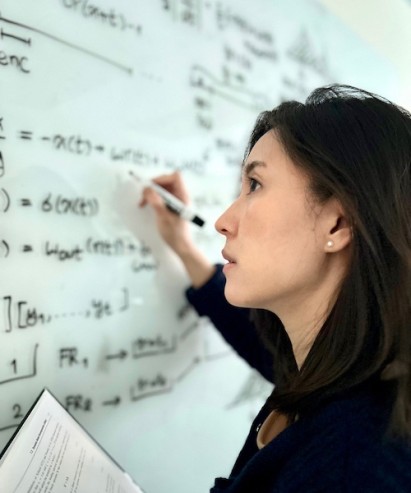
Nuttida Rungratsameetaweemana is the inaugural Maa-Liao Assistant Professor of Biomedical Engineering at Columbia Engineering and leads the Systems Intelligence Laboratory. Her group develops experimental and computational frameworks to understand how the brain supports complex thinking, and how those processes are disrupted in disease.
Lead Photo Credit: Courtesy of Nuttida Rungratsameetaweemana