Faculty & Staff
Luca Carloni and Junfeng Yang Elected 2025 ACM Fellows
The honor recognizes their influential contributions to trustworthy AI, software systems, computer architecture, and design automation
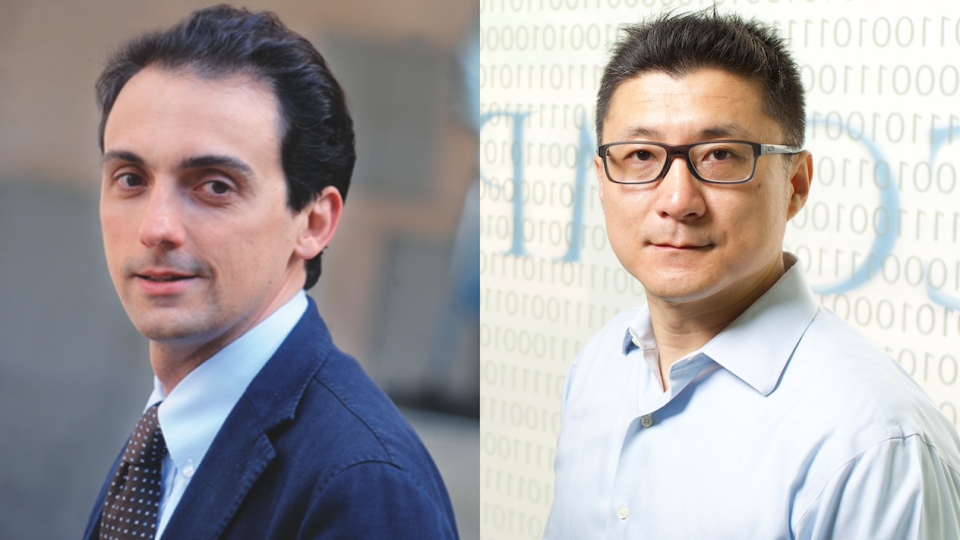
Computer Science Professors Luca Carloni and Junfeng Yang have been elected 2025 ACM Fellows, one of the highest honors in computing, recognizing their lasting contributions and leadership in research and innovation. The 71 Fellows—representing the top 1% of professionals in the Association for Computing Machinery—will be formally recognized at ACM’s annual Awards Banquet on June 13 in San Francisco, California. This distinction highlights the global impact of their work and their influence on the future of computing.
Carloni, who also is chair of the Department of Computer Science at Columbia Engineering, is recognized for “contributions to the design of system-on-chip architectures and heterogeneous computing platforms.” His research spans across the scientific fields of Electronic Design Automation (EDA) and computer architecture. He has made foundational research contributions to methodologies and tools for System-on-Chip (SoC) platforms, heterogeneous computing, system-level design, networks-on-chip, and embedded systems. His seminal paper, “From Latency-Insensitive Design to Communication-Based System-Level Design” (Proceedings of the IEEE, 2015), links his early theoretical work with later advances in system-level design, highlighting the lasting influence of latency-insensitive design on both academic research and industrial practice.
In recent years, Carloni has been a leading advocate for open-source hardware. He proposed and developed Embedded Scalable Platforms (ESP), an open-source research platform designed to address the growing complexity of designing and programming heterogeneous SoC architectures, and founded OSCAR, a workshop dedicated to open-source computer architecture. His work has been recognized with numerous honors, including the 2025 IEEE/ACM A. Richard Newton Technical Impact Award in Electronic Design Automation and the Columbia Engineering Alumni Association Distinguished Faculty Teaching Award, as well as election as an IEEE Fellow and earlier awards such as the Sloan Research Fellowship, NSF CAREER Award, and the Office of Naval Research Young Investigator Award.
Carloni has been a faculty member at Columbia Engineering since 2004 and chair of the Department of Computer Science since 2021. He leads the System-Level Design Group, currently advising seven PhD students and an associate research scientist. To date, 16 PhD students have completed their doctoral degrees under his mentorship. Beyond academia, his research helps engineers design the computer chips that power modern technology, from personal computing and mobile devices to large-scale artificial intelligence systems, by enabling scalable, energy-efficient solutions to one of engineering’s most complex design challenges.
Yang, recognized for “leadership and contributions to trustworthy software and AI systems,” has made lasting influential contributions to improving the reliability and security of both artificial intelligence (AI) and software systems, bridging foundational research with real-world impact. Over more than 17 years as a professor at Columbia, Yang has consistently created principled, practical tools to address failures in complex, real-world systems, launching new research directions.
Yang is a pioneer of software engineering for trustworthy AI, reframing how the field understands and evaluates AI reliability. With his DeepXplore system, he introduced the first coverage metric for neural networks and pioneered coverage-guided fuzzing for deep learning models, uncovering thousands of corner-case failures in production AI systems and inspiring widely used industry tools. He also introduced the concept of machine unlearning, enabling AI models to efficiently forget specific training data to support privacy, security, and model repair without retraining from scratch. His IEEE S&P 2015 paper on machine unlearning—recognized with the 2025 Test-of-Time Award —laid the foundation for the rapidly growing field of data removal and privacy-compliant AI systems. More broadly, Yang’s work helped establish rigorous testing as a prerequisite for deploying large-scale AI models, particularly large language models.
Earlier in his career, Yang advanced the state of trustworthy software by making program analysis and model checking practical for large-scale, deployed systems, uncovering critical bugs in widely used operating systems, databases, distributed systems, and mobile applications used by billions of users. He has received a Sloan Research Award, an Air Force Office of Scientific Research Young Investigator Award, an NSF CAREER award, and an ACM SIGOPS Mark Weiser award. In addition to his research contributions, Yang has mentored 10 PhD graduates and currently (co-)advises 12 PhD students, shaping the next generation of researchers in reliable and secure systems.
Rebecca Wright, Druckenmiller Professor of Computer Science and chair of Computer Science at Barnard, was also named a Fellow.
Lead Photo Caption: Professors Luca Carloni (left) and Junfeng Yang