Research
New Method to Hedge Climate-Induced Energy Risk
Columbia Engineers build model based on tropical Pacific sea surface temperatures to predict monthly renewable energy supply and demand for Texas up to six months in advance.
One of the major challenges in renewable energy is predicting how much is available and when, and how much fluctuation there might be in these predictions–it’s not always sunny or windy when you need it. So how can you depend on a supply of renewable energy when there is a shortage? And how will a surplus of energy impact its price?
These questions are among the concerns people have about an all-renewable grid. While batteries can deal with deficits over a period of a few hours to a day at most, the big question is how to deal with longer-duration shortages, and handle marketing surpluses so the price does not collapse.
Focusing on Texas as the #1 U.S. site for solar and wind energy production
Columbia Engineering researchers, led by Upmanu Lall, a leader in climate risk analysis and water resource management, have been studying this issue for three years and decided to focus on Texas, which is the number one spot in the United States for both solar and wind energy production. They built a model to see if they could predict future renewable energy production in Texas from one to six months into the future, as well as thermal demand (heating and cooling) since both supply and demand depend on climatic conditions.
New model first to use Pacific Sea Surfaces temperature data
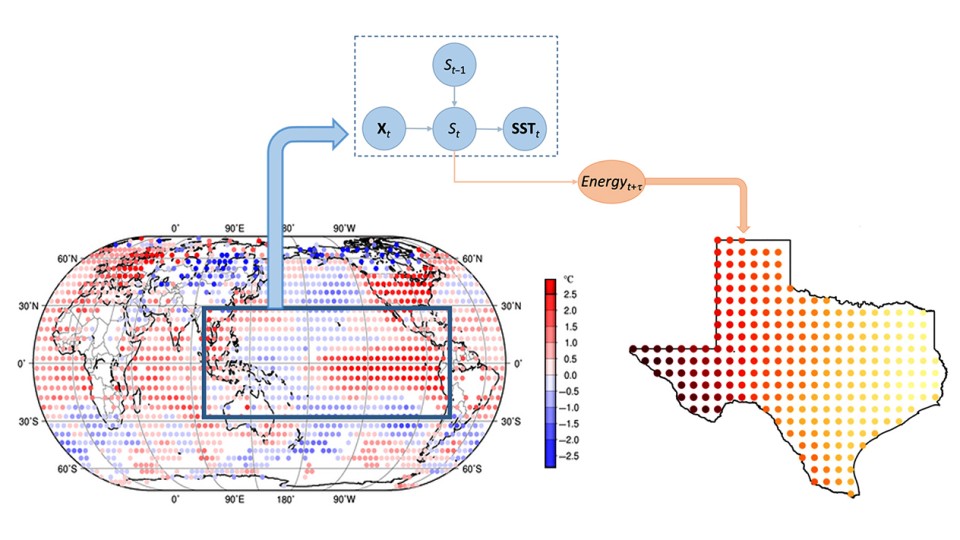
The model is the first to use tropical Pacific Sea Surfaces temperature (SST) data, which are a basis for the El Nino Southern Oscillation, a process well-known to have a weather impact across the globe. Pacific SST is important because ocean temperatures play a significant role in regulating weather patterns and climate, and impact the rate of many processes in the ocean. SST influences atmospheric conditions, oceanic currents, and is a key indicator of climate variability change.
The team built a model that incorporated the SST data and machine learning to predict solar, wind, and thermal demand across Texas, and also developed a specific method to analyze the forecasts for surpluses and deficits. The approach differs from prior work in that it focuses on identifying persistent spatial patterns of SST and the probability of their transition from one pattern to another, as the driver of global climate impacts. The team then made future energy supply and demand projections for Texas and for other regions by using active patterns, the current calendar month (to account for seasonality), and the historical energy supply and demand data corresponding to the future months.
“We found that the predictions we made for the future months in Texas correlate highly with the actual outcomes, which we didn't use to develop our model,” said Lall, director of the Columbia Water Center and visiting professor of earth and environmental engineering at Columbia. “We know that wind and solar energy, as well as heating and cooling demand, is influenced by climate variations but no one else has tried to use changing ocean temperatures data for monthly wind and solar forecasts this far out. And now we’re extending our work to provide global coverage of the forecasts.”
Boon for the electrical industry in hedging their bets
This new technique, published Nov. 1 in Science Advances, will be a boon for the electrical industry to get information on where there is a higher/lower production potential, if it is highly variable or not, and if they can predict what will be available multiple months out. This will enable them to plan operations and design better systems while securing financial hedges through financial derivatives, or insurance-like mechanisms. Essentially, businesses will be able to better direct investments in the renewable grid, design backup strategies for shortages, and offer contracts for periods when there will be a surplus.
Currently, energy options trading can buffer future demand risks. For instance, New York City hedges its risk for summer electricity shortfalls by simultaneously buying hydropower from Quebec with a forward contract for a quantity less than the peak expected if it is too hot in the summer, and also buying a temperature contract on the trading market betting that it will be too hot. If it is too hot, then the demand is higher, but the City gets money from the temperature contract that allows them to buy the needed electricity on the spot market.
Lall notes, “As renewable energy contributions increase, one can expect similar instruments to emerge to cover surplus/shortage in supply as well as demand. Our model would allow utilities and traders the ability to hedge these risks. There is no other competing model that allows this kind of forward planning for the climate-induced risk at the moment.”
Next steps
The researchers are now extending their method to a global model so they can address the same questions anywhere in the world, and are adapting newer deep-learning methods to see if they can improve their technology.
About the Study
Journal: Science Advances
Title: “Potential Climate Predictability of Renewable Energy Supply and Demand for Texas given ENSO hidden state.”
Authors: Mengjie Zhang,1,2 Lei Yan,1,2* Yash Amonkar, 3 Adam Nayak, 1,2 Upmanu Lall1,2
- Department of Earth and Environmental Engineering, Columbia University
- Columbia Water Center, Columbia Climate School, Columbia University
- Center on Financial Risk in Environmental Systems, UNC Institute for the Environment, University of North Carolina at Chapel Hill
Funding: The study was supported by. Upmanu Lall was partially funded by a Columbia-CityU/HK collaborative project that is supported by InnotHK Initiative, The Government of the HKSAR, and the AIFT Lab.
The authors declare that they have no competing interests