
SWE Hosts Women in Engineering Day
Research talks with women, leadership panel, and film inspire student engineers
Columbia Engineering’s undergraduate chapter of the Society of Women Engineers celebrated women in engineering on April 19 with a day of programming that featured “TED-Talks” with female faculty, as well as high-level executives from the Johnson & Johnson Women in Leadership Program.
The group, which organized a “Day of Appreciation” for female faculty in 2017, saw the event as an opportunity for female students to connect faculty and industry experts in an informal atmosphere.
Columbia Engineering sophomores Amy Huang and Iliana Cantu, and Columbia Engineering freshman Nina Taneja spearheaded the event. “We wanted to give our members a chance to hear about the research and career journey of our professors,” said Amy Huang. “It was so incredibly inspiring to hear from our enthusiastic professors who are able to represent Columbia Engineering’s Engineering for Humanity mission through each of their respective departments and research endeavors.”
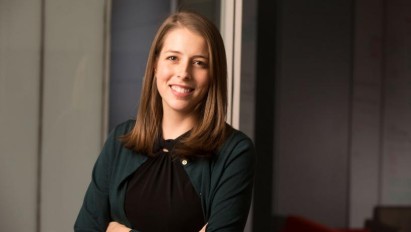
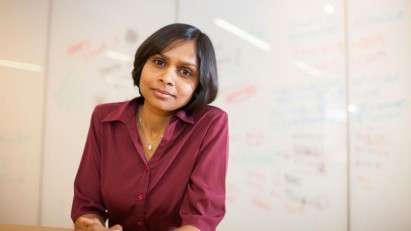
Dean Mary Boyce opened the event by sharing some statistics about women faculty in Columbia Engineering. In the last ten years, female faculty have nearly doubled from 19 to 37, while the number of women engineers who have received tenure here has more than doubled, from 10 to 23. She then introduced five faculty members—Professors Shipra Agrawal, Allie Obermeyer, Katy Barmak, Lydia Chilton, and Sharon Di—who highlighted their current research as well as giving advice and insights into their own respective career journeys.
Lydia Chilton, assistant professor of computer science, brought a series of slides with visual metaphors from advertising, challenging the audience to interpret their meanings. With this demonstration, Chilton gave the audience an insight into how she brings her crowdsourcing and computational tools to the design process, turning a creative design problem into a search problem. In user studies, her method—which she’s dubbed VisiBlends—yields ten times as many creative results as unguided brainstorming sessions. Her research also helps explain why novices get stuck in creative task—many get caught up in improving one idea, rather than seeking multiple ideas, or spend too much time making the first step perfect, only to have to throw it away later when it doesn’t fit with the later steps, or settle for the obvious, rather than the novel, solution. Chilton, who says she’s happiest when finding areas in which to apply computer science, noted that New York City offers opportunities to collaborate with advertising agencies, entertainment companies, and even sports teams.
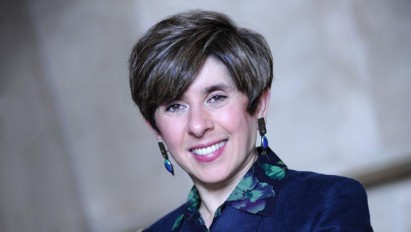
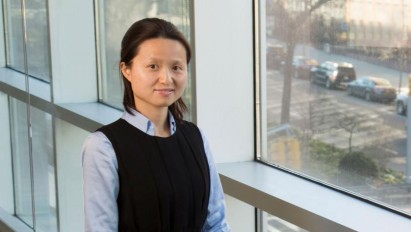
Xuan (Sharon) Di, assistant professor of civil engineering and engineering mechanics, shared her work with self-driving cars, in particular how they interact with human drivers and the traffic environment. She is part of an interdisciplinary team from engineering, mathematics, computer science, and law that is looking at the implications of a transition period from human to autonomous drivers. She explained that there are many issues of product and driver liability that need to be resolved, and that autonomous vehicles may make human drivers less attentive, resulting in moral hazard. She closed with a glimpse into the future, when retail stores, medical clinics and laboratories, and social spaces might travel on wheels.
The talks were followed by a lunchtime Q&A session, moderated by Dean Boyce. An afternoon session featured a leadership panel, moderated by Katie Bettencourt, senior scientist at Janssen R&D Data Services. The panel included several women from Johnson & Johnson: Lona Vincent, senior manager, Insights and Experience Strategy; Tricia Solsaa, senior design manager, Environment; Tracy Wang, senior scientist, Global Upstream Innovation Platform, as well as alumna Dina Vaysman, director of Business Development at Ethicon, and Yijun Le, associate director of Analytical, at Ethicon.
Launched in 2017, the annual J&J Scholars program at Columbia offers generous stipends to undergraduate women nominated by faculty to work full-time on campus over the summer in a faculty lab or on a mentored research project. The J&J scholars also participate in site visits to the company’s facilities in New Brunswick, New Jersey, where they meet accomplished female engineers from academia and industry. The program offered in-depth insights into potential career paths—and helped build networks for ongoing career support.
Women in Engineering day concluded with a screening of the movie, “Hidden Figures,” the story of three brilliant African-American women at NASA who calculated the trajectories for Mercury, the space craft piloted by astronaut John Glenn.
“Women in Engineering Day reached over 60 students this year,” said Iliana Cantu. “The Society of Women Engineers is excited to continue growing its outreach and influence, in order to ultimately foster a welcoming community that celebrates women engineers on Columbia's campus."
Lead Photo Images by Agrawal, Chilton Photo Credit: Timothy Lee Photographers | Di, Obermeyer Photo Credit: Jeffrey Schifman