Research
Understanding How Materials Behave by Watching Them Move
Columbia Engineers developed a machine learning framework that uses AI to infer how materials behave using inexpensive data.
Car-crash simulations, video game animation, and models for designing safe buildings and bridges all rely on models that accurately simulate how different materials behave under stress.
Those models require high-quality data, which is expensive to collect and often unavailable, especially for unconventional materials, such as high-entropy alloys or 3D-printed materials.
In a recent study published in PNAS, Columbia Engineering researchers demonstrate a new method for inferring models by merely observing motion. Conventional methods often required very specific (and expensive) experimental tests to deduce specific types of material behaviors. Unless a material is completely rigid, it always deforms under stress. As a result, the availability of motion data makes the new method highly applicable to a wide range of materials that are expensive to characterize.
“We believe there is an unmet demand for creating high-fidelity models from artificial intelligence with input from physics,” said WaiChing (Steve) Sun, associate professor of civil engineering and engineering mechanics at Columbia Engineering. “Addressing this demand can make the design workflow run much faster and make predictions more reliable.”
We caught up with Sun to learn more about the research.
What was the initial motivation for this paper? Was there a specific problem or question you wanted to address?
Most models that simulate materials — particularly high-fidelity models — have to be calibrated using specialized data. Obtaining such data experimentally isn’t always feasible, and building a complete database relying on experimental processes is almost impossible. As a result, we often have to calibrate important models without sufficient data, which could be particularly risky for some engineering applications, such as the design of composites for aircraft.
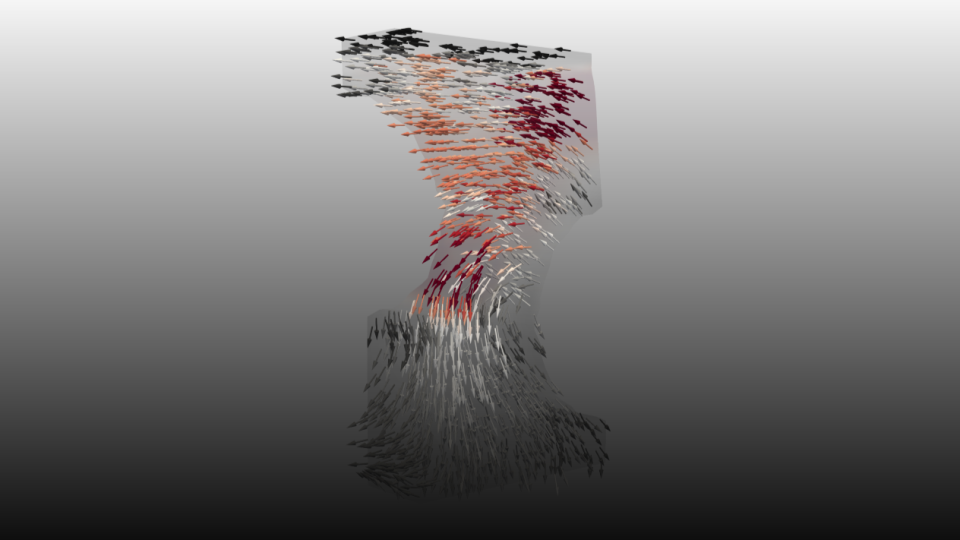
In this paper, we develop an alternative learning algorithm that requires only the data of motion (kinematics) to create material models. Using a technique called digital image correlation, we can extract the displacement field, a collection of vectors that mathematically describe exactly how a material moves. These vectors provide a rich database for identifying material models.
What’s the most important finding or innovation in this paper?
This method makes it possible to simulate material behaviors that we simply couldn’t model, due to insufficient observable data. By demonstrating how to gather additional evidence from unconventional sources, we’re opening the door for researchers to model materials they couldn’t before.
What did you do differently from other researchers who have approached this question or problem?
While other works recognize this data scarcity issue, a key technical barrier is that most materials may eventually exhibit a so-called memory effect. That means the way they behave is influenced by how they’ve deformed in the past.
This behavior often prevents models of the materials from being ”smooth,” in mathematical terms. This non-smoothness may lead to exploding gradients that lead to unstable learning. As a result of this instability, it becomes impossible to use back-propagation to train neural networks for materials with memory effects. Previous attempts to work around this issue have typically yielded unsatisfactory results.
Our approach is to ensure smoothness by proposing regularizing mechanisms to make the neural network-generated constitutive laws differentiable[1] [SS2] . In other words, we have enabled back-propagation such that we discover a new model as if we are training a neural network. This new idea proves to be a turning point, making it possible to discover material laws from kinematic observations without significantly limiting the accuracy of the model.
What was the biggest challenge in this research?
The main challenge was implementing an efficient computational model given the nature of the problem. Overcoming this required developing a GPU-based implementation of the learning algorithm. Although the idea was straightforward, it was interesting to see how well the final results performed, especially when tentatively tested on some experimental data.
What happens next?
Our next step is to first explore ways to apply this idea to another form of material models designed for interfaces where multiple materials touch each other. Deducing mathematical models for those problems is critical for understanding many important problems, such as delamination of composites, fracture of ductile metals, and even pore collapse mechanisms that trigger explosions in energetic materials.
Lead Photo Caption: The arrows in this image represent displacement (with larger arrows indicating greater displacement) and the amount of stress (with red indicating high stress) of a given material.
Lead Photo Credit: Sun Lab
About The Study
Journal: PNAS
Title: Discovering neural elastoplasticity from kinematic observations
Authors: Georgios Barkoulis Gavris and WaiChing Sun
Funding/Acknowledgments: The authors are supported by the Dynamic Materials and Interactions Program from the Air Force Office of Scientific Research, USA, under grant contracts FA9550-22-1-0310 managed by Major Derek Barbee, the Earth Material Program by Army Research Office of the United States under the contract of W911NF-24-1-0116 managed by Dr. Joshua Boschelli, additional support provided by the NSF (the United States of America) under grant contracts CMMI-1846875 for the high-performance computing facility, and the Onassis Foundation through the Onassis Foundation Scholarship Program.