Research
Using Acid to Make Liquid Droplets Restructure Themselves
Columbia Engineers took inspiration from nature to show how a change in pH forces organic molecules to rearrange themselves.
With today’s technology, it’s very expensive — and often impossible — to build microscopic structures from soft materials, like biomolecules.
And yet, living cells do it all the time.
Inside a cell, simple organic components such as enzymes and nucleic acids routinely organize themselves to form complex microstructures that perform specialized functions. These building blocks assemble, reconfigure, and separate as conditions in the cell change. This approach is far more elegant than almost any system of soft materials that humans have engineered to create materials or chemicals.
Researchers at Columbia Engineering demonstrated a new approach for emulating this biological process, described in a study released today in the journal Nature Chemical Engineering.
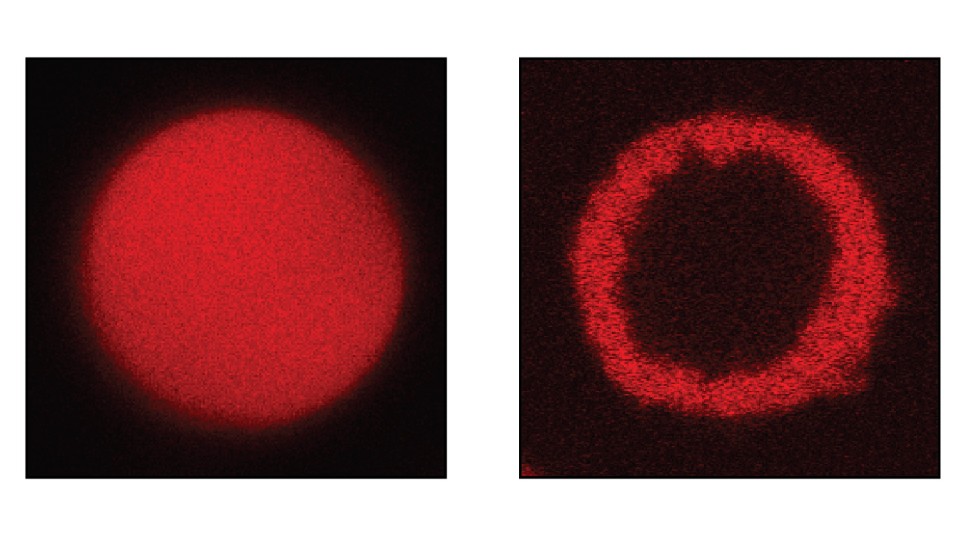
They started with spherical droplets made of enzymes and polymers. Hundreds of these droplets were suspended in a long, narrow tube filled with water. When the researchers added acid at one end of the tube, the droplets developed internal cavities. In some cases, many cavities in a droplet merged, transforming it into a hollow shell.
“This simple physical model allowed us to better understand how a living system might cause transformations,” says Allie Obermeyer, a study co-author and associate professor of chemical engineering at Columbia Engineering. “It’s a new way of showing how condensed material is able to self-structure.”
Importantly, the properties of these shells varied depending on how quickly the pH in the surrounding liquid changed. Engineers could one day exploit this predictability to design and fabricate complex microstructures. Programmable droplets may provide building blocks for synthetic “protocells” that mimic how living cells organize chemistry without membranes.
We asked Obermeyer and co-author Kyle Bishop, a professor of chemical engineering at Columbia Engineering, for more details.
What originally motivated this line of work?
Bishop: Materials scientists think about products in terms of how atoms and molecules are arranged in certain positions. If you put the right stuff together in the right configuration, you get the properties you want. Chemical engineers typically think in terms of how energy and matter flow, like in a system of reactors. When you look at a biological system, such as skin, a material scientist might see a material where a chemical engineer sees lots of little reactors moving around. Our motivation was to explore how you might make materials that are coupled to chemical processes, with an eye to building engineered systems that do what living systems can do.
What are the droplets made of, and what’s inside once they hollow out?
Obermeyer: They’re made from a polymer and a protein called glucose oxidase, which is the enzyme used in blood glucose meters. Those two molecules make the initial spheres and the resulting shells. You can think of the droplets as billiard balls that turn into miniature beach balls. The shells — that is, the beach balls — are filled with the water solution that was originally outside the droplet.
What’s next for this research project?
Obermeyer: Right now, we’re moving beyond just adding acid, which is something of a brute-force approach. In new experiments, we’re trying to use the enzyme itself to catalyze the pH change. That means adding a neutral chemical fuel, such as glucose, and allowing the droplet to trigger its own restructuring. We’re also seeking to understand what happens over longer timescales: How do these structures relax? How can we stabilize them?
Bishop: We’re also exploring how to control the size of these hollow shells. The chemistry inside the droplets is changing while molecules are rearranging themselves. That gives us a lot of variables to control, but it also means there are limitations we don’t understand. Our future research will explore how we can dial in the reactions to control the shells that ultimately form.
To learn more, read the research paper here.
Lead Photo Caption: These microscopy images show dramatic restructuring that occurs within a droplet when pH decreases quickly.
Lead Photo Credit: Obermeyer lab
About The Study
Journal: Nature Chemical Engineering
Title: Transient pH changes drive vacuole formation in enzyme–polymer condensates
Authors: Nisha Modi, Raghavendra Nimiwal, Jane Liao, Yitian Li, Kyle J. M. Bishop & Allie C. Obermeyer
DOI: https://doi.org/10.1038/s44286-025-00322-7
Funding/Acknowledgments: This work was supported by grants from the National Science Foundation (NSF), National Institutes of Health (NIH) and Columbia Engineering. N.M. received support from the NIH National Institute of General Medical Sciences under award number R35GM138378. A.C.O. and K.J.M.B. received support from the NSF Division of Materials Research (DMR) under award number 2425337. J.L. received support from the NSF under award number 1848388. R.N. received support from a SEAS Interdisciplinary Research Seed (SIRS) grant from Columbia Engineering.