Students
What Makes a Good Superconducting Qubit?
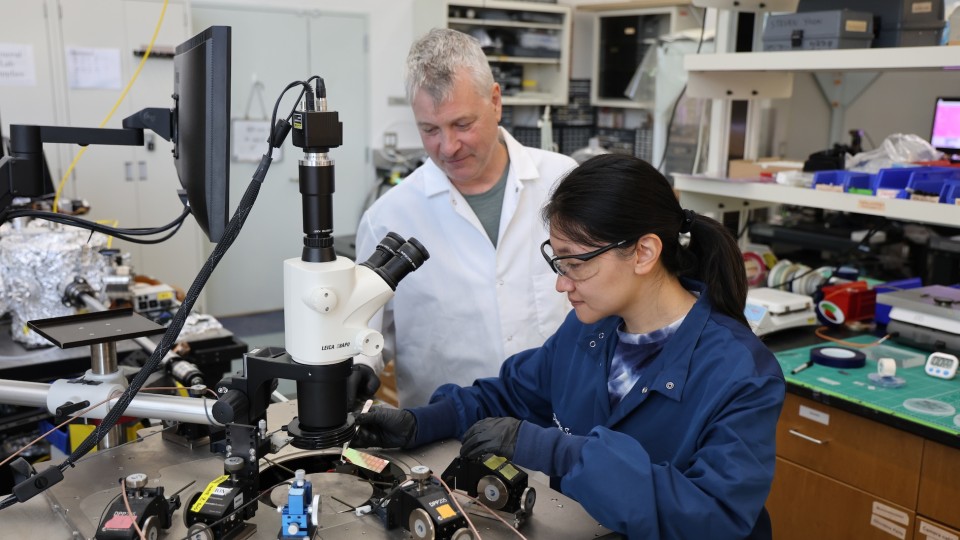
PhD student Xuanjing Chu discusses her new method to break a materials bottleneck in quantum computing.
Today’s superconducting quantum computers rely on aluminum cooled to just a few millikelvins. At such extreme temperatures, this common metal becomes a superconductor, capable of conducting an electrical current without any loss. Ultracold, superconducting aluminum can be used to fabricate Josephson-junction circuits that operate as superconducting quantum bits, or qubits.
But aluminum isn’t the only option to construct a qubit. Materials science has exploded with van der Waals materials. These are crystals that can be peeled into layers just a few atoms thick, often revealing unique quantum properties that could prove valuable in quantum computers.
How do you know whether your material might make a good qubit candidate? Xuanjing Chu, a PhD student working with mechanical engineer James Hone, recently published a new evaluation method in the journal Physical Review Applied. She explains more about her research and why she’s excited about quantum science.

What is the key innovation behind this work?
In superconducting quantum computers, the bottleneck is the material. Aluminum-based qubits have to be kept far below the critical temperature at which they superconduct. For one or two qubits, that’s fine. But if you want to operate thousands of qubits, which will be needed to perform meaningful calculations, you need a lot of cooling power. That’s because you need microwaves to excite the qubits. It’s like putting a microwave in a refrigerator and trying to keep everything cold.
If you want to switch materials, how can you make sure you have a good candidate? Our method provides a useful and straightforward way to characterize the microwave properties of different materials. Researchers often study microwave losses using superconducting resonators. Traditional three-dimensional cavity systems can achieve extremely high performance, but they are not well-suited for measuring two-dimensional materials integrated on a chip.
We developed coplanar waveguide resonators that are easy to fabricate and can be put on a chip with 2D materials. By measuring how microwave fields interact with the material, we can quantify its microwave loss properties and evaluate whether it is suitable for quantum applications. Our platform is also self-calibrating, meaning the device itself provides an internal reference rather than requiring a separate control sample. This helps reduce uncertainties caused by small fabrication variations between nominally identical devices.
So what makes a good superconducting qubit candidate?
We are looking for low-loss in the microwave region. A material suitable for long-lived quantum circuits may dissipate only about one part in ten million of the stored microwave energy during each oscillation cycle. In the paper, we demonstrate that the microwave loss for hexagonal boron nitride, a standard material insulator, is compatible with quantum computing applications. We’ve also started looking at novel superconductors, like molybdenum ditelluride.
“The challenge in the quantum industry is no longer a science challenge: it’s becoming an engineering challenge.”
Xuanjing Chu
How was the process to figure out your method?
I’m an experimentalist, but we had to go pretty heavily into theory and modeling for this paper. Usually, you think a theory is out there in the literature, even if it’s a few decades old, and that if there isn’t a supporting theory, you’ve done something wrong in your experiments. But there was no theory for our specific experimental case! I had to learn about microwave engineering, and we had to do all the modeling and simulations ourselves. That’s a unique challenge!
What brought you to quantum, and to Columbia originally?
I did my undergraduate degree at Fudan University in Shanghai. I was leaning towards more traditional solid-state physics, but it became really exciting to see quantum computing concepts emerge. I started seeing more and more papers pop up, and I wanted to help make the impossible possible: to go from pure laboratory demonstrations to industry-level, practical techniques. I’m a superfan of science fiction, and we’re seeing the transition from the classical to the quantum world in everyday life. I want to be part of it.
I was aware of Jim’s SuperVan collaboration with Kin Chung Fong to explore novel qubits, and I also love New York City. I love to bike around the five boroughs and feel the architecture, the people, and the cultures change. It can feel like you are in different cities. I’ve loved being exposed to the complexity of New York, which gives me a nice break from the lab.
What does the quantum future hold?
The challenge in the quantum industry is no longer a science challenge: it’s becoming an engineering challenge. That will take a lot of people from different backgrounds to overcome. We live in a classical world, so quantum mechanics can feel intimidating, but don’t be afraid. Now is the time to jump in!
Xuanjing Chu is mentored by James Hone, Wang Fong-Jen Professor of Mechanical Engineering and a Columbia Quantum Initiative faculty member.