Research
Why Modeling Climate is More Challenging than Forecasting Weather
Climate models must simulate many overlapping systems to predict or project future climate.
Pierre Gentine is Maurice Ewing and J. Lamar Worzel Professor of Geophysics at Columbia Engineering, professor of earth and environmental sciences and of climate at Columbia Climate School; and director of the Center for Learning the Earth with Artificial Intelligence and Physics (LEAP); and a member of Columbia's Data Science Institute.
In classrooms across the world, students learn that weather is what’s happening at a particular moment, while climate is the long-term pattern.
And yet, climate is more than long-term weather. That means that researchers who build mathematical models of Earth’s climate have to account for many variables that meteorologists can safely ignore. For example, a slight change in global cloud cover makes relatively little difference to next week’s weather forecast, but such a change could fundamentally alter the climate 30 years in the future. Due to the chaotic nature of the climate system, small differences can cause radically different futures.
Weather vs. climate

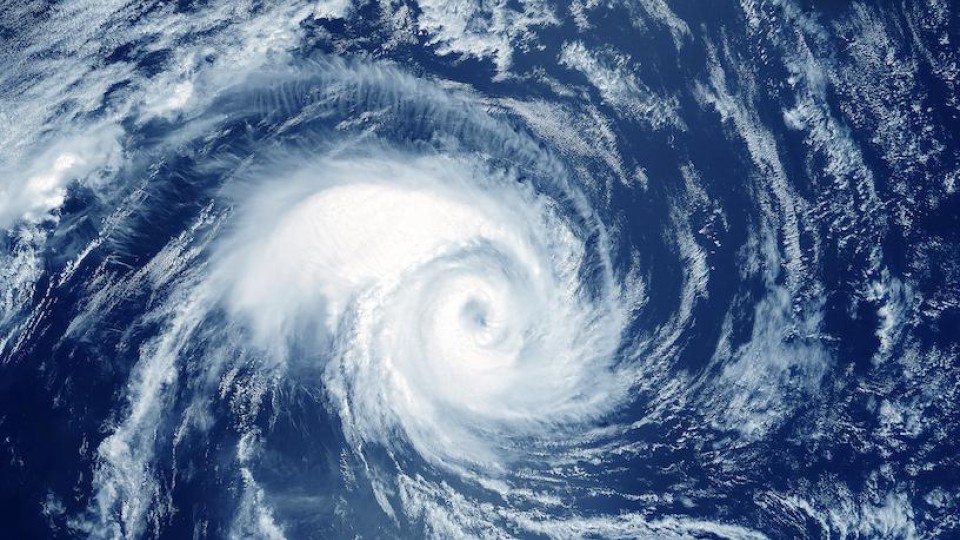
Weather describes the condition of the atmosphere. As masses of air move across Earth’s surface, the temperature in a particular place rises and falls, and precipitation becomes more and less likely. Certain combinations of events can cause anything from cyclonic storms to enduring drought, but every aspect of weather takes place in the thin layer of air surrounding Earth’s surface.
Weather conditions may be extreme, but they usually aren’t long-lasting — the atmosphere’s “memory” only lasts for a few days. In other words, today’s atmosphere has very little impact on weather conditions two weeks from now.
To make predictions beyond this time horizon, we have to incorporate many factors beyond the atmosphere into our models. Everything from the amount of snow cover in Canada to the surface temperature in the Pacific to the annual cycle of budding and falling leaves in Europe’s massive deciduous forest influences the climate. Unlike the atmosphere, these factors tend to have long memories. For example, the amount of soil moisture in the summer will influence the intensity of heatwaves later in the season. Those high temperatures will, in turn, influence processes that unfold even further into the future.
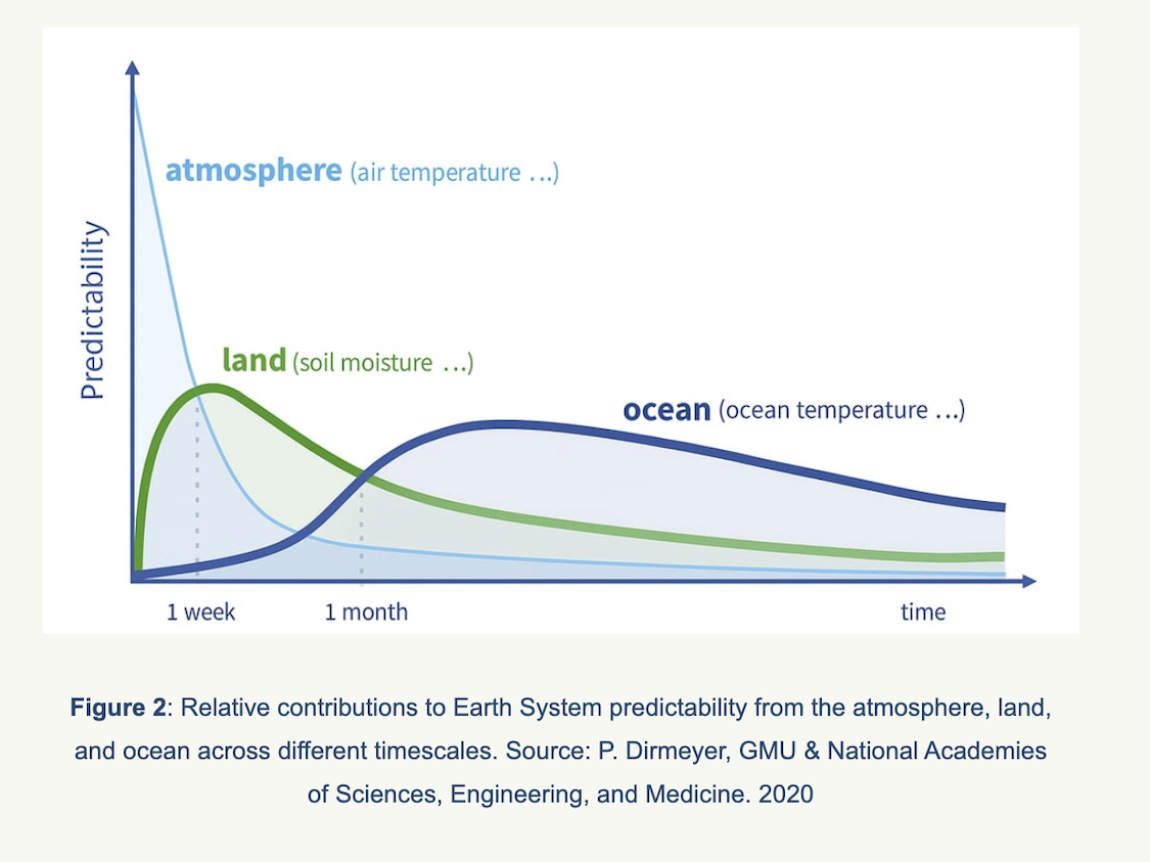
Simply accounting for all of these processes — not to mention understanding how they unfold and interact — is a major challenge in and of itself.
Modeling how they fit together reveals a fundamental limitation to what we can possibly know about the future of Earth’s climate.
A chaotic system
In the 1960s, physicist Edward Lorenz and mathematician Ellen Fetter noticed something strange when they attempted to model atmospheric conditions using a set of equations. When they ran the model on their 600-pound computer, they realized that even slight changes in the initial conditions could bring about drastically different predictions. Inputting variables like temperature to the third place past the decimal would lead to a completely different forecast from inputting the same values to six places past the decimal.
The study of this phenomenon became chaos theory, and the tendency of minuscule changes in initial conditions to cause dramatic changes in the future is widely known as the butterfly effect. The implications for modeling are significant: it is impossible to accurately predict the weather and climate beyond several days, even with almost perfect knowledge of the current state of the atmosphere, land, ocean, and Earth’s ice and snow. This is not a limitation of our models — it’s a fundamental property of any chaotic system.
The implication for longer-term forecasts is clear: climate should be studied statistically. While we cannot predict the exact weather in a specific location a year or more from now, we can estimate the likelihood of temperature or precipitation ranges over seasons or decades. Fortunately, this type of statistical forecast is just what’s needed for practical applications such as planning civil engineering projects capable of withstanding future conditions or designing climate-resilient agricultural policy.
Modeling the right phenomenon
Today’s state-of-the-art weather models work differently from our best climate models. The programs that forecast the weather are designed to be constantly updated with new observations coming in from instruments on satellites and weather balloons, in a process called data assimilation. Through this process, these models refine their predictions for the next few days.
Climate models, on the other hand, aim to capture long-term trends, driven by small but nevertheless important changes, such as in Earth’s energy balance. They’re typically constructed from first principles using equations to implement fundamental knowledge about physics, chemistry, and biogeochemistry. It’s only at the end of the design process that these physics-first models are calibrated against a few real-world observations.
Most importantly, climate predictions are inherently probabilistic. A single model run is not enough to understand variability or to assess risks related to extreme events like heavy rainfall or long-term drought. To prepare for the future climate, it’s essential that we bring to bear all types of models to account for the complexity — and, indeed, the chaos — of our global climate.