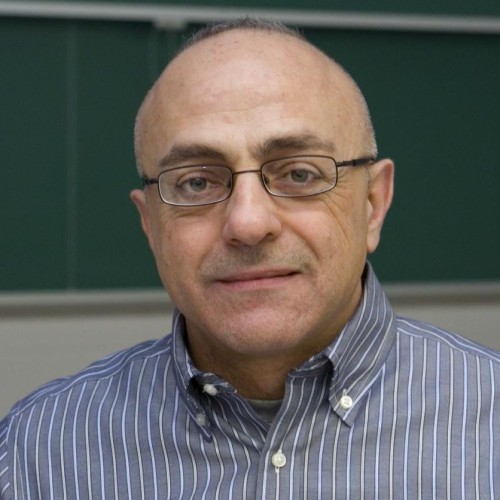
Tom Panayotidi
Lecturer in the Discipline of Structural Engineering and Mechanics in the Department of Civil Engineering and Engineering Mechanics
Lecturer Tom T. Panayotidi is a registered professional engineer in the states of New York and New Jersey. As a Principal Engineer for Burns and Roe, Inc. and currently for Power Engineers, Inc., he has been actively involved in the design of several USACE (U.S. Army Corps of Engineers) and DOE (U.S. Department of Energy) projects and numerous power generating stations across the United States, Central America and Asia.
As a Principal Structural Engineer for General Electric-Hitachi (GEH), he has been involved in the design of a new generation nuclear power plant BWRX-300 SMR (Small Modular Reactor).
As a Consulting Seismic Engineer for URS Corporation (currently AECOM), he was responsible for the structural and geotechnical design of the Advanced Pressurized Water Reactor (MHI) Nuclear Island.
Panayotidi is currently interested in developing user-friendly and easily accessible computational tools and techniques that could be routinely used by practicing engineers to design structures and foundations. Some of the major challenges frequently encountered by design engineers are in the areas of seismic soil-structure interaction; large displacement, inelastic stability analysis of tall structures; response of soils and foundations under static/dynamic (vibratory) loading conditions; improvement in constitutive modeling of concrete that incorporates the effect of cracking, and steel-concrete composite shear wall design.
Panayotidi enjoys teaching undergraduate and graduate courses in civil engineering and engineering mechanics, and sharing his 30+ year extensive design experience with his students. As an adjunct instructor since 1998 in local universities, including Columbia University, the Cooper Union, Stevens Institute of Technology, Rutgers University, and previously as assistant professor of mechanical engineering at Manhattan College, he has enjoyed teaching courses in Theory of Elasticity, Theory of Plates and Shells, Finite Element Analysis, Structural Dynamics, Structural Analysis, Advanced Concrete Design, Prestressed Concrete Design, Steel Design, Geotechnical Engineering, Geotechnical Design, Engineering Mechanics (Statics and Dynamics), Mechanics of Solids, Machine Component Design, Kinematics of Mechanisms, Automation and Control, Engineering Mathematics, among others.
Panayotidi received his BS in mechanical engineering from Columbia University in 1981 and his MS and Doctorate of Engineering Science in engineering mechanics from Columbia University, in 1983 and 1986, respectively. He is a member of ASCE, ASME, ACI and AISC, and serves on ACI committees 370 (Blast and Impact Load Effects) and 447 (Finite Element Analysis of Reinforced Concrete Structures).
Research Areas
- Multi-Hazard Risk Assessment and Mitigation
- Structural Engineering
- Geotechnical Engineering
- Earthquake Engineering
Additional information
-
Professional Experience
- Lecturer in Civil Engineering and Engineering Mechanics, Columbia University, 2013-
- Principal Structural Engineer, General Electric-Hitachi Nuclear, 2023
- Principal Engineer, Power Engineers, Inc., 2013-2018
- Adjunct Professor of Civil Engineering, the Cooper Union, 2014-2018
- Consulting Seismic Structural Engineer, URS Corporation (AECOM), 2010-2012
- Adjunct Professor of civil engineering and engineering mechanics, Columbia University, 2008-2013
- Adjunct Professor of Civil Engineering, Stevens Institute of Technology, 1998-2018
- Principal Engineer, Burns and Roe, Inc., 1991-2010
- Assistant Professor of Mechanical Engineering, Manhattan College, 1987–1990
-
Professional Affiliations
- American Society of Civil Engineers
- American Society of Mechanical Engineers
- American Concrete Institute
- American Institute of Steel Construction
-
Education
- PhD, Civil Engineering and Engineering Mechanics, Columbia University
- MS, Civil Engineering and Engineering Mechanics, Columbia University
- BS, Mechanical Engineering, Columbia University