
From Wall Street to the Culinary World
Moonshot: Engineers Achieving the Impossible | Episode 2
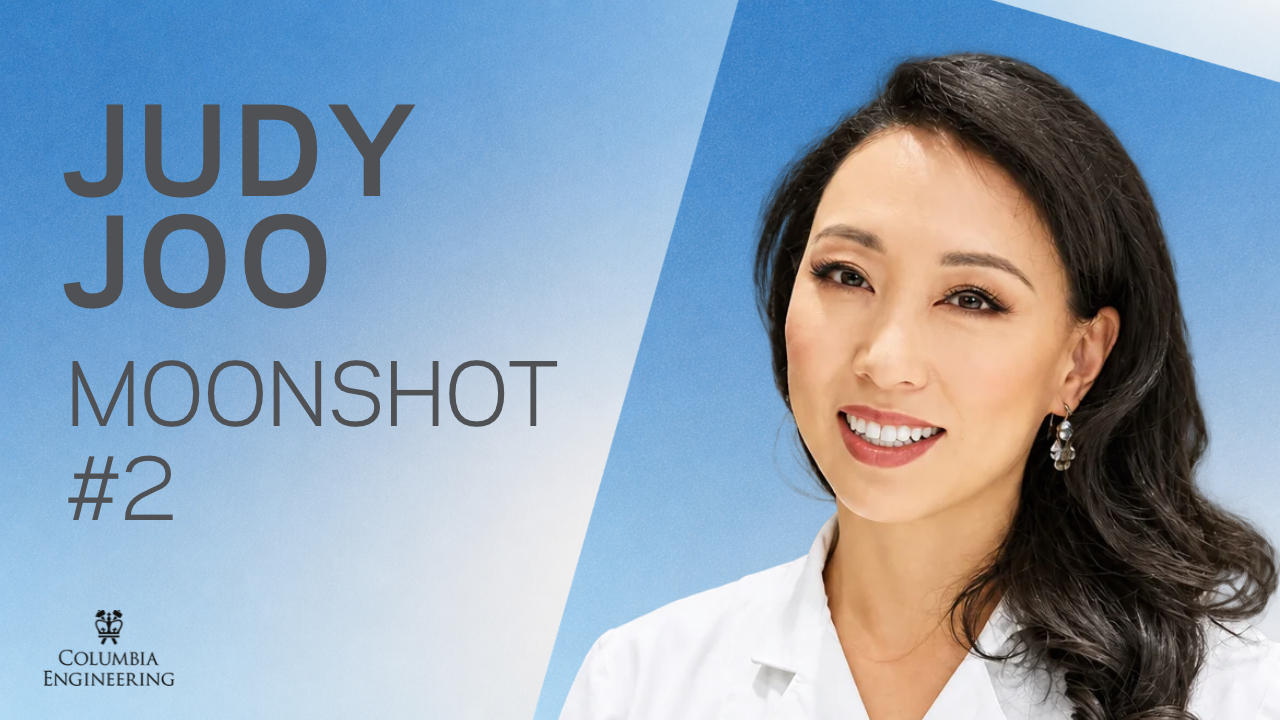
Bestselling cookbook author, restaurateur, and Columba Engineering alum Judy Joo joins host Mike Massimino for the second episode of Moonshot. Judy shares how she pivoted from Wall Street to the culinary world, including what it was like to become the first female Iron Chef in the UK. They get into how the Korean Wave has changed the way people eat, what inspired her new book “Mukja: Let's Eat!,” and how her engineering background still shapes her work.
Episode Highlights
05:18 - Taking the leap from Wall Street to culinary school
12:36 - The casting process that led to Iron Chef
23:28 - The Korean Wave and how the global popularity of Korean culture helped introduce its food to the world
29:30 - How Joo’s engineering education continues to influence her work
41:12 - The persistence behind the TV show, “Korean Food Made Simple”
48:15 - Building Seoul Bird and her fast-casual restaurants across London, Edinburgh, and New York
Transcript
Judy Joo: I was pitching Korean Food Made Simple, the television show, well before the Korean wave happened, well before all of this. And just no, no, no, no, no, all the time. Too small, too esoteric.
Nobody knows what Korean food is. And it took maybe five, six years of just trying and trying and trying, but I never gave up. And eventually I got it on the air.
We had two seasons of it. But there's a lot of rejection. And I've done a lot of casting calls that I've not won.
And I've not, you know, I got Iron Chef, but believe me, that's like one out of a hundred casting calls that I've been on, you know, where I just went, nope, rejected. And sometimes they don't even get back to you and tell you that you've been rejected. They just ghost you. You know what I mean? So hundreds of those for sure.
Mike Massimino: I'm Mike Massimino, former NASA astronaut and Columbia engineering professor, and this is Moonshot. I studied industrial engineering and operations research at Columbia. Same degree as my guest today, actually.
After graduating, I saw The Right Stuff and wanted to be an astronaut. Problem was I hadn't trained for that. So I went to MIT for mechanical engineering and even sat in on undergrad classes to fill in the gaps.
Not because my Columbia degree wasn't good. It was just built for something else. That is pivoting, keeping what you've learned and adding what you need on top.
Today, my guest is Judy Joo, who made a big pivot after graduating from Columbia with an engineering degree. She went straight to Wall Street, trading at Goldman Sachs and then Morgan Stanley. Then she walked away from finance to chase her real love, cooking.
She's now a bestselling cookbook author, the first female Iron Chef in the UK, and the founder of Seoul Bird, a Korean fried chicken concept from New York to London. In the sense of inspiration. Judy, thank you very much for joining us here this morning.
Judy Joo: Thank you for having me.
Mike Massimino: It's great to have you here. You were working on Wall Street, right? On the trading floor, and you made a big shift here, right?
A big pivot. So can you take us back to that moment that you knew you were done? Was there like a specific day or something where all of a sudden, it hits you that a change was needed or did it build up slowly or was it maybe a combination of both?
Judy Joo: I think it was probably a crescendo more than just a one time hit over the head. I think there's always a push and a pull when you're dealing with leaving a certain situation to go to another thing. So there's something that's pushing you and there's something that's pulling you over the fence per se.
And I just didn't love finance, honestly. I was working ridiculous hours. This is when you were allowed to abuse your employees and you worked like 100, 120 hours a week.
And that was normal. Like every single bank had these types of demands on their employees and you never took vacation and you're traveling all the time. And I just burnt out, I would say.
It just wasn't for me. And I didn't have a passion for the markets. Every free second I had, I wanted to read cookbooks or cooking magazines.
I wanted to read Zagat, if you remember Zagat. That was like a book about all the different restaurants, et cetera. So I was just obsessed with the food industry and I didn't really want to be in finance for the rest of my life.
And so I was sick for about nine months with sinusitis and laryngitis. So I just wasn't getting better. And my doctor was just like, you just have to sleep.
And my job was like physically just killing me over time. And so I was like, you know what? I don't love this. I'm just going to quit and go to cooking school, which is what I did.
Mike Massimino: And so it was a crescendo, as you say, a build up to it.
Judy Joo: Yeah.
Mike Massimino: Where you were being pulled by your... it sounded like you were telling yourself something, right? Sometimes you have to listen to what you're telling yourself.
Where do you go? What part of the newspaper do you look at or what magazine catches your eye?
Judy Joo: For sure.
Mike Massimino: That's kind of what was going on with you it sounds like. That's where your passion was.
Judy Joo: Definitely. And I was lucky in hindsight because I always knew what that was. A lot of people have a hard time trying to figure out what their passion is.
They know they don't like what they're doing now, but they don't necessarily know what they want to jump to.
Mike Massimino: Yeah.
Judy Joo: Yeah.
Mike Massimino: But you knew that your whole life?
Judy Joo: I loved food. I loved food.
Mike Massimino: From an early age.
Judy Joo: Yeah. I loved it. I was always fascinated by restaurants. I loved the fact that you could walk through a doorway and be transported to Italy or, you know, Korea or Japan or India or, you know, just for a few hours. And I loved that idea of creating memories like that through spaces. Yeah.
Mike Massimino: All right. So take us through the transition now. So you've at some point that something happened, right? You either quit your job or you started something else or had it.
Judy Joo: Yeah.
Mike Massimino: How was that transition for you into this new this new life?
Judy Joo: You know, it started with cooking school, really, you know, so I quit and I took a little bit of time off just kind of figure out, you know...
Mike Massimino: OK, so you did end before you started the next thing.
Judy Joo: Oh, yeah. Yeah, definitely. So, I mean, just get healthy and to kind of rebalance and reset, you know, and my parents were not happy with this at all because I told them after I quit. So it was very much...
Mike Massimino: You were smart in doing that because you might have been talked out of it.
Judy Joo: Oh, they would have freaked out. So I was like, you know, this is my life. This is what I want to do.
You know, I'm not taking any finances or my parents aren't supporting me. I'm not living under their roof. So this is my life.
I'm going to do what I want to do with it. So I quit and told them after the fact. And and then I started going to cooking school and I never honestly thought it would lead to what I'm doing now.
I think there was a lot of naivete and just blind. I'm just going to jump. You know what I mean?
I'm not even going to think about it because I think if you do think about it too much, you're never going to do it.
Mike Massimino: Yeah, you can talk yourself out of it.
Judy Joo: Completely because there's so many ifs, you know, what if, what if and you know what the chances are you are going to fail. And I failed a gazillion times. Failure is part of the story of success. So, yeah, I think you just got to go for it.
Mike Massimino: Yeah. Failure as long as it doesn't stop you.
Judy Joo: Yeah.
Mike Massimino: Failure is going to happen to everybody who's successful as long as it doesn't stop you. So you started the transition by actually stopping that. How long were you working as a...?
Judy Joo: Five, six years.
Mike Massimino: OK. So that's a significant amount of time.
Judy Joo: Yeah. And it was the heydays. I was there in '97 to 2003.
Mike Massimino: Heydays, meaning things were going well.
Judy Joo: Things were going well. Yeah.
Mike Massimino: Yeah. But it wasn't for you. And you had to listen to your heart.
Judy Joo: Yeah.
Mike Massimino: Your passion. What the universe was speaking to you.
Judy Joo: Yeah.
Mike Massimino: Yeah. So cooking school was I think the important thing is that first step. You don't know where it's going to lead, but you don't have to know all the rest of this.
Judy Joo: Yeah.
Mike Massimino: Is that right? It's just that. But the first one was the first was cooking school.
Judy Joo: In hindsight, I don't think it was necessary absolutely, to go to cooking school. But, you know, I think just being an academic and a student at heart, I was like, OK, I just start with the basics and learn the fundamentals and do this properly. So I went to cooking school here in New York City at the French Culinary Institute. And then I started working at magazines. Yeah.
Mike Massimino: So. OK. So cooking school is how long?
Judy Joo: Only six months. Piece of cake.
Mike Massimino: And you learn. I mean, you learn everything in six months or do you have to specialize?
Judy Joo: Specialized. Yeah. Well, I specialized in pastry. Oh, yes. I'm a pastry chef.
Mike Massimino: OK.
Judy Joo: That was the science thing. That was the science bug I wanted to.
Mike Massimino: OK.
Judy Joo: Take a more scientific.
Mike Massimino: Right. So you started you started with that. And then and then magazines.
Judy Joo: I was working at Saveur magazine back in the day. This is when Gourmet was still open and all the kind of more aficionado style cooking magazines were still in business. And Saveur really considered themselves the National Geographic of Food.
You know, they were very highbrow. They would send their editors all over the world to find this one cookie that some Sardinian grandmother made and has been making for 30 years and bring this back and have a whole story around it about culture and tradition, et cetera, and bring it back. And we'd have to try to recreate this cookie using American ingredients in the American kitchen for the average cook in the middle of America.
So there's a lot of science lab work. It was a kitchen and control variables, multiple testing, all these things.
Mike Massimino: So essentially. So I would think with most of your colleagues, most of the other graduates of the school, did they go work at a restaurant or bakery or something like that?
Judy Joo: Yeah.
Mike Massimino: Did you look at that as well? Or did you know you wanted to do something a little more media related?
Judy Joo: Yeah, I knew I wanted to do food media because I just didn't want to work the hours at the kitchen.
Mike Massimino: Aha.
Judy Joo: Yeah. And I didn't want to work antisocial hours every Friday night, every Saturday night. It's really tough. And also, I didn't want to stand on my feet for, you know, 15 hours a day.
Mike Massimino: You need good shoes.
Judy Joo: Very good shoes. Yeah.
Mike Massimino: OK. So this was a little more reasonable hours.
Judy Joo: Yeah.
Mike Massimino: But it's probably more to it, too, though. I mean...
Judy Joo: Definitely. It's more cerebral. You are your own project manager, I guess. So you are basically working on your own experiments.
Every single recipe you're working independently, whereas if you're working in a kitchen, you're part of an entire brigade and you're making a small part of an entire larger dish or something.
Mike Massimino: Yeah.
Judy Joo: Yeah.
Mike Massimino: That was a big pivot because you gave up a very secure job. And you said your folks weren't really necessarily behind you on this one, but you did it. And you took that first step. And so that's a lesson, right? That you learn. Sometimes it's just going out into the abyss.
Judy Joo: Yeah.
Mike Massimino: Do you think it's gotten easier to do pivots as life goes on for you?
Judy Joo: Yes, completely. Definitely. Because I'm no longer scared of that. I'm an entrepreneur now. You know, I have many different lanes for my work and I'm comfortable with risk, I guess. Being an entrepreneur, you have to be because we're kind of crazy people, you know, you're just willing to bet on yourself at all costs.
And you have this. Yeah, I would say this ignorance around your ability, maybe you just, are just like sheer confidence. Yeah, I guess so. Yeah. And you're just like, yeah, I could do that. That's fine.
I could do that. I can I can take all the punches and I can fail 100 times and get myself back up and, you know, dust that dirt off my shoulders and just go for it again. And it takes a special type of personality to kind of want to do that all the time and not have a safety net of a large corporation and just to rely on yourself with that type of blind ambition, I guess. Yeah.
Mike Massimino: And the work at the magazine eventually led to an opportunity to to become the Iron Chef. This is in the UK. So the magazine was in New York.
Judy Joo: That was in New York.
Mike Massimino: And then did you pursue that? Did it just come to you?
Judy Joo: Yeah.
Mike Massimino: You also were thinking of turning it down at some point.
Judy Joo: Yes. So I got engaged to a guy who had a job opportunity in the UK. So that's what brought us over there.
Mike Massimino: You went over there.
Judy Joo: So we went over there and that's when I started working in kitchens and that's where I started working kind of the terrible hours. But I wasn't working full time. You know, I worked part time.
I was also writing for magazines also at this point. So when Time Out used to be a magazine and like dating myself all the time, like Zagat, Time Out.
Mike Massimino: They're not magazines any longer?
Judy Joo: I know.
Mike Massimino: Zagat is not a magazine anymore?
Judy Joo: I know, Zagat doesn't exist.
Mike Massimino: Really?
Judy Joo: Exactly.
Mike Massimino: And Time Out's not a magazine anymore?
Judy Joo: I think it's only online and they do food halls and everything now. I know. So I started working in kitchens and I also started doing some small television appearances. And I was working for a show, just a regular guest on a show called Market Kitchen and I became a regular cooking Korean food. And like most cities, this world is really small.
And so when Iron Chef came up and was commissioned, everybody got an inquiry to do a casting. So I was like, I might as well throw my hat in the ring. I went for a casting, get called back, get called back again, called back again, again.
And I was almost sick of it by the end of it. And I didn't think I had a chance in the world. And that's almost when you perform your best because there's no pressure, I would say almost.
And ended up landing the role and I was literally floored and flabbergasted by it. I was like, are you kidding me? I remember my agent calling me.
I was like, are you serious? There's no way, you know, because I was only probably like a CDP level. It's a Chef de Partie. It's probably very mid tier. I wasn't a head chef. I wasn't executive chef or anything.
I was just working in kitchens. I didn't have my own restaurant. I felt immensely underqualified for this role entirely.
And especially when like my head chef, the kitchen I was working for, had gone for the role and everything. Everybody had gone out. But I have to say, as you know, television isn't just about being able to cook great food.
You have to be able to speak well. You have to have charisma. You have to, you know, engage with the camera.
There are all these other lanes and tick boxes you have to check in order to make it on TV. And what the producer's looking for is not necessarily what they're looking for that a three Michelin star chef may have, you know, so it's a very different skill set. And also you have to be able to cook under extraordinary circumstances with ridiculous ingredients and under, you know, extremely pressurized environments, you know, so it's, it's not exactly a normal job that when you're a three Michelin star chef that you would gravitate towards.
So that doesn't mean I was the best chef. I was the best chef for this role. You know, um, and, and after working on trading floors, you know, my tolerance for pressure was pretty much on, you know, up here.
So nothing was really freaking me out that much. And I wasn't really getting that nervous about things, you know, cause I'm used to unwinding, you know, billion dollar FX trades and lining up treasuries and hedges on the side, you know, that kind of stuff. And so I'm like, we're making cake. Literally, we're making cake. If somebody gets their dinner two minutes late, it's okay. You know, like it's not going to be terrible.
Mike Massimino: Yeah. A couple of things there resonate, I think is, is one is that you might not be this, you know, the top student or chef in this case, or the brightest in the class or whatever, but that's not always what's important, right? That doesn't mean, well, for this job, that means no, that's not how they're doing it.
They're looking for people in some cases, well, in your case, looking for someone who does well on TV, who can think under pressure, but also someone who can be a team player and who's going to show up and, show the passion. And, that doesn't always come out in the final grade you got in a class. And it's like, oh yeah, we want that person cause they're the top student.
Right. So there, that doesn't mean just because you might not be top in one thing, and that doesn't mean that you're not going to be the top in another or the best suited. That's one thing. The other thing is that you mentioned that you were shocked that they wanted you, right?
Judy Joo: Completely.
Mike Massimino: I think sometimes I think we think of what we think of ourselves, um, even though you obviously have a lot of confidence and everything, sometimes you got to listen to what other people are telling you. And some people, sometimes they see something in you that you may never have expected. And it's time to listen when that happens.
Judy Joo: Definitely. And I think also for whatever reason, just being female, we're always second-guessing ourselves because we're way too thoughtful. And I've always felt I've been underqualified for pretty much every single job I've ever been offered.
And, all of my very fabulous qualified, power women girlfriends are the same way, we're always, I don't know why, but...
Mike Massimino: I think it's being human personally, Judy. If you ask me, I've written a bit about this, you know, it's kind of the same thing. Like, how did I get here? And people have asked me about this imposter syndrome.
And I'm like, I think it's just being a normal person. If you're an arrogant nut, you know, you come in, I'm the greatest ever. Who's going to want to be around this person? That doesn't work. And I think that most, successful people have a little, you know, humility and appreciation.
Judy Joo: You can see yourself from the 10,000 foot view and you question it.
Mike Massimino: Yeah. I think it's just being humble and understanding. You might not know everything and being someone who people want to be around, which I think makes you successful.
Judy Joo: That's true. Yeah.
Mike Massimino: Was there a time though? I mean, you see, you're going into a whole new world here and a little intimidating, I would think too, right?
Judy Joo: Yeah, definitely.
Mike Massimino: But was there a moment once you got there that you realized you belong there? Did that happen? Was there a moment like that?
Judy Joo: Gosh, I don't know if I feel like I ever belong, to this day. I mean, I definitely have confidence that I belong in the chair and stuff et cetera, but I don't know if I necessarily feel that, maybe this is just a healthy level of humility, but I'm always learning. And I feel like I have a lot to still learn.
And I know I have a very keen awareness of what I don't know. Which is why I hire great people to fill those gaps of what I don't know. Yeah, I would say, in my older age, I'm in my fifties now.
So, it's something that comes with age where you just settle into yourself and it's not necessarily about not belonging, but I actually don't care as much anymore, you know? And so I'm like, yeah, I don't know that. I don't care if I don't know that, you know, I'm very, I'm much more content with, who I am and what I bring to the table and what I've done.
And yeah, it's just this level of a combination just knowing who I am, knowing what I don't know, knowing what I do know, knowing what I've done and being okay with that. Yeah.
Mike Massimino: Do you feel like maybe in a different way, like you found your people, that the people you're around, that that's the world, you know...?
Judy Joo: Completely, I've found my tribe, for sure. And I've culled people from my tribe. I think that's also important, too—culling. Yeah.
I just don't want to be around negativity. And so negative people, I'm just like, okay, peace out, peace out. Like, like we can be friends at arm's length, you know, I just don't want to be around negativity.
I don't want to be around Debbie Downers. If you just suck energy out of me, I just can't do it. I just don't have the bandwidth anymore.
And whereas when I was younger, I probably would have tolerated much, much more of that, I would say. And, um, and I have, you know, friends from school here that I still love and adore, you know, friends from high school, et cetera. And, you know, I feel like I found my, my people and my friends and my girlfriends, you know, there, there's no pretense.
Like we're like each other's psychiatrists and psychologists and we laugh, we cry. We're genuinely happy for each other. We genuinely feel each other's pain and more. Yeah.
Mike Massimino: What about the people you work with? Same feel?
Judy Joo: Definitely.
Mike Massimino: You have that shared passion.
Judy Joo: Yeah. And, I've done enough in my life, also my fifties, that I don't want to work with assholes.
You know, am I allowed to say that word? I just don't want to work with assholes. I don't have the time to, I don't need to.
And I just don't want to work with people who aren't good people and don't share the same vision and aren't aligned with, with my moral compass.
Mike Massimino: Yeah. I think that's maybe part of like when you go into a new environment, you're feeling it. You might not always feel comfortable what you're doing because you're challenging yourself. But I think, uh, it sounds like being around the people who are like-minded when you have that shared goal can, that can help the feeling of belonging and teamwork part of it.
Judy Joo: Yeah. And being transparent and you know, everything is a transaction, but you have to be happy. I have to be happy and we both make money.
You know, it's not like I'm going to screw you. I'm not, you know, I'm going to get screwed. It has to be very much a balanced relationship. And I feel that that's what everybody's looking for. Yeah.
Mike Massimino: Okay. Now going back to when you were a kid, where'd you grow up by the way? Did you?
Judy Joo: New Jersey.
Mike Massimino: You grew up in New Jersey.
Judy Joo: I'm a Jersey girl.
Mike Massimino: All right. So where in New Jersey?
Judy Joo: I was born in Summit, New Jersey.
Mike Massimino: Northern sort of?
Judy Joo: Union County. It's not that far.
Mike Massimino: It's kind of like New York City area, right?
Judy Joo: It's a big commuter town.
Mike Massimino: Is it more Philadelphia or New York City?
Judy Joo: More New York City. But I grew up in a small town called Berkeley Heights and went to school in Summit.
Mike Massimino: Okay. So that's where you went to school. And then of course you came here to Columbia, but as a kid, you've talked about your Korean roots, right?
Like you had, I would get sent to school with, you know, some odd Italian cookies once in a while, but there was a lot of Italian kids around, so it didn't matter. But, you were embarrassed by your Korean lunchbox as a kid. Is that right?
And now you watch kids who like that sort of stuff. So as things have changed, what was that like for you? Was it uncomfortable?
Judy Joo: Completely. I think every immigrant kid didn't want their parents to pack them weird, smelly things for lunch. You know, I just wanted Lunchables, you know, those like little crackers that you spread the cheese on and you have like a bit of ham and stuff like that.
So I would just beg my parents never to pack that, you know, never to pack kimchi. I mean, God forbid they packed me smelly kimchi, you know, or anything. And, you know, it really is a full circle pinch me moment because now I'm serving Korean food at Madison Square Garden and at Citi Field to the masses, you know, like how did I go from being embarrassed of
my lunchbox to serving Korean food in some of the biggest arenas in New York City. You know, it's just insane. I mean, when I was growing up, people didn't even know what Korea was.
They thought it was like part of China, part of Japan. They didn't understand that it was its own country. Like nobody knew anything about Korea.
Mike Massimino: What do you think happened? How did this happen?
Judy Joo: You know, it's the Korean Wave is the Korean government made this conscious decision and dumped all of this money into promoting Korean culture. And it works. Yeah. It works. That's all the K-pop. That's all of the Korean drama.
It's Korean beauty, everything. And all of that, all that Korean culture is, is called the Korean Wave. And that's why it's just splashed across the shores around the world.
And, you know, K-pop is obviously a huge driver. I see your BTS t-shirt right now. I'm kidding. I'm kidding.
Mike Massimino: I don't know what the heck this is I'm wearing. It seemed like the right color for today. I'm going to do a film.
Judy Joo: I'm kidding.
Mike Massimino: But yeah, I don't even know what that is. What is that? I don't even know what that means.
Judy Joo: BTS is the biggest K-pop band.
Mike Massimino: Really?
Judy Joo: Yes.
Mike Massimino: Okay. See what I'm learning here.
Judy Joo: Oh my gosh. Blackpink.
Mike Massimino: You could be making that up. Make up something else. And I'll think it's true. I have no idea. I'm really sorry.
Judy Joo: Well, BTS has been compared to the Beatles.
Mike Massimino: Really?
Judy Joo: Yes. They're massive.
Mike Massimino: That's kind of big.
Judy Joo: They're huge.
Mike Massimino: I mean, the Beatles were big. They were a little before my time, but you know.
Judy Joo: Massive. So BTS is a phenomenon.
Mike Massimino: Wow. I better get up to speed on this.
Judy Joo: Yeah. And Korean dramas, people are exceedingly addicted to Korean dramas.
Mike Massimino: Some of those movies.
Judy Joo: Yeah. But also like the series.
Mike Massimino: Oh yes. I've seen a couple of those, well I haven't seen those.
Judy Joo: Squid games, you know.
Mike Massimino: Those ones I've seen. That's not a soap opera, is it? That was more like an action kind of.
Judy Joo: Squid games is a series. Yeah. Okay.
Mike Massimino: I watch too many sports, Judy. Like I'm impressed that you have stuff at Madison Square Garden and Citi Field.
Judy Joo: That's fun.
Mike Massimino: Yeah. So yeah. Okay. I'll look up some of these others, but probably not. But cool.
Judy Joo: Yeah. All these are drivers towards Korean culture and ultimately Korean food.
Mike Massimino: Okay. All right. Well, Korean food's pretty good. I think that has something to do with it too.
Judy Joo: It does.
Mike Massimino: Once you start trying that stuff.
Judy Joo: Yeah.
Mike Massimino: And a lot of my friends were in the service were stationed in Korea and they brought food culture. Even those Americans came back with that food culture too.
Judy Joo: Yeah. And they brought fried chicken to Korea and that's how Korean fried chicken evolved.
Mike Massimino: Really? We had something going the other direction?
Judy Joo: Yes, of course.
Mike Massimino: An American import over there?
Judy Joo: It always happens that way. The trade of ideas always goes both ways.
Mike Massimino: Well, I think as the world becomes, as we get to know each other a little bit more, I think we talked about what home is and where it is. And I think the world is really our home.
Judy Joo: Definitely.
Mike Massimino: And as we get to know each other more and exchange food and ideas, this is a good thing.
Judy Joo: Right.
Mike Massimino: So, all right. Okay. Going back to your parents, again, back to your youth here. They didn't even tell people you'd become a chef for a long time, apparently.
Judy Joo: Yeah.
Mike Massimino: But now they're probably into it, aren't they?
Judy Joo: Yeah.
Mike Massimino: So what was that like to watch that change with your folks?
Judy Joo: I mean, it's gradual, I would say. I think now they tend to more say I'm a celebrity chef to distinguish that I'm not like working on the line in some basement in a hot, sweaty kitchen. You know what I mean? I think they want to elevate me to a certain level or somehow, whatever their weird way of thinking.
Mike Massimino: Yeah.
Judy Joo: I mean, certain things resonate with them. Certain things don't. Like they couldn't care less about the TV stuff.
I try to get them to watch me on the Today Show or one of the morning shows and they never remember.
Mike Massimino: Really?
Judy Joo: They can never do it. I'm like...
Mike Massimino: That's why we have tape. Send them the clip.
Judy Joo: Exactly. Even that, they would...
Mike Massimino: They don't?
Judy Joo: Really? It just doesn't really...
Mike Massimino: They don't watch these shows, apparently.
Judy Joo: No.
Mike Massimino: Do their friends watch these shows?
Judy Joo: Their friends will text them and say, we saw your daughter on TV.
Mike Massimino: That's good. That's a plug.
Judy Joo: They're like, oh, okay.
Mike Massimino: Yeah.
Judy Joo: But certain things like giving the commencement speech here at Columbia, they really enjoyed that.
Mike Massimino: Yeah. Yeah. Did they show up for that or they came?
Judy Joo: Yes, they came. Yeah.
Mike Massimino: All right.
Judy Joo: And I mean, I cooked for Prime Minister Rishi Sunak, so they thought that was cool.
Mike Massimino: Okay.
Judy Joo: And the Korean President, Yeol, at the time.
Mike Massimino: Wow.
Judy Joo: So there's certain, I guess, more highbrow things that they like.
Mike Massimino: Yeah. Did they like your food, though? Did they let you...
Judy Joo: No, they think it's too salty.
Mike Massimino: They do?
Judy Joo: They do. They come to my restaurant. They're like, where's the Korean food?
Mike Massimino: Wow. Really? They're from... I guess they were immigrants. They came from... You were born...
Judy Joo: I was born here.
Mike Massimino: You were born here. Okay. So they are immigrants.
Judy Joo: So it's a different palate, you know?
Mike Massimino: Yeah. Where's the Korean food? It's like when I went to China, I was like, where's the Chinese food?
Judy Joo: Yeah, basically.
Mike Massimino: When I was in China, where's the Chinese food? You know, so we have a different...
Judy Joo: Yeah.
Mike Massimino: Okay. So yours is more... Should I say more Americanized?
Judy Joo: But I think every Korean-American chef, they struggle with their Korean-Korean parents or their Korean... Because everything's too salty and everything.
Mike Massimino: It's too salty in America.
Judy Joo: Yeah, it's too salty in America. There's just a different standard.
Mike Massimino: Wow. That's pretty funny. So they won't... They will still eat some of your stuff, I would...
Judy Joo: Oh, yeah. Yeah, definitely.
Mike Massimino: Your parents cook a lot? Did they do that?
Judy Joo: Oh, yeah. My mom still cooks.
Mike Massimino: Did you ever have her in the kitchen at one of your places or...
Judy Joo: No.
Mike Massimino: Did you ever have her on the show or anything?
Judy Joo: She's come on TV with me before. Yeah, she's been on with me. I think maybe Katie Couric when she had her show. I can't remember. I brought her on to one of the talk shows. I can't remember.
Mike Massimino: Yeah. As long as you don't let her comment on the food. It sounds like just... She was talking about me when I was a kid, you know, something like that.
Judy Joo: Yeah.
Mike Massimino: This is cool. All right. So now you mentioned you spoke at the commencement speech. I heard that. That was a pretty good speech.
Judy Joo: Oh, thank you.
Mike Massimino: That was good. Class day a few years ago. And you have these deep ties to Columbia.
Judy Joo: Yeah.
Mike Massimino: I mean, it's just why we got you to come here. You love the place. I love the place.
I was an undergraduate here well before you. Changed my life, you know, and just showed me dreams are possible. It's a great place to be educated. And you have that affection for the place, obviously.
Judy Joo: Definitely.
Mike Massimino: And you're in a whole different career, one would say now from... But maybe not. I mean, as far as...
Judy Joo: I agree.
Mike Massimino: How you're... Your engineering background, you've already mentioned a couple of times, has played a role. So are you still relying on that?
The things you learned here at Columbia and your engineering background and how so? How's that go?
Judy Joo: So I was an operations major in the industrial engineering department.
Mike Massimino: So was I actually.
Judy Joo: And everything I do is operations now. You know, planning a restaurant is very much like planning a city. And you have to look at workflows, customer journey, back of house journey, everything in a kitchen is all about operations and efficiency.
I'm looking at material sciences also, you know, are things durable? Are things easy to clean? What kind of materials are we using for our chairs, ergonomics, human factors?
The chairs have to be comfortable, but not too comfortable. I don't want people staying too long. Acoustic engineering, lighting, everything. It's all engineering at the end of the day.
Mike Massimino: Yeah.
Judy Joo: Mechanical engineering with all my equipment, you know, we're looking at everything.
Mike Massimino: Yeah. I think, is it also safe to say it's a way of thinking about things or problem solving working together?
Judy Joo: Yeah, yeah, definitely. My COO, he's always complaining because I never take no for an answer because I'm always like, well, why can't you do this or this or that? Because I'm always looking at ways to solve a problem. And I think that's very much an engineering thing because nothing's impossible.
Mike Massimino: No, it's not. You have to figure out how to engage. It might be very complex, but how do you engage it?
So you're very happy with the education you had. It wasn't like, oh man, I'm this engineer and now I want to become a chef. That was a waste of time. That wasn't the case at all.
Judy Joo: No. And also, like I mentioned before, cooking is very much a science. A hundred percent. Yeah.
Mike Massimino: Tell me a little more about that.
Judy Joo: Well, I mean, particularly in pastry, you know, the different protein content of your flour very much determines what your outcome is, the type of fat you use, are you using butter, oil or, or lard, even if you use a whisk or a spoon or a spatula, um, how you mix something greatly affects the end product. If you cook something low and slow versus high and quickly, it's, it's all science. All of it. Yeah.
Mike Massimino: It's amazing where it can take you. I especially think this is such a great example for our students and this is what you spoke about in commencement and that your education that you get because you're interested in something or you're good at it or whatever, that doesn't, you're not pigeonholed there.
You don't have, you can apply. And especially those other lessons, you mentioned those lessons of perseverance and not giving up and problem solving.
Judy Joo: Yeah. I mean, I was talking to a rising senior here on campus and she is, is an engineer, but she's, she loves food. And I was like, why don't you look at something that's food adjacent, you know?
And, um, it doesn't matter what kind of engineer you are. I mean, even something like chocolate or coffee, you drink it or eat it almost every day. The science and the engineering behind making chocolate or making, you know, coffee is massive, absolutely massive.
You can get so incredibly nerdy about coffee, you know, like how, how you harvest the beans, how you roast the beans, what is the correct mix of the percentage of the ratios of different types of beans, the grind size of the coffee, the velocity of the water, the temperature of the water going through it. And people have written dissertations about coffee. And so, you know, you can look at anything and there's engineering behind it.
Mike Massimino: It seems to me that this is an advantage in your, in your field that if you just went to cooking school from the get-go and worked in kitchens and so on, would have possibly a different outcome.
Judy Joo: Yeah, definitely.
Mike Massimino: And it can be applied, I think, to a lot of areas.
Judy Joo: Everything, even, I mean, you love sports, you know, all this moneyballing, AI and baseball, everything, you can design golf clubs, you can design, you know, tennis rackets, it's all physics, it's all mechanical engineering, everything, you know, how do you design a club that's new or the ultimate putter or something? Yeah.
Mike Massimino: Yeah. There's all, there's all science and engineering behind it. So what's the most unexpected place you think your engineering degree has shown up in your restaurants?
You know, is there, there's something that people would never guess that an engineer did this?
Judy Joo: I would say definitely in the design of the front of house dining room, because people usually attribute that entirely to the architects. I'm constantly arguing with my architects because I care about durability, how easy things are to clean, if they're going to stain, and overall operations. You know, even something as simple as making this a beveled corner instead of a 90 degree corner. I'm constantly telling, my architects to change that corner.
Cause I know after two months, it's going to be banged up and it's going to be not in good shape and it's going to look terrible. Everybody's going to be hitting themselves on that. So looking at beautiful spaces, but in a way and bringing in functionality and operations into it changes things. Whereas architects just want to make beautiful places. Yeah.
Mike Massimino: In the design of all those little things here and there.
Judy Joo: Also sound is a huge part of restaurants. You don't want sound bouncing all over the place. It's so noisy. So you have to think of materials that absorb sound. You think of like acoustically.
Mike Massimino: Yeah. Is that unusual? I mean, do you have other chefs that you're, that you have encountered that come from an engineering background?
Judy Joo: Not from engineering. Yeah. And so I'm always looking at like even like where the lighting is coming from, where the speakers are, back of house, like where do you put the dirty dishes?
Is that easy, accessible to get to the potwash and, you know, a customer journey from the second they enter the doorway, you know, also with all of this online ordering with deliveries, you know, that's practically like a manic station. Cause you've got like four different delivery apps, like all coming into you. Like how is that processed and consolidated together to speak to your own, like, you know, POS system, your point of sale system.
How does that get to the kitchen? Where is that fed in? And then checking it, making sure that everything is in there. So it is all operations.
Mike Massimino: Are there engineers working in the food business that aren't cooks? I would think that you probably have some of them to help you.
Judy Joo: Tons. For all of the systems, all the systems. Yeah. Everything.
Mike Massimino: And that's another way to, even if you don't cook, but you're interested in food.
Judy Joo: Definitely. You could work for a Resy. You could work for an OpenTable or one of these companies that is doing all these things. Yeah. Yeah.
Mike Massimino: Okay. Restaurants are unpredictable, right? You've dealt with COVID and supply chain disruptions and cost of living issues.
And there are all these things that are beyond your control, right? So it's like a lot of chaos going on, right? And you mentioned how your, maybe your previous life working in the floor might have helped with that. But how do you keep making these big bets? You also, you're very entrepreneurial.
Judy Joo: Yeah.
Mike Massimino: Knowing that there's so much that's, it's out of your control. I mean, you can't, when COVID happens and all of a sudden, you know, the restaurant business changes, right? Or something happens and everything is disrupted for things that are, how do you manage that?
Judy Joo: You know, I think it's, it's a mindset also. You just have to surrender yourself to the fact that you can't control everything. Ever. Period. And so much of it is out of your control. And particularly in the restaurant industry, you know, we have restaurants in London and we had COVID and then we had the energy crisis and then we had the war in Ukraine, which really caused, you know, energy spikes.
They're the breadbasket of Europe. Most people don't know that they grew so much stuff.
Mike Massimino: The Ukraine?
Judy Joo: Yeah. All of the oil, all of the, everything was being chickens, et cetera, everything. Vegetable oil, safflower oil. And so that really affected supply chain.
We had tons of supply chain spikes. And then the war, you know, with Gaza and Israel that, you know, with the Suez Canal, and then now the Strait of Hormuz, like all of this, these are huge shipping channels and really affecting the UK. And so again, and we get a lot of ingredients from Asia.
And so again, supply chain spikes, that is not in our control at all. None of that. So you just have to run with the punches and you just can't worry too much because you just kind of like laissez faire, you know, like it's going to happen, be prepared and deal with it when it hits your plate. Yeah.
Mike Massimino: And it probably applies to more than just a restaurant business, I would imagine.
Judy Joo: Completely.
Mike Massimino: Yeah. But it's, but especially in your business.
Judy Joo: Where I think a lot of businesses are just, you know, at the end of the day, it all trickles down, you know? Yeah. What the markets are doing affects everyone. Yeah.
Mike Massimino: All right. So like someone's an entrepreneur or someone, just anybody working in a business, not doing like your standard job, whatever that means, where these things are, do you have any advice of what, is there like something you keep in mind or, you know, like, remember this?
Judy Joo: Yeah.
Mike Massimino: Like all of a sudden, like, you know, it's, you know, cause you can get scared off, right? Oh no, this is too, but how do you, is there anything that you, is there like something you keep in mind or an example?
Judy Joo: Just go for it. Just go for it. But you have to really be confident in betting on yourself and your ability to execute it.
And you're going to work harder than you ever have in your entire life. And don't kid yourself by this is going to be easier than working for a big corporate, you know, company. Cause it's not. A big corporate company, you could take two weeks off, not check your phone. It's fine. If you don't check your phone when you're working for yourself or you miss something, like it's you, the buck stops with you, you know? So it's a lot of work. You will fail a gazillion times.
Mike Massimino: Yeah.
Judy Joo: So expect that it's not going to work on the first time. It's just not possible. So be comfortable with failure and learn from it and embrace it and just keep trying.
Mike Massimino: Yeah. That's the thing in our, in our space missions is that we plan, plan, plan, plan, plan, rehearse, rehearse, rehearse. And now we're getting ready to execute, but be ready for things to change. There's always something that's unexpected or different.
Judy Joo: Definitely. And whatever you think is going to go wrong, it does.
Mike Massimino: It will. And there's always a, let's say there's always a gremlin out there. Every spacewalk, every day, there's some gremlin that's going to surface that we never thought of.
Judy Joo: Completely.
Mike Massimino: But it's, but again, you know, for us, it was like working as a team. You would, you know, how to engage the problem. Okay.
This is a different problem, but let's put our heads together and see how we can try to attack this thing. When you mentioned about, you're going to fail, fail, fail. Is there something you can share?
I mean, I can think of a lot of things I failed at, every day, but is there something that was like an example of one that maybe was the, I don't know, the biggest and most meaningful or something you can share with us that people would be like, whoa, because people can see you have success where you are now. Like, ah, it played like a symphony, but that wasn't the case. You haven't, can you share one of those with us?
Judy Joo: Oh, I have so many. Sometimes timing has a lot to do with it. I would say sometimes you're ahead of your time.
And I think that timing actually has a lot to do with it. So I was pitching Korean Food Made Simple, the television show well before the Korean Wave happened well before all of this, and just no, no, no, no, no, all the time too small, too esoteric. Nobody knows what Korean food is and took maybe five, six years of just trying and trying and trying, but I never gave up.
And eventually I got it on the air. We had two seasons of it. And, um, but there's a lot of rejection and I've done a lot of casting calls that I've not won.
And I've not, you know, I got Iron Chef, but believe me, that's like one out of a hundred casting calls that I've been on, you know, where I just went, nope, rejected. And sometimes they don't even get back to you and tell you that you've been rejected. They just ghost you.
Judy Joo: You know what I mean?
Judy Joo: So hundreds of those for sure. And, um, and you're just like, okay, yeah, they didn't want me. That's fine. That's fine. It's okay. You know, so just don't take it too personally.
Mike Massimino: Yeah. I think those are really important lessons for young people. That's why we're all thrilled to have you involved here at Columbia.
Cause you set such a great example. And I think it seems to me also the pattern I'm noticing here is that it, it doesn't end, right. It's not like all of a sudden, right.
You have these challenges that come up as you, the changes you went through and the pivots and then taking your lumps here and there and you're saying, I mean, it doesn't stop now I've made it. That's it. It's that same resilience that's needed after you get the position you want or you're in the spot you're right.
Judy Joo: Yeah.
Mike Massimino: Is that safe to say? Cause that's what I'm starting to get here.
Judy Joo: Yeah. Yeah. But also being comfortable in where you are, I think is important too.
Mike Massimino: Yeah.
Judy Joo: I'm good. I'm cool.
Mike Massimino: But things are going to change and you still have to keep going at it. Okay. A couple more questions here.
If you're doing well here the the pursuit of cooking how, how did you get into this in the first place? Like, was there someone who inspired you? Did someone teach you to cook? How did this all happen?
Judy Joo: My mom. Yeah. So my mom is still an amazing and a wonderful cook. She was always cooking everything from scratch because particularly back then you couldn't buy these things.
You couldn't really buy kimchi. You couldn't really buy, you know, all of the things that my parents craved to literally get that taste of home. And so there was all kinds of stuff fermenting in our house and smelled really funky and things drying on our back porch and everything like chilies and seaweed and all kinds of, yeah. Yeah.
Mike Massimino: Is this typical for, for their generation?
Judy Joo: I think so. Yeah. Yeah. And, you know, they had a garden, you know, where perilla leaves were growing. I remember having to pick them and I hated the smell on my fingers.
Mike Massimino: Really?
Judy Joo: And they're quite hairy. So it was like, yeah, a little uncomfortable.
Mike Massimino: Wow.
Judy Joo: Yeah. I have a lot of food memories and, um, you know, making dumplings by the hundreds that was kind of child labor-ish-y.
Mike Massimino: Was that for a holiday? That was all the time?
Judy Joo: No, that was all the time. You know, you make them for, and you freeze them so you don't have to make them for a while. But then, you know, you had to do another batch of a thousand or something.
Mike Massimino: Wow.
Judy Joo: Yeah.
Mike Massimino: Did you have a lot of family around you that were doing the same thing?
Judy Joo: No. Well, this is just, just because we came over, but, um, I think a lot of my other, I didn't have that many Korean American friends growing up because we just didn't live near any, any Koreans. But I think, you know, this is a very common occurrence in most immigrant homes.
Mike Massimino: Yeah.
Judy Joo: Not just Korean.
Mike Massimino: So, but your neighborhood wasn't a lot of Korean Americans and you didn't have many cousins?
Judy Joo: Nobody nearby.
Mike Massimino: Okay. Right.
Judy Joo: I remember we used to drive for like six hours to Binghamton, New York, like Vestal, New York to Binghamton.
Mike Massimino: Wow.
Judy Joo: That's the closest relative. Yeah.
Mike Massimino: So it was food was what else? So it's time with your, your parents, it sounds like with your mom, right. Doing those things.
Um, and it, you probably, you kind of look for, you have this, you're looking back, it sounds like very fondly on this.
Judy Joo: Definitely. Definitely.
Mike Massimino: So it kind of, was it a, it was a community within your family and love and time spent.
Judy Joo: Completely. Yeah.
Mike Massimino: Cause there's a lot more to food than just a food. Isn't there?
Judy Joo: Well, you sit there and you're, you know, you're kind of in production, but you're talking, you know, what, while you're doing it. Yeah.
So you're catching up. You're talking about things, what you did today, what you want to do, what you're thinking about.
Mike Massimino: And all centered around the meal and also the preparation of the food.
Judy Joo: Yeah.
Mike Massimino: And did that play a role in what you're doing today, do you think? That early experience?
Judy Joo: Yeah. I mean, for me, food is definitely a language of love and having seen all the love and hard work that goes into something, um, it it's, you know, food is definitely highly emotive. If you think of the Ratatouille movie scene, you know, where he takes that one bite of ratatouille and then he's transported to when he's a young boy and he's got a scuffed knee and eats ratatouille and then all of a sudden nothing hurts anymore.
His knee's better and all is good in the world, you know, and that's what food does. It's that power, that love, that passion, that, that romance, you know? Yeah.
Mike Massimino: And space travel as well. Has any of your food gone flown to space?
Judy Joo: No, but yeah, we should work on that. I'd love to do that.
Mike Massimino: I'm one of only two astronauts that gained weight in space that I know of. That's how much I like the food.
Judy Joo: I love it.
Mike Massimino: I did it twice. The other guy only did it once. But, uh, but food was, it's more than just a nourishment in that, in that situation.
Judy Joo: Yeah.
Mike Massimino: It was reminders of home and we would always try to have a meal, a group meal together at the end of the day. Breakfast, you're kind of rushing around and but we would try to do that. Uh, and the, it's interesting on the space station, there's a table there and it's the right, it was the Russians' idea and they had a lot of, uh, of experience of, uh, flying long duration flights before the Americans did.
Judy Joo: Okay.
Mike Massimino: And, uh, they wanted a table and we were like, well, why do you need a table, it's floating anyway, you know, but it was a gathering point where you could sit around and share that. And I think that's what food means, uh, to, to a lot of people. It's more than just what you're ingesting.
And it sounds like that's what you've also, that affected you, but in a huge way. And you've been able to bring that love and affection of that whole experience to, to what you do.
Judy Joo: This is why people are always like, oh, nobody can make this dish like my grandmother or my, you know, whoever it's it's cause it's full of that love.
Mike Massimino: Yeah. Which, uh, yeah. An important ingredient. Um, so this career you got, you're in a lot of different directions with it. I mean, it's all food. We say that the center point is food, but you branched out into things like creating dishes, writing. You also, how many restaurants do you have?
Judy Joo: Right now we have six, but they're fast casual. So it's, it's like a Shake Shack model. It's like, you know, $15 price point per head. You're in and out six minute ticket time. It's to go.
Mike Massimino: What's the name of the place?
Judy Joo: It's called Seoul Bird. So it is fast casual is that style of restaurant.
Mike Massimino: Okay. And there's six of them in, where are they?
Judy Joo: They're in London, Edinburgh and New York.
Mike Massimino: Okay. Those are good places. All right. So you run restaurants, you have the TV thing going on, uh, writing, you got a new book coming out. Can we get a picture? This is an advance copy, but it's going to look just like that.
Judy Joo: Right. So this is book number four.
Mike Massimino: Okay. How do you pronounce that?
Judy Joo: Mukja: Let's Eat!: Fan-Favorite Recipes from K-Pop, K-Dramas & More.
Mike Massimino: I think it's going to be very popular.
Judy Joo: I hope so. What's fun about this is that, um, it's meant to look like a scrapbook. So everything looks like stickers. It's all illustrated. And we, um, got all the images from all the dramas and all the celebrities and the K-pop stars.
So, um, every recipe has been inspired by, um, a drama or K-pop or whatever. So yeah, it's very fun. Yep. And so they're like 85 recipes in this. So eat your heart out. Yeah.
Mike Massimino: So out of this stuff, an aside question, what would you want to fly in space? If you were going to space, what dish would you bring with you?
Judy Joo: Oh gosh. I would love to eat. I mean, my favorite Korean dish is probably Sundubu Jjigae, which is a silken tofu seafood stew.
Mike Massimino: Okay.
Judy Joo: Yeah.
Mike Massimino: Seafood stew.
Judy Joo: Seafood stew. That's spicy.
Mike Massimino: Oh, that's good. Spicy. It's very, very good. It clears your sinuses in space.
Judy Joo: If soup is too hard to eat in space, maybe like...
Mike Massimino: Or we can figure out a way.
Judy Joo: Yeah. Like a straw in a bag.
Mike Massimino: All food needs a little liquid. Most food has a little liquid, liquidy consistency to it because it'll adhere to your spoon.
Judy Joo: Ah, okay.
Mike Massimino: Like it's like a glue. It won't float around. Crumbs are not a good idea.
Judy Joo: No?
Mike Massimino: So, uh, yeah, try to limit that.
Judy Joo: So rice is hard.
Mike Massimino: No, rice is okay.
Judy Joo: You can have that.
Mike Massimino: Yeah, because rice still has like a little, it doesn't need a lot. It's because there's no forces acting on it except for the surface tension. So it'll stick there.
Judy Joo: Maybe kimchi fried rice is another good one.
Mike Massimino: I think that'd be perfect. Yeah, that would be really good. I got to bring some biscotti from one of my friend's restaurants.
He wanted to cater the whole thing, but it was an Italian restaurant. Michael's in Brooklyn. Plug for those guys.
Judy Joo: I want to cater it. I want to cater it.
Mike Massimino: I think there is... I can get in touch with the right people. They'd love to eat your food.
Judy Joo: Let's do it. Let's get kimchi to space.
Mike Massimino: Let's get, let's do it. It'd be a big hit. I guarantee it.
Judy Joo: I think kimchi's been to space. I think the Koreans did it. I think. Not quite sure.
Mike Massimino: It might be, uh, but I think yours would be better. Um, okay. But I was getting back to the question I was trying to lead up to. Do you have a, uh, do you have a favorite thing out of all those elements of your career or?
Judy Joo: Probably the books.
Mike Massimino: The books.
Judy Joo: I really like the books. I enjoy writing and I enjoy recipe development, like coming up with new dishes. Um, yeah.
Mike Massimino: And you like the books. You like the writing process. How many, how many do you have?
Judy Joo: This is my fourth one.
Mike Massimino: Okay. That's a good number. So, uh, so what, what is it? You like the writing part of it? There's a lot to a book.
Judy Joo: Yes. I like, um... Promoting, I'm not so good at, but the writing is fun. The production is fun.
Mike Massimino: Yeah.
Judy Joo: Yeah. This one, we didn't do a photo shoot for because it's illustrated, but I like the production of taking all the photos and styling the food.
Mike Massimino: Nice.
Judy Joo: All of that is quite fun.
Mike Massimino: All right.
Judy Joo: Yeah.
Mike Massimino: Cool. All right. All right. Uh, a couple more here. Um, where's your favorite spot to grab a Korean meal when you're back here in New York City?
Judy Joo: Gosh. Um, I'm kind of old school. I would have to say.
Mike Massimino: Other than your place.
Judy Joo: Yeah. If I'm not going to Citi Field or Madison Square Garden. Um, I just took my parents to New Wonjo, which has been around since the nineties.
Mike Massimino: Is that in New York?
Judy Joo: It's in New York. It's on 32nd Street and it was still really good. And my parents enjoyed it, but I've been going there since I was a student. Yeah. So it's one of the old school places, um, on 32nd Street. That's, it's stood the test of time.
Mike Massimino: Yeah. We like going down. That's K-town. Yeah. So we enjoy going there. Yeah.
Judy Joo: I also just had an amazing meal. It's my first time going to Bom, which is in the Flatiron District, B-O-M, Bom, and that was more fine dining. It was like, I don't know, 15 courses or something. Yeah. That was very good.
Mike Massimino: That's Korean. Okay. So you do like going to other restaurants, not just your own.
Judy Joo: Oh yeah. No, that's how you do research and that's how you get inspiration. You're constantly eating out.
Mike Massimino: Do you have a, like a favorite, you said those are your favorite places to go, but is it just for the food? It's also the whole package.
Judy Joo: It's a whole package. Um, yeah, I mean, I like visiting new places. I always, I like Cote obviously also, that's Simon Kim's barbecue place in Flatiron. Also, I'm friends with so many of the chefs.
Mike Massimino: Yeah. It's kind of an unfair question. Cause I know you're leaving out probably a hundred that you're like, oh, well, but like a lot of them.
Judy Joo: Yeah. Like, I'm good friends with Esther Choi, and I love what she's doing with Mokbar. Also, Jihan, he's got Nami Nori and, yeah. So like I'm always supporting all my friends out there. Yeah.
Mike Massimino: And is it when you go out, is it mainly Korean food?
Judy Joo: No, I explore everything. Yeah. Like tonight I'm going to Shukette. Um, yeah. So that's Middle Eastern. Yeah. Um, and, uh, where else have I been?
Um, uh, going to, oh, last time I went to Elio's on the Upper East Side. That was good Italian. Yeah.
Mike Massimino: So you also like going out everywhere.
Judy Joo: Yeah.
Mike Massimino: Um, this is amazing. I think there's so many things, the pivot though, at the beginning of, you know, getting in, you were obviously interested in engineering. What got you interested in engineering?
Judy Joo: Because both my parents were science people. So my father is a retired physician and my mom was a chemist and she, you know, um, then she went into real estate. So she pivoted also, but, um, yes, it's science.
Mike Massimino: You should give her a hard time. I don't tell people you're a real estate agent. I say, you're a housing consultant, a structural, you know, give her some, sorry, mama.
Judy Joo: Exactly. So, um, science is really all I knew. Um, I didn't really know too much about what other things you, you could do.
Mike Massimino: And you were good at it, obviously, too.
Judy Joo: I like math and science just kind of came much easier. And back then the Columbia University application was the same for engineering and CC.
And there was a little tick box on the upper right-hand corner. And that was it. It said CC or SEAS.
And I remember like hesitating and I was like, okay, I'll just apply to SEAS, that's it. Like, it's like not this. Yeah.
Mike Massimino: Wow. And that was, so you were filling out an application with a, with a typewriter and pen and pencil. That's what I had to do. But now it's all this common, whatever it is.
Judy Joo: Yeah.
Mike Massimino: Yeah. I think it was probably back when I applied in 1980, it was a, maybe the same thing. I remember that you could, one or the other, I've got one last question.
Um, what's your next moonshot? Do you have another thing you really want to do? What's the, what's the next thing that's on the horizon?
Judy Joo: I don't know. I mean, I'm thinking of another pivot, but I'm not quite sure. It's not going to be drastic.
It's not going to be drastic, but I would love to get into the wellness space somehow. Yeah. So we'll see.
Mike Massimino: What does that exactly mean?
Judy Joo: Just more kind of healthy eating and wellness. Well, wellbeing type stuff.
Mike Massimino: Like both psychological as well, or?
Judy Joo: I mean, that's always part of it, but more on the eating side. Yeah.
Mike Massimino: Okay. This is healthy stuff though, isn't it? It's real food.
Judy Joo: Yeah. But not all of it.
Mike Massimino: Not all.
Judy Joo: I mean, like fried chicken. I've got a Korean corn dog on the cover, you know.
Mike Massimino: What's wrong with that? So getting more like encouraging people, like coming up with dishes that are, taste really great, but are also healthy for people. Will it still taste good?
Judy Joo: Definitely. I'm all about that.
Mike Massimino: All right. So that's, that's another moonshot.
Judy Joo: I definitely want, everything has to taste good. I don't like eating food that doesn't taste good.
Mike Massimino: Nobody does.
Judy Joo: Yeah. People eat those protein bars and stuff. I'm like, oh, they're so gross. Yeah. They're disgusting. And they put those like powders in their drinks. And I'm like, I can't drink that.
Mike Massimino: I do that stuff. You can add stuff to it. You can add a little flavor to it. Yeah, but it's all right. Put a little ice in there and think it's milkshake. Yeah. You want it to taste good.
Judy Joo: It has to taste good. And I guess like the education of like helping educate people around making good food choices.
Mike Massimino: Yeah. That'd be good too. Yeah. Cause that's, we want to take care of ourselves.
Judy Joo: Yeah, definitely.
Mike Massimino: Okay. So that's the next moonshot.
Judy Joo: Yeah.
Mike Massimino: All right, Judy, thank you very much for taking, I know you're a busy person. You don't even live here in this country, I guess. Right.
You live in London and you took time out of your busy schedule here in New York. You have a lot going on and, uh, thank you. I really, for me, I really enjoy, ah, we're really thrilled to have you, uh, in one of our very first podcasts.
So we don't really know what we're doing here, but that shouldn't hold us back. Right. But no, really it's been, it's been very inspirational for me.
And I think anyone who listens to this, they're going to, they're going to learn a lot from it and, uh, maybe even change a couple of lives here. So thanks very much for sharing your time with us.
Judy Joo: To infinity and beyond. Thank you.