Clinical demonstration of 3D arrhythmia mapping using Electromechanical Wave Imaging
The researchers ran a double-blinded clinical study to evaluate the diagnostic accuracy of EWI for localizing and identifying the sites of atrial and ventricular arrhythmias. Fifty-five patients, who had pre-existing cardiac disease including previous catheter ablations and/or other cardiovascular co-morbidities, underwent EWI scans prior to their catheter ablation procedures to generate activation maps of their hearts. The team retrospectively compared EWI maps and 12-lead ECG assessments made by six expert electrophysiologists in a team led by Wan to the site of successful ablation found on the intracardiac electroanatomical maps obtained during invasive catheter mapping.
“The accuracy of EWI was higher than that of clinical diagnosis by electrophysiologists reading standard 12-lead ECGs,” says the study’s co-first author Lea Melki, a PhD student in the department of biomedical engineering working in Konofagou’s team who teamed up with electrophysiology fellow and co-first author, Chris Grubb, to accomplish that task. “While the inter-observer variability of our expert electrophysiologists may have played a role, we also know that 12-lead ECGs are limited in diagnosing arrhythmias from the posterior side of the heart, while EWI allows for easier anatomical location in 3D. In fact, a big advantage of EWI is the ease with which activation maps can clearly demarcate the earliest sites of interest along with direct anatomic visualization using standard echocardiography scans that clinicians are already trained on.”
The researchers are now planning a long-term clinical study, set to start later this year that will use EWI prediction to improve ablation outcomes by increasing the accuracy of the ablation site and spare normal tissue from ablation.
“It’s really clear now that, when used in conjunction with standard 12-lead ECG, EWI can be a valuable tool for diagnosis, clinical decision making, and treatment planning of patients with arrhythmias,” says Melki. “We believe our EWI technique, with minimal training, will result in higher accuracy in the site of ablation, a faster procedure, and fewer complications and repeat visits after the procedure. This is a win-win for everyone, both patients and clinicians.”
Columbia Engineering
Columbia Engineering, based in New York City, is one of the top engineering schools in the U.S. and one of the oldest in the nation. Also known as The Fu Foundation School of Engineering and Applied Science, the School expands knowledge and advances technology through the pioneering research of its more than 220 faculty, while educating undergraduate and graduate students in a collaborative environment to become leaders informed by a firm foundation in engineering. The School’s faculty are at the center of the University’s cross-disciplinary research, contributing to the Data Science Institute, Earth Institute, Zuckerman Mind Brain Behavior Institute, Precision Medicine Initiative, and the Columbia Nano Initiative. Guided by its strategic vision, “Columbia Engineering for Humanity,” the School aims to translate ideas into innovations that foster a sustainable, healthy, secure, connected, and creative humanity.
Lead Image Caption: Electromechanical wave imaging (EWI) activation maps are capable of localizing the arrhythmic origin and differentiating irregular beats (figure 2) from consecutive normal sinus rhythm beats (figure 1) on the same patient before ablation. Red illustrates early and blue represents late activation (in milliseconds). The red arrow indicates the earliest activated region displayed by EWI, which successfully corresponds to the source of the arrhythmia in agreement with the site that was ablated with the intracardiac ablation site. LV = left ventricle, RV = left ventricle, ANT = anterior, POST = posterior.
Journal
Science Translational Medicine
About the Study
The study is titled “Noninvasive localization of cardiac arrhythmias using electromechanical wave imaging.”
Authors are: Christopher S. Grubb 1, Lea Melki 2, Daniel Y. Wang 1, James Peacock 1, Jose Dizon 1, Vivek Iyer 1, Carmine Sorbera 1, Angelo Biviano 1, David A. Rubin 1, John P. Morrow 1, Deepak Saluja 1, Andrew Tieu2 , Pierre Nauleau 2, Rachel Weber 2, Salma Chaudhary 1, Irfan Khurram 1, Marc Waase 1, Hasan Garan 1, Elisa E Konofagou 2,3, and Elaine Y. Wan 1.
1 Division of Cardiology, Department of Medicine, Vagelos College of Physicians and Surgeons, Columbia University, New York, NY 10032
2 Ultrasound Elasticity Imaging Laboratory, Department of Biomedical Engineering, Columbia University, New York, NY 10032
3 Department of Radiology, Columbia University Medical Center, New York, NY 10032
The study was supported by the National Institutes of Health (NIH R01 HL140646-01, R01 HL114358, and R01 EB006042).
The authors declare no financial or other conflicts of interest.
Face Shields
Columbia Engineering FaceShieldOne Instructional Training
New York, NY—April 3, 2020—Columbia Engineering researchers have joined forces with the Columbia University Irving Medical Center (CUIMC) to work to meet the urgent needs of the NYC hospital systems. Teams of Columbia Engineering faculty, technical staff, and students have been collaborating 24/7 over Zoom and Slack to create designs for face shields that can be manufactured at scale, by the tens to hundreds of thousands per day.
While they have been able to produce thousands of these shields in the Engineering School’s Makerspace using water jet cutting, it has become clear—after numerous discussions with clinicians—that NewYork-Presbyterian and other hospitals in NYC and across the country need many more: 50,000+ per day, per hospital. So the engineers, in collaboration with CUIMC and NewYork-Presbyterian, have developed designs that can be die cut for less than $1 per shield, made in seconds, and are easy to assemble on the spot.
After receiving initial feedback from NewYork-Presbyterian medical staff and making adjustments, the researchers gained approval to put one of the designs into testing at the Hospital. The one-piece face shields are being made by a contract manufacturer in Connecticut that can meet the demand, and 10,000 were delivered to NewYork-Presbyterian late last week for testing. The tests went well and NewYork-Presbyterian has scaled up the production for deliveries of 50,000 per day starting this week.
At the same time, two additional designs—another from Engineering researchers and a third from collaborators at Engineering and the Zuckerman Institute—have also been ordered for use at other regional and national hospitals. The Columbia designs will soon be used in Europe, as well as countries in Asia and North Africa. The designs are also downloadable for others to use for free.
Columbia FaceShieldOne Instructional Video
“We have been in close contact with our colleagues on the medical campus and hospital regarding emerging urgent needs—it has been remarkable to see our engineers step up to rapidly design and prototype a face shield that can be easily mass produced and meets this important PPE need. Universities and hospitals are working collaboratively behind the scenes on a number of critical issues to address this dynamic situation which impacts us all,” says Columbia Engineering Dean Mary C. Boyce. “If, back in early March, anyone had suggested that we would be designing and mass producing a product in just a week—or even at all—we would have said a clear ‘no.’ But desperate times call for extraordinary measures.”
Columbia Engineering researchers are also working on rapid response solutions for other urgent problems faced by hospital workers, including ventilators, HEPA filters, sample collection swabs, sterilization, PPEs, and more. To help health professionals connect and collaborate with innovators to rapidly solve emerging problems during the COVID-19 pandemic, the School has established the Columbia COVID Tech Innovation Group. The website includes an interest form for anyone looking to help, suggest a project, or remain informed.
In addition, Dean Boyce has just announced a design challenge open to students, faculty, and staff from all Columbia schools. Launched on April 2, the Columbia Engineering Design Challenge: DIY Ventilators for COVID-19 is focused on designs for non-invasive ventilators that can help care for critical patients suffering from pulmonary diseases such as that induced by COVID-19. Selected teams will receive funding to build their designs and the challenge winners, who will be announced April 27, will receive additional funds.
A second challenge—the Virtual Campus Design Challenge—has been developed as a hackathon for all Columbia and Barnard students to address the challenges of remote living as a campus community. The challenge, which will run over the weekend of April 4-6, aims to bring students together virtually to design and build virtual solutions to all aspects of campus life.
Columbia Engineering
Columbia Engineering, based in New York City, is one of the top engineering schools in the U.S. and one of the oldest in the nation. Also known as The Fu Foundation School of Engineering and Applied Science, the School expands knowledge and advances technology through the pioneering research of its more than 220 faculty, while educating undergraduate and graduate students in a collaborative environment to become leaders informed by a firm foundation in engineering. The School’s faculty are at the center of the University’s cross-disciplinary research, contributing to the Data Science Institute, Earth Institute, Zuckerman Mind Brain Behavior Institute, Precision Medicine Initiative, and the Columbia Nano Initiative. Guided by its strategic vision, “Columbia Engineering for Humanity,” the School aims to translate ideas into innovations that foster a sustainable, healthy, secure, connected, and creative humanity.
Related
The Schuck Lab: Light-matter Interactions at Nanoscale. Video Credit: Jane Nisselson
About the Study
Journal: Nature
Title: “Infrared nanosensors of piconewton to micronewton forces.”
Authors: Natalie Fardian-Melamed1*, Artiom Skripka2,3, Benedikt Ursprung1, Changhwan Lee1, Thomas P. Darlington1, Ayelet Teitelboim2, Xiao Qi2, Maoji Wang4, Jordan M. Gerton4, Bruce E. Cohen2,5, Emory M. Chan2, P. James Schuck1
- Department of Mechanical Engineering, Columbia University
- The Molecular Foundry, Lawrence Berkeley National Laboratory
- Nanomaterials for Bioimaging Group, Departamento de Física de Materiales, Facultad de Ciencias, Universidad Autόnoma de Madrid
- Department of Physics and Astronomy, University of Utah
- Division of Molecular Biophysics and Integrated Bioimaging, Lawrence Berkeley National Laboratory,
Acknowledgments: N.F.-M. gratefully acknowledges support from the European Union's Horizon 2020 research and innovation program under the Marie Skłodowska-Curie grant agreement No. 893439, the US Department of State Fulbright Scholarship Program, the Zuckerman-CHE STEM Leadership Program, the Israel Scholarship Education Foundation (ISEF) International Fellowship Program, and the Weizmann Institute’s Women’s Postdoctoral Career Development Award. B.U. and P.J.S. acknowledge support by the National Science Foundation under grant no. CHE-2203510. A.S. acknowledges the support from the European Union's Horizon 2020 research and innovation program under the Marie Skłodowska-Curie grant agreement No. 895809 (MONOCLE). Work at the Molecular Foundry was supported by the Office of Science, Office of Basic Energy Sciences, of the US Department of Energy under contract number DE-AC02-05CH11231. X.Q., B.E.C., and E.M.C. were supported in part by the Defense Advanced Research Projects Agency (DARPA) ENVision program under contract HR0011257070, and C.L. and P.J.S. under DARPA ENVision contract HR00112220006. T.P.D. and P.J.S. also acknowledge support for the scan-probe measurements from Programmable Quantum Materials, an Energy Frontier Research Center funded by the US DOE, Office of Science, Basic Energy Sciences (BES), under award DE-SC0019443.
The authors declare no financial or other conflicts of interest.
Education and Community
Four teams– MOBY, ParkinPlay, Thimble, and The Vermont Recreational Center with On-Site Wastewater Treatment–walk us through their projects. (Video: Jane Nisselson)
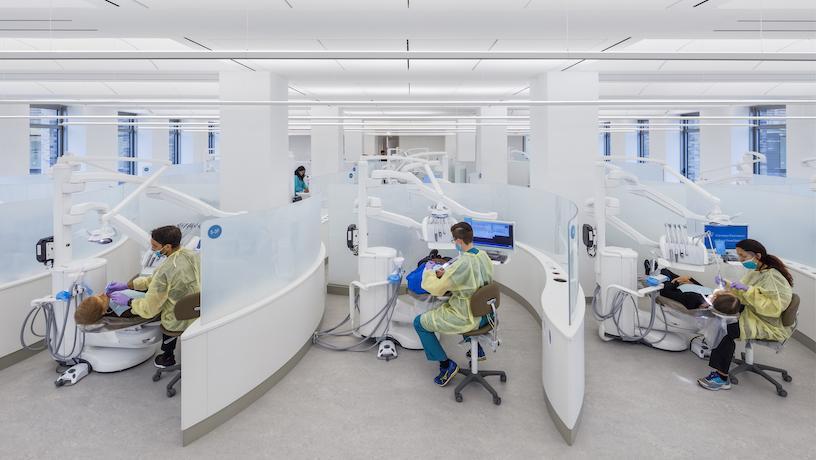
We celebrated our graduates’ senior design projects. We partnered with the dental school to launch a new program in dental engineering. Along with our colleagues at Columbia Business School, we graduated the first cohort of MBAxMS students. The Columbia University Formula Racing team made an impressive showing at the national competition, and the Columbia Space Institute’s rocketry team brought home a gold (and set its own records) at the inaugural FAR-OUT competition in the Mojave Desert. Our faculty partnered with collaborators across disciplines to teach courses on the social implications of AI and the political impact of algorithms and machine learning. Researchers in the storied Carleton Laboratory worked with the city to restore the pumps in the Morningside Park pond.
Driving the Dialogue
We launched The Lever, a limited-series newsletter featuring faculty perspectives on global challenges. The first series explored solutions for storing renewable energy. We also kicked off the Lecture Series in AI. In one of the first talks, the legendary deep-learning researcher Yann LeCun, who is Meta’s chief AI scientist, delivered a talk to more than 1,000 attendees. Media outlets across the world tapped our researchers’ expertise in articles and video on topics from digital twins in biomedical research to desalination technology and intelligent robots— and every aspect of AI. Kristen Myers and Christine Hendon challenged us to imagine how engineers can improve women’s health, and Pierre Gentine asked if AI could save the environment. Tal Danino dazzled readers with an art book featuring research inspired images from his lab.
Celebrating Faculty Excellence
Columbia Engineering celebrated the election of faculty members Jingguang Chen and Jeannette Wing to the National Academy of Engineering and congratulated Marco Giometto, Alex Urban, and Brian Smith on their NSF CAREER awards. We commended Gordana Vunjak-Novakovic on winning a Chan Zuckerberg Biohub New York Investigator Award. We were pleased to share that Oleg Gang was named a 2024 Vannevar Bush Fellow, that Ke Cheng received the Coulter Award, that Christos Papadimitriou and Michael Weinstein were named Simons Society Senior Fellows. We congratulated Vishal Misra on his appointment to vice dean of computing and artificial intelligence and John Kymissis on being named vice dean of infrastructure and innovation, and Kymissis' election to the National Academy of Inventors.