The Future of Software-Controlled Cooking
Watch how Columbia mechanical engineers constructed a cheesecake using 3D food printing techniques.
Research produced by Dr. Jonathan Blutinger and his team at the Creative Machine Labs at Columbia University (directed by Prof. Hod Lipson) and Prof. Christen Cooper, Pace University Nutrition and Dietetics.
Addressing food printing challenges
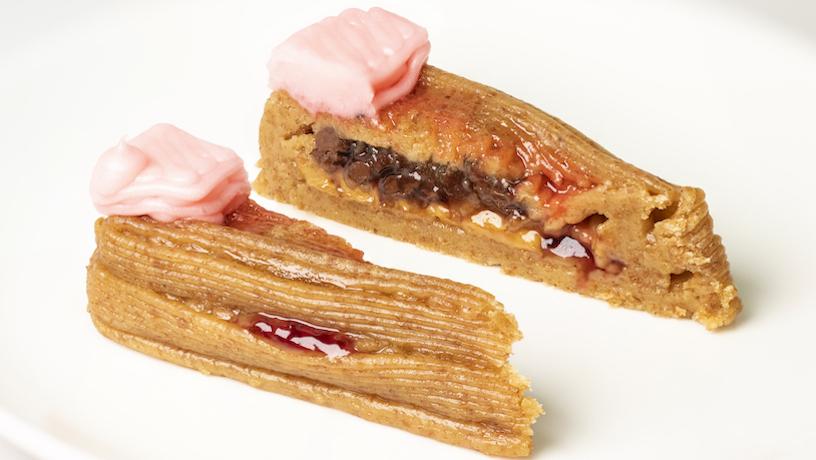
Food printing technology has existed since Lipson’s lab first introduced it in 2005, but to date the technology has been limited to a small number of uncooked ingredients, resulting in what many perceive as less than appetizing dishes. Blutinger’s team broke away from this limitation by printing a dish comprising seven ingredients, cooked in situ using a laser. For the paper, the researchers designed a 3D-printing system that constructs cheesecake from edible food inks — including peanut butter, Nutella, and strawberry jam. The authors note that precision printing of multi-layered food items could produce more customizable foods, improve food safety, and enable users to control the nutrient content of meals more easily.
“Because 3D food printing is still a nascent technology, it needs an ecosystem of supporting industries such as food cartridge manufacturers, downloadable recipe files, and an environment in which to create and share these recipes. Its customizability makes it particularly practical for the plant-based meat market, where texture and flavor need to be carefully formulated to mimic real meats,” Blutinger said.
To demonstrate the potential of 3D food printing, the team tested various cheesecake designs, consisting of seven key ingredients: graham cracker, peanut butter, Nutella, banana puree, strawberry jam, cherry drizzle, and frosting. They found that the most successful design used a graham cracker as the foundational ingredient for each layer of the cake. Peanut butter and Nutella proved to be best used as supporting layers that formed “pools” to hold the softer ingredients: banana and jam. Multi-ingredient designs evolved into multi-tiered structures that followed similar principles to building architectures; more structural elements were needed to support softer substrates for a successful multi-ingredient layered print.
Is 3D food printing healthy?
“We have an enormous problem with the low-nutrient value of processed foods,” Cooper said. “3D food printing will still turn out processed foods, but perhaps the silver lining will be, for some people, better control and tailoring of nutrition--personalized nutrition. It may also be useful in making food more appealing to those with swallowing disorders by mimicking the shapes of real foods with the pureed texture foods that these patients--millions in the U.S. alone--require.”
The potential of 3D food-printing
Laser cooking and 3D food printing could allow chefs to localize flavors and textures on a millimeter scale to create new food experiences. People with dietary restrictions, parents of young children, nursing home dieticians, and athletes alike could find these personalized techniques very useful and convenient in planning meals. And, because the system uses high-energy targeted light for high-resolution tailored heating, cooking could become more cost-effective and more sustainable.
“The study also highlights that printed food dishes will likely require novel ingredient compositions and structures, due to the different way by which the food is ‘assembled,’ ” said Lipson. “Much work is still needed to collect data, model, and optimize these processes.”
Blutinger added, “And, with more emphasis on food safety following the COVID-19 pandemic, food prepared with less human handling could lower the risk of foodborne illness and disease transmission. This seems like a win-win concept for all of us.”
About the Study
JOURNAL: npj Science of Food
STUDY: “The Future of Software-Controlled Cooking”
AUTHORS: Jonathan David Blutinger (1, Christen Cupples Cooper (2), Shravan Karthik(1), Alissa Tsai (1), Noa Samarelli (1), Erika Storvick (1), Gabriel Seymour (1), Elise Liu (1), Yoran Meijers (1,3) and Hod Lipson (1)
- Department of Mechanical Engineering, Columbia Engineering
- Department of Nutrition and Dietetics, Pace University
- Department of Food Technology, Wageningen University, Netherlands.
FUNDING: The study was supported by NSF AI Institute for Dynamical Systems, grant 2112085, and by a grant from the Redefine Meat Ltd.
The authors declare no financial or other conflicts of interest.
In Brief: Professors Chris Wiggins and Matthew Jones on "How Data Happened'
Two professors, two fields, two schools. A data scientist and applied mathematician teaching with an expert on the history of science and technology. One class, one book, one vision. We went behind the scenes with Columbia's two professors for a brief exchange on their book "How Data Happened" which emerged from their class "Data: Past, Present, and Future." (Photo Credit: Jane Nisselson)
While it is widely believed that data is an unbiased, objective numerical tool, Wiggins and Jones challenge this notion by using history to illustrate how data wields considerable power in shaping our perception of the absolute truth. “It was a realization for me, and I think for many other technologists over the last, let's say, six or seven years, that data and data science rearranges power,” Wiggins acknowledged. “Something we've talked about in class is how much of the history was shaped by people who had some interest, created some new capabilities, and every one of those capabilities rearranged power.”
“We begin the book at the end of the 18th century because that's when there's an explosion of the idea that somehow numerical data is more reliable; it might be more appropriate for understanding not just the natural world, like the movement of planetary bodies, but the economic world, the social world, the political world,” Jones added. “And the explosion of that idea, from the 19th century to the present, is one of the great transformations in how we even understand the world.”
The book encourages readers to become critical thinkers when it comes to data by understanding how it is embedded in particular power dynamics that affect our daily lives, such as socio-economic relationships.
“Data comes from a Latin word that means ‘to give’,” said Wiggins, “and I liked the fact that it means given, because it speaks to the way that data doesn't really invite critique, right?”
Rather than presenting data as merely quantitative versus qualitative, the authors explore the inherent “unquestioned truthiness” people often associate with numbers and the belief that having numbers makes an argument more valid than one without them.
“We want to invite people to question by looking at things historically,” Wiggins said. “Part of what the book poses is: How do we maintain some critical abilities around data?”
Following the thought-provoking panel discussion, Wiggins and Jones participated in a lively question-and-answer session with an enthusiastic and packed audience. Afterwards, the two authors signed copies of their new book, leaving attendees inspired and eager to dive into its pages.
About Chris Wiggins
Wiggins is the chief data scientist at The New York Times, since 2014, and a founding member of Columbia’s Data Science Institute; his research applies machine learning to computational biology.
About Matthew Jones
Jones studies the history of science and technology, focusing on early modern Europe and on recent information technologies.
About the Study
Journal: Nature Human Behaviour
Study title: “Neuronal activity in the human amygdala and hippocampus enhances emotional memory encoding.”
Authors: Salman Ehtesham Qasim (Department of Psychiatry, Icahn School of Medicine at Mount Sinai), Uma Rani Mohan (Surgical Neurology Branch, NINDS, National Institutes of Neurological Disorders and Stroke), Joel Stein (Department of Radiology, University of Pennsylvania), and Joshua Jacobs (Departments of Biomedical Engineering, Neurological Surgery, Columbia University). Both Qasim and Mohan were graduate students in Joshua Jacobs’ lab at Columbia Engineering when beginning this project.
This work was supported by NIH grants U01-NS113198 and R01-MH104606.
COI: The authors declare no financial or other conflicts of interest.