“The challenge in the quantum industry is no longer a science challenge: it’s becoming an engineering challenge.”
Xuanjing Chu
How was the process to figure out your method?
I’m an experimentalist, but we had to go pretty heavily into theory and modeling for this paper. Usually, you think a theory is out there in the literature, even if it’s a few decades old, and that if there isn’t a supporting theory, you’ve done something wrong in your experiments. But there was no theory for our specific experimental case! I had to learn about microwave engineering, and we had to do all the modeling and simulations ourselves. That’s a unique challenge!
What brought you to quantum, and to Columbia originally?
I did my undergraduate degree at Fudan University in Shanghai. I was leaning towards more traditional solid-state physics, but it became really exciting to see quantum computing concepts emerge. I started seeing more and more papers pop up, and I wanted to help make the impossible possible: to go from pure laboratory demonstrations to industry-level, practical techniques. I’m a superfan of science fiction, and we’re seeing the transition from the classical to the quantum world in everyday life. I want to be part of it.
I was aware of Jim’s SuperVan collaboration with Kin Chung Fong to explore novel qubits, and I also love New York City. I love to bike around the five boroughs and feel the architecture, the people, and the cultures change. It can feel like you are in different cities. I’ve loved being exposed to the complexity of New York, which gives me a nice break from the lab.
What does the quantum future hold?
The challenge in the quantum industry is no longer a science challenge: it’s becoming an engineering challenge. That will take a lot of people from different backgrounds to overcome. We live in a classical world, so quantum mechanics can feel intimidating, but don’t be afraid. Now is the time to jump in!
Xuanjing Chu is mentored by James Hone, Wang Fong-Jen Professor of Mechanical Engineering and a Columbia Quantum Initiative faculty member.
Highlights: Designing for Impact
Here’s a look at some of the capstone projects on display at Senior Design Expo 2026. Credit: Timothy Lee
Many of the projects in this year’s expo integrated AI with custom hardware. The Clinical Handwashing Coach, which tracks handwashing sessions, is being tested at a hospital in Pasadena, California. The team of electrical engineering students designed an AI system to ensure that medical professionals comply with handwashing protocols. Other teams from the department used AI to create noise-canceling headphones with real-time language detection and translation (team ANURA) and a wearable device that inexpensively creates digital transcriptions (CLACS).
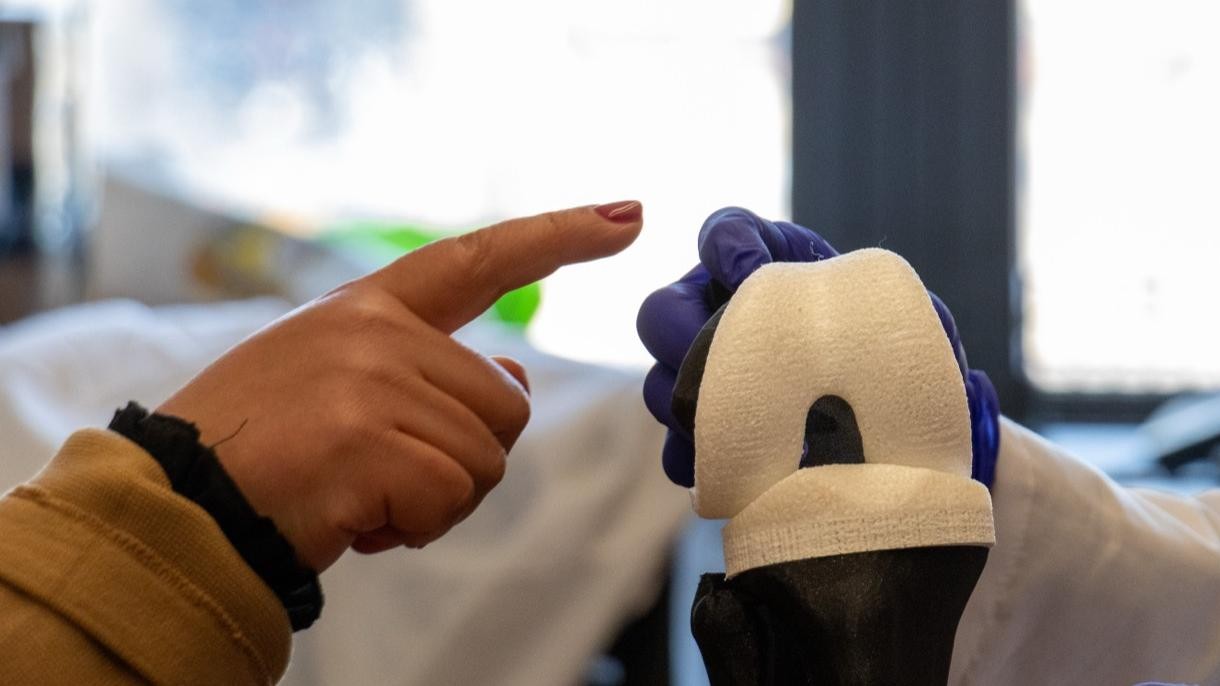
A couple of projects tackled wheelchair comfort and mobility autonomy. The Mechanical Engineering team STAR (Self-Transfer with Automated Reversing) Lift made moving in and out of a wheelchair easier for wheelchair users with upper-body mobility, allowing them to transfer themselves to a bed without assistance. Team Wheel-E created a specialized seat cushion for wheelchair users that helps alleviate the painful symptoms of prolonged sitting.
Urban green infrastructure was the main theme for many projects in the Department of Civil Engineering and Engineering Mechanics. The Morningside Park Rehabilitation Project reimagined the local neighborhood park by proposing two new community centers for public use and an upgraded drainage system that can handle heavier rainfall runoff.
From AI devices to reimagining a neighborhood park, the Class of 2026 proved that the best engineering goes beyond the classroom and makes an impact in the world.
It’s a particularly exciting moment for Columbia, where generations of researchers have been exploring the science behind fusion and chipping away at technical hurdles since the Plasma Physics Laboratory was established in 1961.
That legacy continues today. In the past year, Columbia Engineering launched a minor in fusion energy and announced the Columbia Fusion Research Center, which nurtures existing partnerships with the fusion industry and provides a framework for collaboration with new partners.
In celebration of these milestones, Columbia Engineering is focusing on fusion in the latest issue of The Lever, the School’s collection of limited-series newsletters on major problems and solutions. Subscribe today to start receiving the five-part series, “Making Fusion a Reality,” featuring faculty from Columbia Engineering, the School of International and Public Affairs, and beyond.
Meet the Contributors
Image
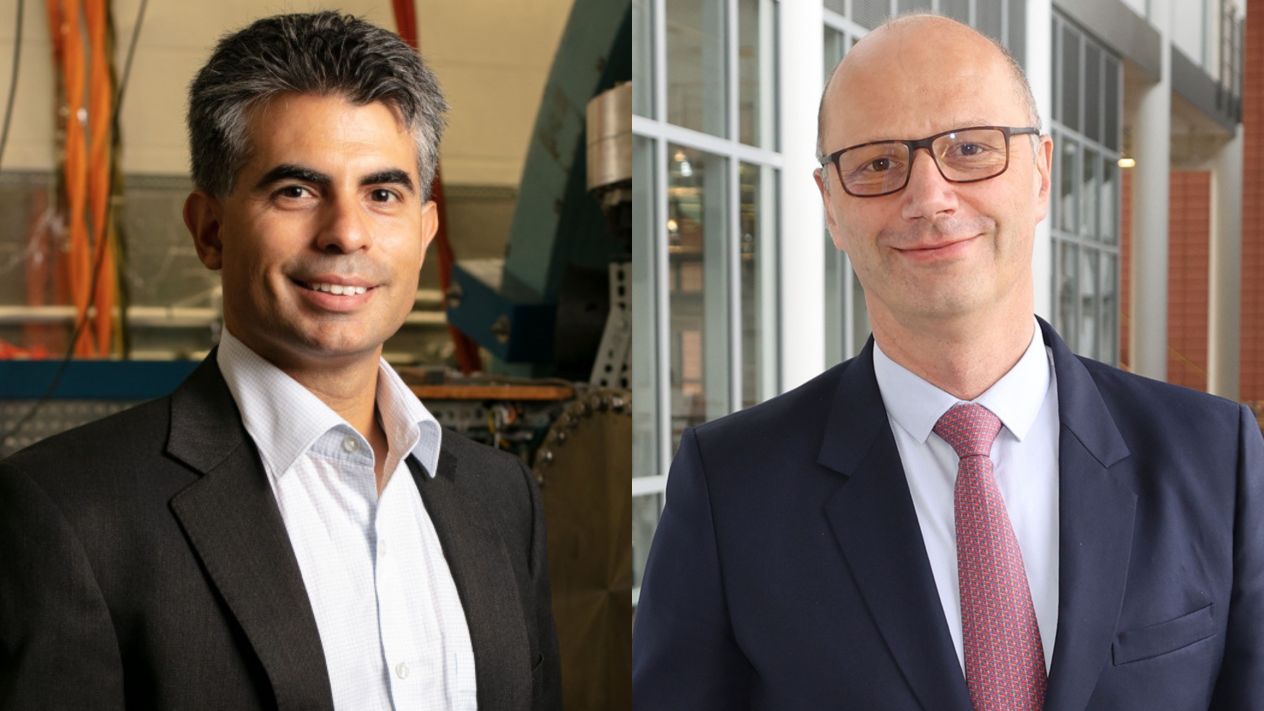
Associate professor of applied physics and applied mathematics at Columbia Engineering; Director of Columbia Fusion Research Center | Image
Assistant professor of applied physics and applied mathematics | Image
Senior research scholar in the faculty of international and public affairs |
Image
CEO of the Fusion Industry Association |