Authors: Sai Mali Ananthanarayanan, Charles C. Branas, Adam N. Elmachtoub, Clifford Stein, and Yeqing Zhou
Adds Zhou, also a co-lead author, "Our simulation model is not only general, in that it can be adapted to any number of elevators, floors, and general traffic patterns, but it also takes into account potential issues in implementation such as the impact of limited lobby space--It’s very flexible."
While these initial approaches offer simple, low-tech solutions, the team is also looking at more advanced elevator systems that would enable them to embed AI technologies to more efficiently and safely manage elevators. They are developing algorithms for moving elevators that can depend on the global state of the system, which can be measured via sensors in the elevators and waiting areas.
“We’ve simulated for different building types and calibrated data from a large New York City building,” says Stein, who is also the Associate Director of Research at the Data Science Institute. “Our proposed interventions will be useful to any high-rise building managers who are formulating reopening plans. We’re excited to be part of engineering a speedy recovery for New York City and locations around the world with a vertical transportation solution.”
For more information on implementation, building operators and facility managers can email:
[email protected].
###
Columbia Engineering
Columbia Engineering, based in New York City, is one of the top engineering schools in the U.S. and one of the oldest in the nation. Also known as The Fu Foundation School of Engineering and Applied Science, the School expands knowledge and advances technology through the pioneering research of its more than 220 faculty, while educating undergraduate and graduate students in a collaborative environment to become leaders informed by a firm foundation in engineering. The School’s faculty are at the center of the University’s cross-disciplinary research, contributing to the Data Science Institute, Earth Institute, Zuckerman Mind Brain Behavior Institute, Precision Medicine Initiative, and the Columbia Nano Initiative. Guided by its strategic vision, “Columbia Engineering for Humanity,” the School aims to translate ideas into innovations that foster a sustainable, healthy, secure, connected, and creative humanity.
Photo and Video Credit: Kindea Labs for Columbia Engineering
About The Study
The study is titled “Queuing Safely for Elevator Systems Amidst a Pandemic.”
Authors are: Sai Mali Ananthanarayanan, Adam Elmachtoub, Clifford Stein, and Yeqing Zhou (all Department of Industrial Engineering and Operations Research, Columbia Engineering), and Charles C. Branas (Mailman School of Public Health).
The study was supported by an $85,000 award under Columbia Engineering’s “Urban Living Tech Innovations” initiative to develop technology innovations for urban living in the face of COVID-19. Adam Elmachtoub and Yeqing Zhou were also supported by National Science Foundation CMMI-1944428. Cliff Stein and Sai Mali Ananthanarayanan were also supported by National Science Foundation CCF-1714818.
The authors declare no financial or other conflicts of interest.
Links
Paper: https://onlinelibrary.wiley.com/doi/10.1111/poms.13686
DOI: 10.1111/poms.13686
https://www.youtube.com/watch?v=5KvX7_WNGFw
http://engineering.columbia.edu/
https://ieor.columbia.edu/
https://datascience.columbia.edu/
https://www.publichealth.columbia.edu/
Multi-Materials 3D Printing with Laser Inversion
New York, NY—July 27, 2020—Additive manufacturing—or 3D printing—uses digital manufacturing processes to fabricate components that are light, strong, and require no special tooling to produce. Over the past decade, the field has experienced staggering growth, at a rate of more than 20% per year, printing pieces that range from aircraft components and car parts to medical and dental implants out of metals and engineering polymers. One of the most widely used manufacturing processes, selective laser sintering (SLS), prints parts out of micron-scale material powders using a laser: the laser heats the particles to the point where they fuse together to form a solid mass.
“Additive manufacturing is key to economic resilience,” say Hod Lipson, James and Sally Scapa Professor of Innovation (Mechanical Engineering). “All of us care about this technology—it’s going to save us. But there’s a catch.”
The catch is that SLS technologies have been limited to printing with a single material at a time: the entire part has to be made of just that one powder. “Now, let me ask you,” Lipson continues, “how many products are made of just one material? The limitations of printing in only one material has been haunting the industry and blocking its expansion, preventing it from reaching its full potential.”
Wondering how to solve this challenge, Lipson and his PhD student John Whitehead used their expertise in robotics to develop a new approach to overcome these SLS limitations. By inverting the laser so that it points upwards, they invented a way to enable SLS to use—at the same time—multiple materials. Their working prototype, along with a print sample that contained two different materials in the same layer, was recently published online by Additive Manufacturing as part of its December 2020 issue.
“Our initial results are exciting,” says Whitehead, the study’s lead author, “because they hint at a future where any part can be fabricated at the press of a button, where objects ranging from simple tools to more complex systems like robots can be removed from a printer fully formed, without the need for assembly.”
Selective laser sintering traditionally has involved fusing together material particles using a laser pointing downward into a heated print bed. A solid object is built from the bottom up, with the printer placing down a uniform layer of powder and using the laser to selectively fuse some material in the layer. The printer then deposits a second layer of powder onto the first layer, the laser fuses new material to the material in the previous layer, and the process is repeated over and over until the part is completed.
This process works well if there is just one material used in the printing process. But using multiple materials in a single print has been very challenging, because once the powder layer is deposited onto the bed, it cannot be unplaced, or replaced with a different powder.
“Also,” adds Whitehead, “in a standard printer, because each of the successive layers placed down are homogeneous, the unfused material obscures your view of the object being printed, until you remove the finished part at the end of the cycle. Think about excavation and how you can’t be sure the fossil is intact until you completely remove it from the surrounding dirt. This means that a print failure won’t necessarily be found until the print is completed, wasting time and money.”
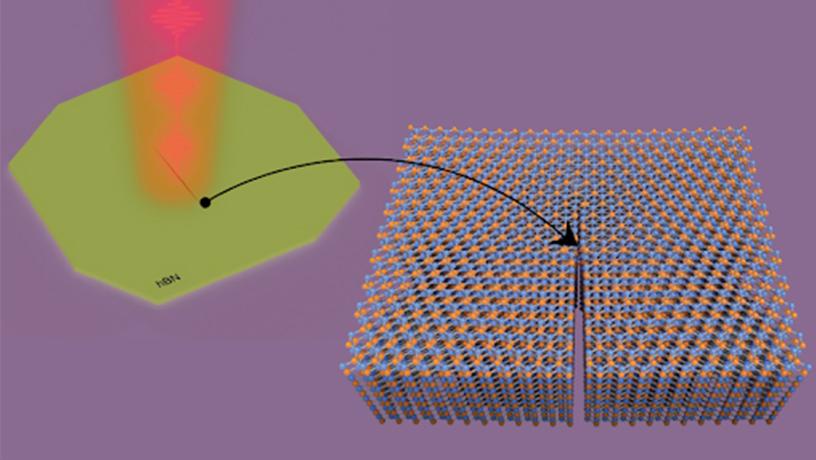
The researchers decided to find a way to eliminate the need for a powder bed entirely. They set up multiple transparent glass plates, each coated with a thin layer of a different plastic powder. They lowered a print platform onto the upper surface of one of the powders, and directed a laser beam up from below the plate and through the plate’s bottom. This process selectively sinters some powder onto the print platform in a pre-programmed pattern according to a virtual blueprint. The platform is then raised with the fused material, and moved to another plate, coated with a different powder, where the process is repeated. This allows multiple materials to either be incorporated into a single layer, or stacked. Meanwhile, the old, used-up plate is replenished.
In the paper, the team demonstrated their working prototype by generating a 50 layer thick, 2.18mm sample out of thermoplastic polyurethane (TPU) powder with an average layer height of 43.6 microns and a multi-material nylon and TPU print with an average layer height of 71 microns. These parts demonstrated both the feasibility of the process and the capability to make stronger, denser materials by pressing the plate hard against the hanging part while sintering.
“This technology has the potential to print embedded circuits, electromechanical components, and even robot components. It could make machine parts with graded alloys, whose material composition changes gradually from end to end, such as a turbine blade with one material used for the core and different material used for the surface coatings,” Lipson notes. “We think this will expand laser sintering towards a wider variety of industries by enabling the fabrication of complex multi-material parts without assembly. In other words, this could be key to moving the additive manufacturing industry from printing only passive uniform parts, towards printing active integrated systems.”
The researchers are now experimenting with metallic powders and resins in order to directly generate parts with a wider range of mechanical, electrical, and chemical properties than is possible with conventional SLS systems today.
Columbia Engineering
Columbia Engineering, based in New York City, is one of the top engineering schools in the U.S. and one of the oldest in the nation. Also known as The Fu Foundation School of Engineering and Applied Science, the School expands knowledge and advances technology through the pioneering research of its more than 220 faculty, while educating undergraduate and graduate students in a collaborative environment to become leaders informed by a firm foundation in engineering. The School’s faculty are at the center of the University’s cross-disciplinary research, contributing to the Data Science Institute, Earth Institute, Zuckerman Mind Brain Behavior Institute, Precision Medicine Initiative, and the Columbia Nano Initiative. Guided by its strategic vision, “Columbia Engineering for Humanity,” the School aims to translate ideas into innovations that foster a sustainable, healthy, secure, connected, and creative humanity.
ABOUT THE STUDY
The study is titled “Inverted multi-material laser sintering.”
Authors are: John Whitehead and Hod Lipson, Mechanical Engineering, Columbia Engineering.
The authors declare no financial or other conflicts of interest.
The Big Idea - Reimagining the Battery
Conscientious consumers are always on the lookout for ways to limit carbon footprints, whether driving hybrids, installing solar panels or purchasing sustainably-sourced goods. But those results can be a drop in the bucket beside massive systemic emissions—measured in hundreds of billions of tons—stemming from key industrial sectors like construction and big data. Just cleaning up these two fields could be a game changer in the fight against climate change.
Take your home, for instance. Better insulation and more weather stripping are decent ways to increase a building’s efficiency after the fact, but by the time it’s been built tons of carbon emissions have already been baked in: conventional processes for manufacturing cement and steel currently account for 11% of all anthropogenic greenhouse gas emissions, and that’s likely to double by 2050 absent urgent innovation.
Ah-Hyung (Alissa) Park, Lenfest Earth Institute Associate Professor of Climate Change in earth and environmental engineering, as well as an associate professor in chemical engineering and director of the Lenfest Center for Sustainable Energy, is also cofounder of the Columbia startup GreenOre CleanTech. The company utilizes her patented methods for harvesting carbon and valuable chemical products from iron and steel waste known as slag. In addition to deploying their methods in China, where they have a commercial plant in the works, she and her team are also partnering with the state of Wyoming to replace standard cement production with a greener approach recycling ash from power plants into a variety of useful materials.
With cement processing alone generating around five percent of humans’ greenhouse gas emissions, going carbon-neutral would be transformative—but carbon-negative could be revolutionary. Professors Daniel Esposito and Shiho Kawashima are working on a new cement alternative that could help lay the foundation for a greener urban landscape. Synthesized from seawater, their material can withstand as much weight as the industry standard while absorbing substantial amounts of CO2. They’re currently translating their research into scalable production processes for future construction.
“We’re getting promising results in the lab, so we plan to do lifecycle analysis and techno-economic analysis to demonstrate our technology’s environmental benefits and economic viability,” Kawashima says.
While less conspicuous, data infrastructure is on pace to become another enormous source of emissions. Moving, storing, and particularly processing the trillions of gigabytes so effortlessly at our fingertips requires a vast amount of energy. If present trends continue, the information economy could soon produce half as many greenhouse gases as the entire transportation sector, with cloud computing consuming a fifth of the world’s electricity. As is, data centers already cause nearly two percent of our total carbon output—and that’s while we’re still at the dawn of artificial intelligence. Training algorithms require gigawatts of power, and the energy costs of rapidly proliferating AI could be staggering.
That’s partially because our wireless lifestyles actually rely on a vast tangle of inefficient electronic wiring, fundamentally the same materials we’ve been using since the 1940s. Professors Keren Bergman and Michal Lipson, however, are reconceiving the mechanics of computation using a whole new framework: frictionless optical components. Fiberoptics already use this principle to transfer data over long distances—but such bulky systems have proved incompatible with today’s data centers. Lipson and Bergman’s “photonic” elements neatly sidestep that issue by encoding data in the form of light directly on the chip.
Lipson’s group recently had a breakthrough pairing an optical funnel with optical fiber to achieve highly efficient high-bandwidth transmissions even when components weren’t in perfect alignment, while Bergman’s group in the Lightwave Research Laboratory just won a $4.8 million DARPA grant to develop efficient optical interconnects for feeding high-bandwidth signals from chips to anywhere in a computing system. Such advances could one day soon allow artificial intelligence to reach unlimited potential without consuming unreasonable amounts of energy.