In 1925, Max Born coined “quantum mechanics” to explain, under one theory, the growing number of observations that were physics. Its basic tenets: quantum objects are simultaneously particles, with masses, charges, and discrete amounts of energy called quanta, and waves, with given frequencies and wavelengths. These quantum objects, which include electrons and photons of light, can combine in unique and often counterintuitive ways.
Though scientists in Europe initially developed the theory, Columbia has had a part in quantum history since its earliest days. In 1909, Max Planck brought the concept of energy quanta — the idea that would eventually lend the field its name — to North America in a series of lectures at Columbia. In the coming decades, as theory gave way to applications, Columbians made several Nobel Prize-worthy quantum discoveries that led to now commonplace technologies, including:
- I.I. Rabi’s observations of magnetic resonance, which led to today’s magnetic resonance imaging (MRI).
- Charles Townes’ amplified electromagnetic waves; the result, lasers, are just about everywhere.
- Louis Brus’s connection between a particle’s size and the color of light it emits; these quantum dots have found applications in LED displays, solar panels, and biological sensors.
Today, Columbia’s researchers are creating entirely new materials with unique quantum properties, controlling individual photons of light and entangling them together, and developing theories to guide quantum research into its second century. So, what’s to come? Columbia Engineers share where they think the (quantum) world is heading:
“One hundred years is a pretty long time. Perhaps we will have a quantum computer with a wide variety of applications — ones we aren’t even thinking about now. Quantum sensors may also become ubiquitous, all linked through a network and with capabilities we haven’t even dreamed of yet. I think a lot of it will hinge on these technologies that we’re working on here.”
Alexander Gaeta
David M. Rickey Professor of Applied Physics and Materials Science, Professor of Electrical Engineering, and co-lead of the Columbia Quantum Initiative.
Gaeta studies how laser light interacts with matter.
“We’ve been studying quantum systems for several decades already, but it’s been remarkable to see how quickly the field has grown recently. I’m particularly excited about using present-day quantum devices to simulate complex quantum materials and resolve long-standing, fundamental questions about how many electrons interact to create complex emergent behavior. There’s a lot of synergy here that could help us discover materials that revolutionize how we store energy, perform classical computing, and more in this century.”
Assistant Professor of Applied Physics and Applied Mathematics Devarakonda combines physics, chemistry, and materials science to create and study quantum materials.
“In the next 100 years, the way we vote, earn, spend, negotiate, medicate, dress, compute, communicate, sense, and think will rely on harnessing the counter-intuitive laws of quantum mechanics. Just as the steam engine and electricity have transformed civilization, there will be no aspect of everyday life untouched by the fact that nature is quantum mechanical.”
Srivani Family Associate Professor of Computer Science. Yuen studies the theoretical foundations of quantum computing.
“We’ve seen the story before with quantum dots, and lasers, and other quantum advances: a curiosity in the lab becomes a breakthrough that becomes routine and used everywhere. We’re in the earliest stages with new kinds of quantum materials and what they will enable, but some of our lab curiosities will translate and scale into real devices.”
Wang Fong-Jen Professor of Mechanical Engineering. Hone studies the fundamental properties of 2D materials and their potential applications.
The next 100 years will likely be the most exciting time for quantum technology as we build the promises from decades ago into a reality. Quantum sensing, simulation, and computing will transition from initial demonstrations to useful technologies and beyond. In the end, quantum science may stop being ‘quantum’: it will just be technology, like semiconductors or AI today.
Sherry Zhang
Assistant Professor of Applied Physics and Applied Mathematics
“While quantum computing currently gets much of the attention, quantum sensing may ultimately prove equally, if not more, impactful. The so-called quantum advantage originates from coherent states and quantum- entangled systems, enabling, for example, deep-brain imaging with photons that never touch the sample and detection of gravitational waves. By reducing noise and increasing precision by orders of magnitude, quantum sensing will become critical to fields spanning medical diagnostics to space travel. We have only begun to scratch the surface.”
Professor of Mechanical Engineering. Schuck builds tools that can control single photons and electrons.
Described in a study published Dec. 8 in Nature Electronics, BISC includes a single-chip implant, a wearable “relay station,” and the custom software required to operate the system. “Most implantable systems are built around a canister of electronics that occupies enormous volumes of space inside the body,” says Ken Shepard, Lau Family Professor of Electrical Engineering, professor of biomedical engineering, and professor of neurological sciences at Columbia University, who is one of the senior authors on the work and guided the engineering efforts. “Our implant is a single integrated circuit chip that is so thin that it can slide into the space between the brain and the skull, resting on the brain like a piece of wet tissue paper.”
Shepard was joined in the BISC effort by senior and co-corresponding author Andreas S. Tolias, PhD, professor at the Byers Eye Institute at Stanford University and co-founding director of the Enigma Project. Tolias’s pioneering work training AI models on large-scale neural datasets — including datasets recorded in the Tolias laboratory using BISC — enabled the team to evaluate the device’s neural decoding performance. “BISC turns the cortical surface into an effective portal, delivering high-bandwidth, minimally invasive read–write communication with AI and external devices,” Tolias says. “Its single-chip scalability paves the way for adaptive neuroprosthetics and brain-AI interfaces to treat many neuropsychiatric disorders, such as epilepsy.”
Dr. Brett Youngerman, assistant professor of neurological surgery at Columbia University and a neurosurgeon at NewYork-Presbyterian/Columbia University Irving Medical Center, served as the chief clinical collaborator on the project. “This high-resolution, high-data-throughput device has the potential to revolutionize the management of neurological conditions from epilepsy to paralysis,” he says. Youngerman, Shepard, and NewYork-Presbyterian/Columbia epilepsy neurologist Dr. Catherine Schevon were recently awarded a grant from the National Institutes of Health to implement BISC in the management of drug-resistant epilepsy. “The key to effective brain-computer interface devices is to maximize the information flow to and from the brain, while making the device as minimally invasive in its surgical implantation as possible. BISC surpasses previous technology on both fronts,” continues Youngerman.
“Semiconductor technology has made this possible, allowing the computing power of room-sized computers to now fit in your pocket,” Shepard says. “We are now doing the same for medical implantables, allowing complex electronics to exist in the body while taking up almost no space.”
Smaller, Safer, and Faster
BCIs work by interfacing with the electrical signals that neurons use to transfer information throughout the brain. Today’s state-of-the-art BCIs, used in medical contexts, are constructed from individual microelectronic components, including amplifiers, data converters, radio transmitters, and power management circuits. To accommodate all these devices, a large canister of electronics must be surgically implanted in the body, either by removing a portion of the skull or by placing the device in another location, such as the chest, and running wires to the brain.
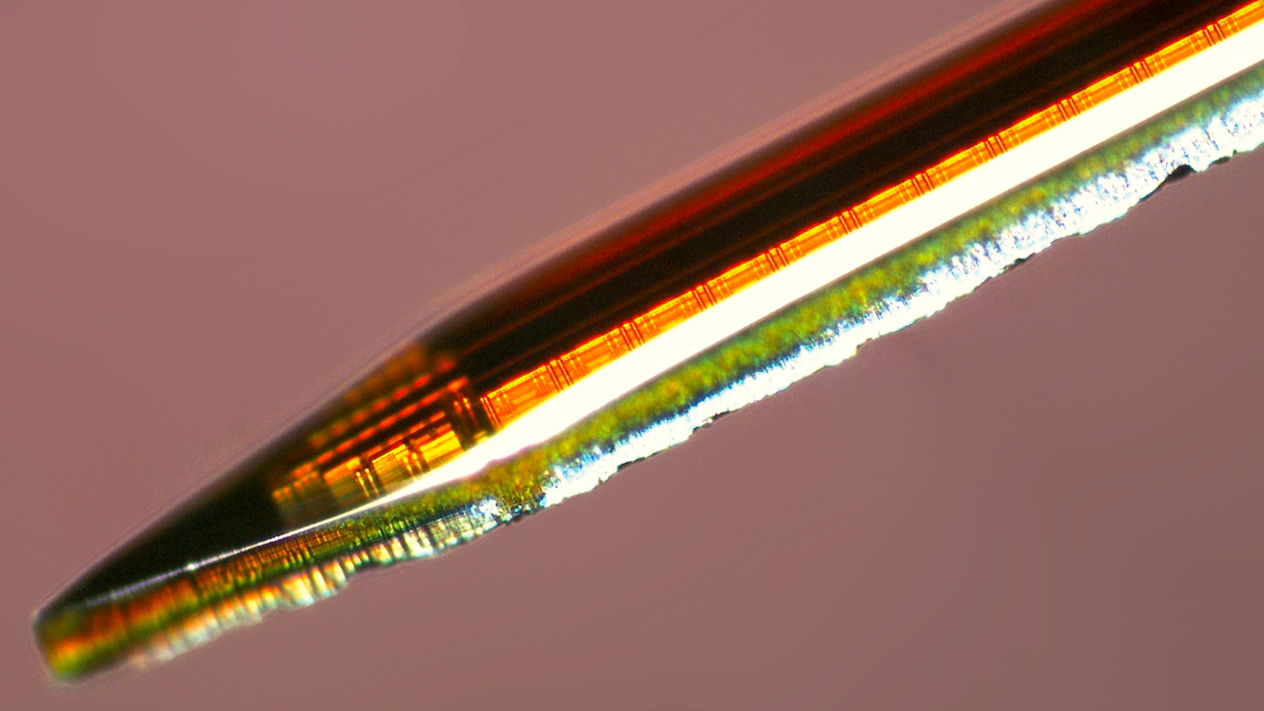
BISC works differently. The entire implant, which occupies less than 1/1000th the size of a conventional device, is a single complementary metal-oxide-semiconductor (CMOS) integrated circuit chip thinned to just 50 μm. With a total volume of approximately 3 mm³, the flexible chip conforms to the surface of the brain. This micro-electrocorticography (µECoG) device integrates 65,536 electrodes, 1,024 simultaneous recording channels, and 16,384 stimulation channels. By leveraging the large-scale manufacturing techniques developed in the semiconductor industry, these implants can be easily manufactured at scale.
The single-chip implant includes a radio transceiver, wireless powering circuit, digital control, power management, data conversion, and the analog circuits required to support the recording and stimulation interfaces. The battery-powered relay station powers and communicates with the implant, transferring data via a custom ultrawideband radio link that achieves 100 Mbps data bandwidths — a connection with at least 100 times higher throughput than any competing wireless BCI device. The relay station is itself an 802.11 WiFi device, in effect forming a relayed wireless network connection from any computer to the brain.
BISC has its own instruction set, supported by an extensive software stack, which together constitute a computing architecture designed for BCIs. As demonstrated in this study, these high-bandwidth recording capabilities allow brain-signal patterns to be submitted to advanced machine-learning or deep-learning frameworks for decoding complex intentions, perceptions, or states.
“By integrating everything on one piece of silicon, we’ve shown how brain interfaces can become smaller, safer, and dramatically more powerful,” Shepard says.
The BISC implant was manufactured using TSMC’s versatile 0.13-μm Bipolar-CMOS-DMOS (BCD) technology. This manufacturing process integrates three technologies onto a single chip to create mixed-signal integrated circuits (ICs). This integration enables the efficient combination of digital logic (from CMOS), high-current and high-voltage analog functions (from bipolar and DMOS transistors), and power devices (from DMOS), all of which are essential for BISC.
From Lab to Clinic
To make this technology available to doctors and patients, Shepard’s group partnered closely with Youngerman at NewYork-Presbyterian/Columbia University Irving Medical Center. Together, they refined surgical methods to safely implant the paper-thin device in a preclinical model and demonstrated its recording quality and stability, as described in the current study. Studies in human patients for short-term intraoperative recordings are underway.
“These initial studies give us invaluable data about how the device performs in a real surgical setting,” Youngerman says. “The implants can be inserted through a minimally invasive incision in the skull and slid directly onto the surface of the brain in the subdural space. The paper-thin form factor and lack of brain-penetrating electrodes or wires tethering the implant to the skull minimize tissue reactivity and signal degradation over time.”
Extensive pre-clinical testing of BISC in the motor and visual cortices drew on collaborations with both Dr. Tolias and Bijan Pesaran, professor of neurosurgery at the University of Pennsylvania, both of whom are leaders in computational and systems neuroscience.
“The extreme miniaturization by BISC is very exciting as a platform for new generations of implantable technologies that also interface with the brain with other modalities such as light and sound,” Pesaran says.
Developed under the Neural Engineering System Design program of the Defense Advanced Research Projects Agency (DARPA), BISC combines Columbia’s strengths in microelectronics, Stanford’s and Penn’s cutting-edge neuroscience, and NewYork-Presbyterian/Columbia University Irving Medical Center’s surgical innovation.
Toward Real-World Applications
To accelerate translation, the Columbia and Stanford teams launched Kampto Neurotech, a spin-off company founded by Columbia electrical engineering alumnus Dr. Nanyu Zeng, one of the project’s lead engineers. Kampto Neurotech is developing commercial versions of the chip for preclinical research applications and raising funds to advance the system toward human use.
“This is a fundamentally different way of building BCI devices,” Zeng says. “In this way, BISC has technological capabilities that exceed those of competing devices by many orders of magnitude.”
In a technological landscape driven by advances in artificial intelligence, BCI technologies have drawn considerable recent interest in both restoring function to those affected by neurological conditions and in potentially augmenting human capabilities by providing direct interfaces to the brain.
“By combining ultra-high resolution neural recording with fully wireless operation, and pairing that with advanced decoding and stimulation algorithms, we are moving toward a future where the brain and AI systems can interact seamlessly — not just for research, but for human benefit,” says Shepard. “This could change how we treat brain disorders, how we interface with machines, and ultimately how humans engage with AI.”
Lead Photo Caption: The BISC implant shown here is roughly as thick as a human hair.
Lead Photo Credit: Columbia Engineering
About The Study
Journal: Nature Electronics
DOI: 10.1038/s41928-025-01509-9
Title: Stable, chronic in-vivo recordings from a fully wireless subdural-contained 65,536-electrode brain-computer interface device
Authors: Taesung Jung, Nanyu Zeng, Jason D. Fabbri, Guy Eichler, Zhe Li, Erfan Zabeh, Anup Das, Konstantin Willeke, Katie E. Wingel, Agrita Dubey, Rizwan Huq, Mohit Sharma, Yaoxing Hu, Girish Ramakrishnan, Kevin Tien, Paolo Mantovani, Abhinav Parihar, Heyu Yin, Denise Oswalt, Alexander Misdorp, Ilke Uguz, Tori Shinn, Gabrielle J. Rodriguez, Cate Nealley, Sophia Sanborn, Ian Gonzales, Michael Roukes, Jeffrey Knecht, Daniel Yoshor, Peter Canoll, Eleonora Spinazzi, Luca P. Carloni, Bijan Pesaran, Saumil Patel, Joshua Jacobs, Brett Youngerman, R. James Cotton, Andreas Tolias, Kenneth L. Shepard
Funding/Acknowledgments: This work was partly supported by the Defense Advanced Research Projects Agency (DARPA) under Contract N66001-17-C-4001, the Department of the Defense Congressionally Directed Medical Research Program under Contract HT9425-23-1-0758, the National Science Foundation under Grant 1546296, and the National Institutes of Health under Grant R01DC01949