Event highlights
Credit: Diane Bondareff/Columbia University
Recognizing the importance of open conversations about career journeys, Columbia Engineering Dean Shih-Fu Chang and Columbia University Interim President Katrina Armstrong, both joined the event; Dean Chang gave introductory remarks and President Armstrong kicked off the discussion and shared her own experience as a woman in STEM.
Armstrong talked about her unconventional career path– from studying architecture as an undergraduate to completing medical school and ultimately rising through the ranks in higher education in leadership roles at the University of Pennsylvania, Harvard, and now, at Columbia. She encouraged attendees to regularly check in with themselves, emphasizing the importance of making changes before reaching burnout. She also highlighted the value of finding what works for each individual. She shared a personal anecdote about how she became known for letting her kids sleep in their school clothes instead of pajamas—a simple adjustment that made hectic mornings a little easier.
“The best advice I ever received was to be yourself because you're not going to change who you are,” Armstrong said. “And if you try to be somebody else, you're going to be so much less effective than just being who you are.”
Building connections
The second half of the event consisted of breakout sessions between small groups of students and women faculty members from across Columbia. With cups of coffee in hand, students and professors–women in STEM– exchanged stories, laughter, and insights.
A common theme professors shared with students was the importance of advocating for yourself and pursuing what you're passionate about. University Professor and Mikati Foundation Professor of Biomedical Engineering Gordana Vunjak-Novakovic emphasized that when you truly love what you do, it never feels like work—even when challenges arise. Christine Hendon, associate professor of electrical engineering, encouraged students to believe in themselves, even when others doubt their ideas.
"If someone says it won’t work, figure it out, run some simulations, test for tolerance analysis, and if it looks feasible—go for it," Hendon said. "When you finally get to the point where it works, it’s the best feeling ever.”
In this relaxed setting, conversations flowed and what started as casual chats soon turned into meaningful discussions about careers, research, and personal experiences.
“This event showcases the magic of Columbia,” said Githika, “and how there is a community that wants to not just collaborate with each other, but grow with each other.”
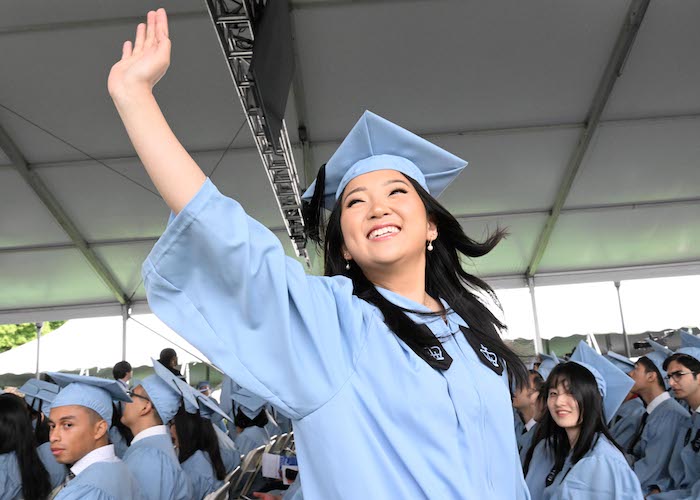
Lead Photo Caption: Columbia faculty, students and staff gathered in Carleton Commons March 7 for a special networking opportunity for women in STEM.
Lead Photo Credit: Diane Bondareff/Columbia University
“Many people truly grasped AI’s rapid evolution when ChatGPT emerged, but AI research at Columbia had been thriving for years,” said Vishal Misra, vice dean for computing and AI at Columbia Engineering and professor of computer science. “This event was a chance to spotlight the work happening across the University and underscore our unique interdisciplinary approach to AI.”
Columbia leverages its broad academic strengths to explore AI beyond just technological development from medicine to law and business to journalism.
“AI is transforming every field,” said Richard Zemel, the Trianthe Dakolias Professor of Engineering and Applied Science in the Department of Computer Science, and event co-host. “Columbia’s approach ensures we are not just advancing AI technology, but also examining its broader implications and shaping policies for its responsible use.”
A showcase and network opportunity
“I'm a researcher and I love to share what I've been doing,” said Yunzhu Li, assistant professor of computer science. Li and his students presented a robot equipped with advanced tactile sensors that significantly improved its ability to perform tasks requiring precise gripping. Li emphasized the importance of participating in these types of demo events, noting that they create valuable opportunities for collaboration.
“These sessions open the door for partnerships with fellow professors and, of course, students who can bring fresh ideas and perspectives to the research,” he added.
Demo Session Highlights
Photo Credit: David Dini/Columbia Engineering
The steady hum of conversation between participants and the crowd of attendees filled the space, and discussions ranged from technical breakthroughs to real-world applications of the projects.
“We have only scratched the surface with our research and need more collaborators,” said Judah Goldfelder, a demo session participant and Engineering PhD student in the Creative Machines Lab. His project, developed in partnership with Google, focused on reducing buildings’ carbon emissions by five percent. Advocating for an open-source model, he convinced Google to make the project publicly accessible, enabling contributors to collaborate via GitHub.
This initiative produced a publicly available toolkit to help researchers develop AI-powered heating and cooling systems, reducing energy waste and pollution. The open-source benchmark aims to standardize research efforts in this area and foster collaboration across institutions. “Scaling this project requires more collaborators, and I got a lot of inquiries about the project at this event,” Goldfelder said.
The AI demo session featured 13 projects from across the School. Visit this project page for a list of the day’s demo descriptions and participants.
Lead Photo Credit: David Dini/Columbia Engineering