
Umut Cakar
Umut Cakar
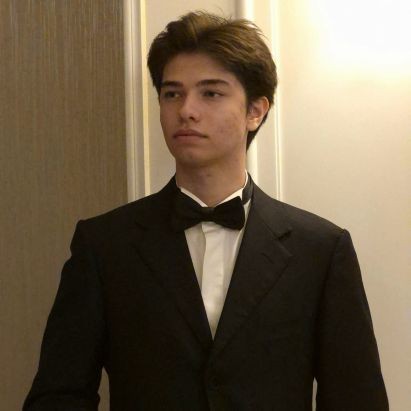
Umut Cakar comes from Turkiye, where he attended the TED Ankara College High School. At Columbia, he aims to major in electrical engineering and minor in computer science.
In his sophomore year, Umut joined the national TUBITAK research competition with his friend where they had to blend physics and biomimicry, and came up with a 3D-printed concrete structure design that mimicked caterpillars’ body geometry to improve seismic-resistance. As this experience made him curious about out-of-the-box engineering inventions, he decided to combine his passion for robotics with bio-inspired technologies to help address the earthquake vulnerability of his country.
Collaborating with MIT alum Dr. Sergio Navarro in his junior year, Umut began researching snake-inspired robots that could navigate tight spaces during search and rescue operations. Building his own snakebot prototype and simulation pipeline, he conducted a study comparing how two biomimetic locomotion gaits performed against the challenging terrains of post-earthquake environments. In October 2025, Umut’s paper was published in the IEEE Safety, Security and Rescue Robotics Conference, named as “the stepping stone between biomimetics and safety robotics”. He later won the Rising Star Award for being the first high school student to present in IEEE SSRR history.
Beyond this, Umut has been involved in a wide range of academic and professional ventures from machine learning to business strategy. He studied AI for autonomous vehicles at Harvard Summer School, was a LaunchX summer consultant for NewMail.ai, served as the chief editor of his school’s humanities journal and led Locke Finance Technologies to national finals in TEKNOFEST’s annual startup competition. In addition, he has a deep passion for physics and has served as the vice president of team AstroTED in CERN’s particle physics competition. Here, Umut researched proton radiation with Professor Omer Yavas, founder of Turkish Accelerator and Radiation Laboratory, and designed a physics simulation to test NASA’s new spacesuit materials (BNNTs and hydrogen-rich polymers) against galactic cosmic rays.
In his free time, Umut enjoys spending time in nature, working out, reading, watching movies, playing classical guitar and bullet chess. Throughout his time in New York City, he is excited to explore thrift shops, make new friends and try foods from different cultures. Looking ahead, Umut is eager to use electrical engineering and computer science to explore the intersection of hardware and software to create novel technologies that protect and support human life.