
Campus
Building a Road to Space
CEO David Limp told students about his unlikely path to Blue Origin and humanity’s path to the stars.
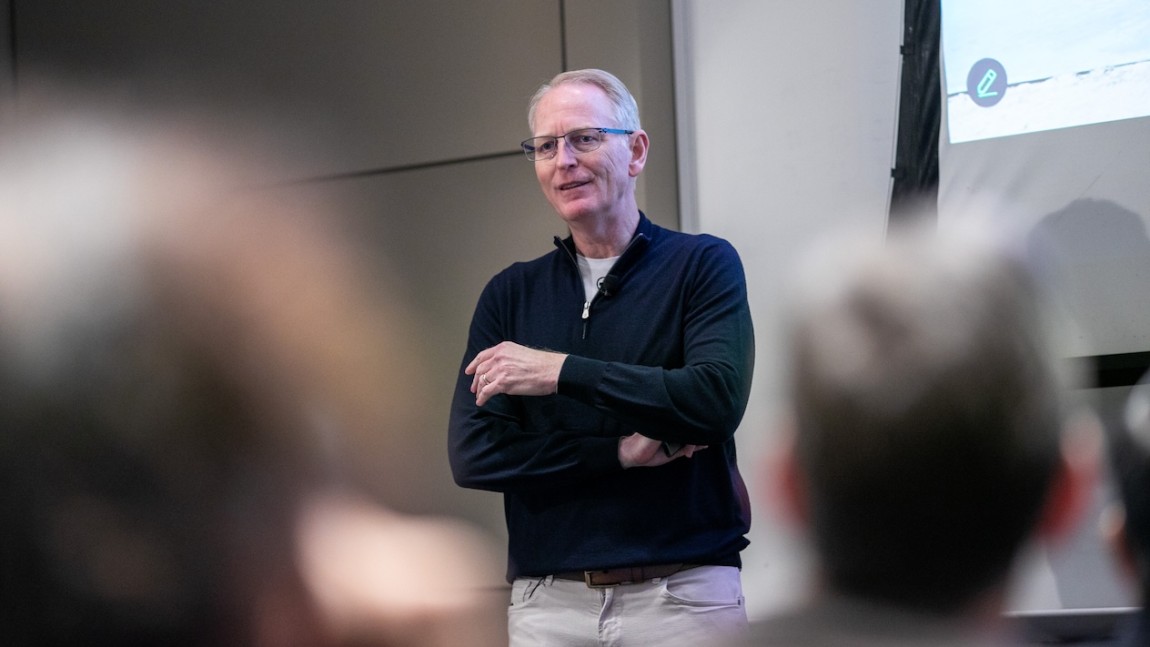
Even the overflow room was packed for Blue Origin CEO David Limp’s talk on Nov. 5 in Davis Auditorium. Dean Shih-Fu Chang introduced Limp, whose visit marked another installment in Columbia Engineering’s Tech CEO Lecture Series.
In his presentation, Limp walked students through the company’s vision for an infrastructure for safe, inexpensive, and frequent transportation to space. He made the case for developing a hydrogen-based space economy and for using the Moon as humanity’s strategic gateway. At the end of the talk, he showed a video of a late-stage test of the company’s New Glenn rocket, which made headlines the following week for a successful launch and controlled landing on an ocean platform.
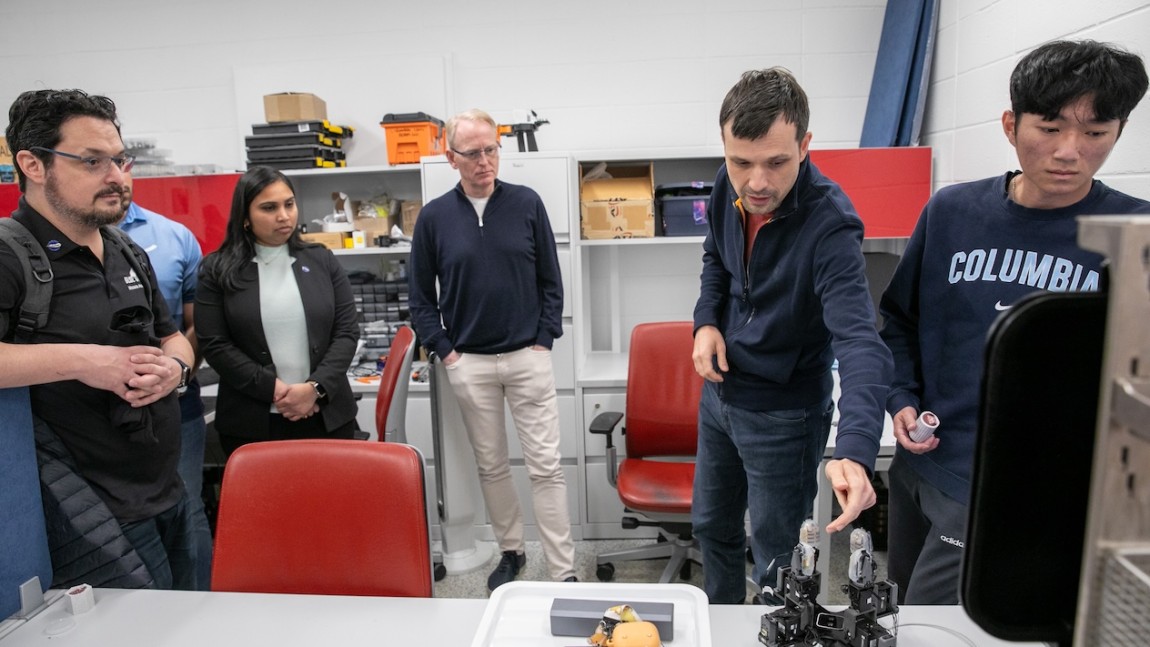
During his visit to campus, Limp met with members of the Columbia Space Initiative, the Robotic Manipulation and Mobility Lab, Columbia Engineering student leaders, and students in the Dual MBA/Executive MS in Engineering and Applied Science (MBAxMS) program.
An unlikely path
Limp has seen a lot of the technology sector. Prior to joining Amazon in 2010, he held leadership roles at Apple, Liberate Technologies, Palm, and served as a Venture Partner at Azure Capital Partners. At Amazon, he was senior vice president of Amazon Devices & Services, where he led the development and operations of Alexa, Echo, Kindle, Fire TV, Ring, and other technologies.
Despite that experience, he seemed like an unlikely candidate to lead one of the top private space companies.
“I have zero background in aerospace,” he said. “I’m classically trained as a computer scientist.” When Bezos first approached him about running Blue Origin, he said, “I told Jeff no… I don’t want to fail you.” Bezos persisted. Limp ultimately concluded the company was moving “from an R&D phase to a productization phase,” which matched his experience building and scaling complex systems.
A bold vision
Limp spent most of the talk discussing the company’s long-term mission. Space, he argued, is essential to protecting life on Earth. “It’s important as a human race that we preserve this planet,” he said. “We can do that by building a road to space.” Moving heavy industry off-world, he added, could allow Earth to become “a vacation paradise for all of us.”
Realizing that vision will take time, he says. “I will not see this in my lifetime. My kids will not see this in their lifetime,” he said. “But your kids will have a big hand in making this actually come to fruition.”
He framed the technical path ahead in three parts: dramatically reducing the cost of sending mass to orbit, developing a space-based hydrogen economy, and establishing a permanent presence on the Moon. Reusability, he said, remains the single most important driver of lower launch costs. “Could you imagine… flying an airliner from east to west coast, and at the end of its landing, just throwing it away?”
Throughout the talk, Limp encouraged students to avoid the easy or obvious path — and to seriously consider making a career in the aerospace field.
“We are looking for visionary people who care about what we’re talking about here,” he said. “Some of the best learning in my career was going down a cul-de-sac or a dead end… Take a lot of risks.”
Lead Photo Caption: Blue Origin CEO David Limp speaks on campus in our Tech CEO Lecture Series
Lead Photo Credit: David Dini/Columbia Engineering