
How Industry-Academic Partnerships Support Bold Ideas
From technical know-how to blue-sky thinking, Columbia Engineers are lending their expertise more widely than ever before.
by Grant Gurrin
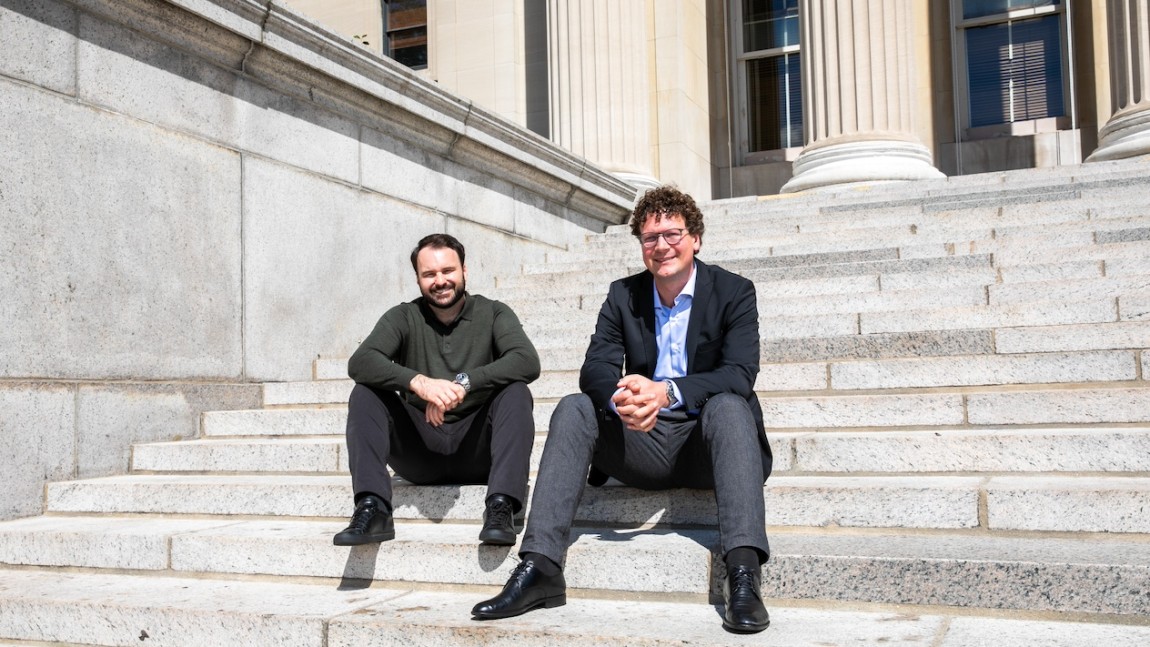
There were few signs that Matthias Preindl was on sabbatical when he arrived at his office in Morningside Heights.
An associate professor of electrical engineering, Preindl was on campus to host Wesley Pennington, the entrepreneur building Tau Motors, a technology company pioneering modern power conversion systems that include electric motors that don’t require rare earth magnets and software-defined power electronics. Pennington initially connected with Preindl in 2018, when first developing the technology platform for Tau.
The partnership started with a series of “small but impactful bets for advanced research topics that laid the groundwork for something much bigger,” said Pennington, the company’s founder and CEO. Tau continued sponsoring Preindl’s lab to advance Tau’s research agenda, eventually expanding the collaboration to include a portfolio license of IP from the university.

In 2025, Tau became the founding partner of the Columbia Center for Advanced Electrification, which Preindl leads.
“Our collaboration with Matthias and Columbia helps us pursue bleeding-edge R&D to accelerate Tau’s platform in a strategic and directed manner, but outside of our day-to- day operations,” Pennington said. “This highly aligned, more fundamental work allows us to explore and push the boundaries of the field to inform the expansion of our capability while providing the university with relevant, real-world challenges.”
Pennington is far from the only executive who sees academic partnerships as a chance for a competitive edge. Industry now drives the vast majority of American research. Businesses account for roughly three-quarters of the nation’s total research spending, a figure approaching $900 billion per year.
Only a small fraction of that money — less than one percent — flows directly to colleges and universities, but the absolute numbers are significant. In recent years, industry funding for academic research has exceeded 60% of the National Science Foundation’s total budget.
Large companies, such as Bloomberg LP, also see value in those partnerships. “By working with academia, we can stay abreast of the latest evolution of technology and science,” says Shawn Edwards BS’90 MS’95, Bloomberg’s CTO and a chair emeritus of the Board of Visitors at Columbia Engineering.
“In so many fields, research is at the leading edge of what becomes useful, practical, and applicable.”
After decades of ad hoc partnerships with industry, Columbia Engineering began scaling up its collaboration program roughly five years ago. Today, hundreds of companies like Bloomberg and Tau Motors partner with the School to develop new technologies, attract high-caliber talent, and scan the horizon for the next big opportunity.
Developing New Product Lines

Ann Schoeb is chief research and development officer at Birla Carbon, a global manufacturer of an important material called carbon black. She joined the company as it elevated R&D to a C-suite priority.
According to Schoeb, Birla Carbon’s partnership with the Columbia Electrochemical Energy Center (CEEC) supports the company’s effort to look at the fundamentals of the carbon black and synthetic graphite materials it already makes and to develop future product lines. Working with the company exposes academic researchers and students to the challenges specific to industry and large-scale production.
“They help bring insights a lot faster than if we were working on these materials by ourselves,” she said.
Like many other companies, Birla Carbon conducts a lot of in-house research to develop new products and refine its manufacturing processes. Partnering with academia gives them an opportunity to focus on the future.
“It’s easy to focus only on developing products that customers are already asking for, but that could make a company vulnerable to missing the next big market disruption,” Schoeb said. “If you’re not connected to longer-term research, the next disruption may leave you out of the market or behind the rest of the industry.
As Birla Carbon expands into a new market — carbon-based materials for batteries — the partnership with CEEC provides several advantages, including access to experimental facilities on the Morningside Heights campus.
“We’re gathering data we might not otherwise get, and I value the thought partnership that academics bring,” she said. “We partnered with CEEC because they’re specialists in the energy storage space.”
In helping Birla Carbon expand the supply of materials for the batteries necessary to transform the energy storage market, CEEC faculty and students are also pursuing their own collective goal of electrifying the energy system.
If you’re not connected to longer-term research, the next disruption may leave you out of the market or behind the rest of the industry.
Ann SchoebChief Research and Development Officer at Birla Carbon
“We’re tapping into their knowledge and experience to show that one plus one is more than two and to understand the why behind our materials’ performance advantages,” Schoeb said.
Attracting Talent and Building Pride

For Edwards, the CTO at Bloomberg, partnerships with universities have another benefit — building and sustaining a team of talented engineers.
“Collaboratively publishing papers with academics is a great way to recruit talent,” he said. “It’s also a fantastic way to keep our talent.” Edwards leads a global team of more than 9,000 engineers who develop and maintain Bloomberg’s infrastructure and data systems. Many come from academic research back-grounds, and he sees the company’s collaborations with universities as an essential outlet for that intellectual drive.
“We hire people who come from the research community, many with PhDs,” he said. “They aren’t satisfied applying technology — they want to have one foot in the research world.”
Through PhD fellowships and a faculty grant program, Bloomberg engineers work closely with academic researchers to crack unsolved problems in areas including AI, cloud computing, quantitative finance, and information security. The most successful projects become new products that his team eventually integrates into Bloomberg’s own systems.
“Our engineers solve specific problems from customers every day,” Edwards said. “Our collaborations with academia are aimed at solving problems that would unlock
capabilities or unleash new sources of value.”
The partnerships also improve morale across the engineering team.
“People want to work for an advanced tech company, and they feel great when they see that Bloomberg was involved in this academic funding or that research,” he said. Bloomberg’s partnerships with universities also strengthen its reputation in the research community, making it easier to attract new engineers. The company collaborates with Professor Ali Hirsa to host the annual Bloomberg-Columbia Machine Learning in Finance Conference, now in its 11th year.
“It helps get our name out there,” Edwards said. “We make connections when we’re presenting papers, hosting conferences, or collaborating with professors and students. It’s a great way to find and attract talent. People are attracted to Bloomberg because we’re doing this.”
For Edwards, this blend of collaboration and visibility is part of what keeps Bloomberg’s engineering culture vibrant. “It’s also a huge morale boost for the rest of the company,” he said. “When people see Bloomberg contributing to research or open-source work, it reminds them they’re part of something that’s pushing technology forward.”
Hunting for the Next Huge Idea
Chris White is not interested in incremental improvement. As head of NEC Labs America, a subsidiary of the global technology company founded in Japan 126 years ago, he’s looking far past the horizon.
“Our goal is not to make a product 10% better — it’s to come up with an entirely new market for NEC,” said White, who sees his lab as carrying forward the legacy of industrial labs like XeroxPARC and Bell Labs. As a bridge between the company’s business units and the U.S. research enterprise, NEC Labs America gives the company an opportunity to develop foundational technologies.
“The idea is to get a whole bunch of smart people together, make them aware of important problems, and give them the freedom and flexibility to start solving those problems,” White said. “I see engaging with academia as a way to expand the group of experts we can draw on.”
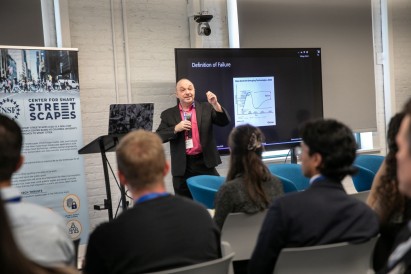
For White, the value of collaboration with Columbia doesn’t lie in the faculty’s technical expertise but rather in their creativity and ability to frame and solve problems. “If I have an electrical engineering problem, I want to send a biologist, a mathematician, and an architect to solve it,” he said. “The electrical engineers might laugh at their solution, but every once in a while, you get a really big disruption that really changes the way we look at things across many domains.”
In its partnership with Columbia and the NSF Engineering Research Center for Smart Streetscapes, NEC Labs is bringing that spirit of open-ended innovation to city management and streetscapes. The company is taking what it has learned about distributed sensing, time-dependent data analysis, real-time anomaly detection, and root-cause analysis in the context of factories and telecommunications networks and applying it to cities.
“It’s a great example of taking what we learned in one setting and bringing it to another,” he said. “Interacting with professors at Columbia and experts in New York City was the only way to make that happen.”