
A Silicon Bridge from Morningside Heights to Cupertino
Alumnus Joao Cerqueira shares how his time at Columbia prepared him for a career designing next-generation chips at Apple — and the importance of hands-on education in shaping future hardware engineers.
by Xintian Tina Wang
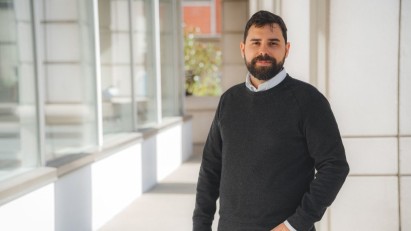
When Joao Cerqueira MS’16, PhD’19 arrived in New York from his hometown of Brasília, Brazil, he carried a passion for computer hardware, an appetite for innovation, and a deep belief that hardware design was poised to shape the future of computing. A decade later, as a staff engineer on Apple’s Hardware Technologies team, Cerqueira’s journey embodies the powerful ways Columbia Engineering’s partnerships with industry can inspire the next generation of technology leaders.
Cerqueira’s path to Columbia was defined by an early fascination with the invisible architecture powering modern life. After earning his BS in electronic engineering at the University of Brasília in 2014, he sought out graduate programs that combined rigorous fundamentals with an applied, hands-on approach. Columbia’s Department of Electrical Engineering offered exactly that.
At VLSI Design Lab at Columbia University (VLSIDL), led by Associate Professor Mingoo Seok of electrical engineering, Cerqueira immersed himself in research on ultra-low leakage, energy-efficient digital integrated circuits and microprocessors. His PhD thesis not only pushed the boundaries of how systems consume and conserve energy but also earned him recognition as a Qualcomm Innovation Fellowship recipient in 2017.
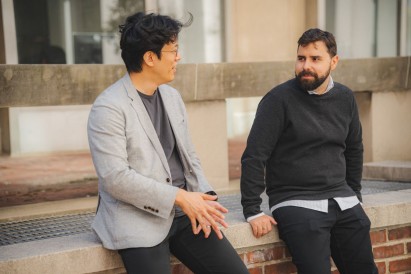
“At some point in his PhD program, I found that Joao is not afraid of dealing with very complex digital processor design,” recalls Seok, who served as Cerqueira’s PhD advisor. “He seems to have a knack for transforming a complex design problem into multiple layers of simpler problems without losing the connections among the layers. This capability enabled him to design and prototype a 16-core microprocessor titled CATENA. It was the largest chip our group had prototyped at that time. I think this preparation greatly helps him in working with custom silicon, where he must deal with very complex problems across circuits and architecture.”
After joining Apple, Cerqueira continued his connection to Columbia Engineering — this time through education. He became Apple’s liaison for the ELEN E6350 VLSI Design Lab course, taught by Bernard J. Lechner Professor Peter Kinget of electrical engineering and Seok, which bridges academia and industry by giving students hands-on experience designing, fabricating, and testing real chips through Apple’s sponsorship.
“Joao has been very instrumental to the success of the VLSI Lab course,” says Kinget. “He has been particularly helpful in managing the complex digital designs — full CPUs, accelerators — that several student groups have built over the years. He guided the students in translating their theoretical knowledge into effective design methodologies using the digital design tools that are standard in industry.”
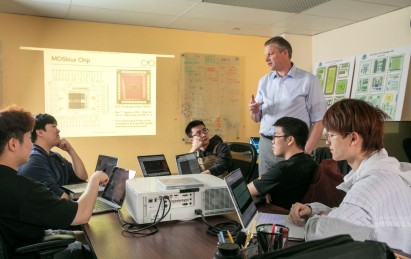
Today, Apple’s support of the Columbia tapeout class helps ensure that this cycle goes even further. Since 2022, Apple engineers have mentored students in the electrical engineering department at Columbia, offering guidance during design reviews and supporting chip fabrication and packaging.
The company also sponsors awards for standout projects, providing students with a unique opportunity to see how their classroom work translates directly into the innovations that power the devices they use every day.
That experience of turning theory into reality has stayed with me and continues to drive me today.
Joao Cerqueira MS’16,PhD’19Engineer, Apple
Bridging academia and industry on campus
In 2019, shortly after defending his dissertation, Cerqueira joined Apple’s silicon engineering team in Cupertino. His work now focuses on some of the most complex aspects of modern chip design: optimizing energy efficiency and performance at scales that power millions of devices worldwide.
Cerqueira remains closely connected to Columbia. He often returns to campus to mentor students, share career advice, and emphasize the opportunities available in hardware-related fields. He pointed to his own experiences at Columbia as formative. “I remember the late nights in my PhD time, debugging problems that felt impossible at first,” he says. “With persistence and team- work, we finally got it working — and seeing it in silicon was unforgettable. That experience of turning theory into reality has stayed with me and continues to drive me today.”
Jennifer Lee, director of career placement in the electrical engineering department, underscored the importance of the alumni connection: “I have been collaborating with Joao for the past few years to organize these annual career events, which have proven to be invaluable for our students seeking to work in hardware roles.”
In his recent presentation to electrical engineering students, Cerqueira walked through the chip design cycle, highlighting the wide range of skills involved — from architecture and logic design to verification, physical implementation and silicon validation.
He emphasized that every student brings different strengths, and that part of the journey is discovering where they fit best within that process.
The innovation engine
Columbia’s EE program highlights a larger truth: it prepares students for careers in hardware technology, computer architecture, and chip design. For Columbia students, Apple’s support of the Columbia tapeout class brings real-world expertise into the classroom.
As industry and academia continue to redefine what’s possible with custom silicon, the need for engineers who can balance innovation with practical design constraints has never been greater.
“Hardware isn’t abstract — it’s exciting and impactful,” he says. “The chips you design can end up in millions of people’s hands, and that’s incredibly motivating.”
For students considering a career in hardware, Cerqueira’s advice is straightforward: embrace the breadth of the field, stay curious, and take advantage of the resources Columbia offers. “The lab work, the mentorship, the partnerships — they all add up. When you get to industry, you’ll realize just how well-prepared you are.”