Research
How Data and Partnerships Can Address Air Pollution
Air pollution is both a climate and public health crisis. Professor V. Faye McNeill explains why solving it requires innovation, collaboration, and global action.
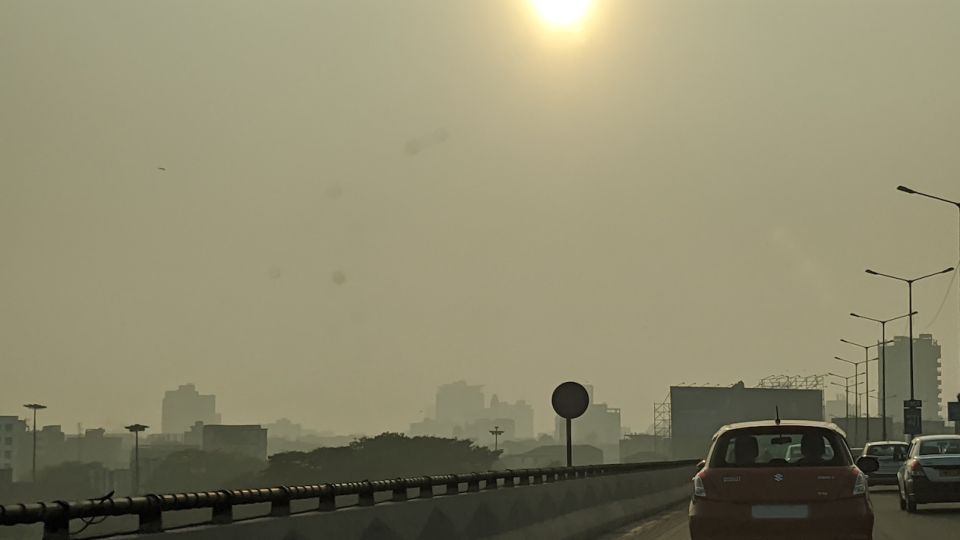
Air pollution and climate change are deeply interconnected, with major pollutants influencing the climate and often sharing sources with greenhouse gases. While natural sources of air pollution do exist, human activities such as burning fossil fuels have contributed the most to the emission of air pollutants. Data from the World Health Organization show that 99% of the global population breathe air that exceeds guideline limits and contains high levels of pollutants.
As part of Climate Week 2025, Columbia Engineering is hosting a series of events to share progress and start conversations on practical solutions to the planet’s most urgent challenges. The Sept. 22 event, “Data and Partnerships for Global Clean Air and Climate,” showcased pioneering work by Columbia researchers and others in their efforts towards cleaner air and a sustainable climate. It featured a panel discussion moderated by V. Faye McNeill, professor of chemical engineering at Columbia Engineering and earth and environmental sciences at Columbia Climate School, as well as networking and interactive displays.
We sat down with McNeill to discuss air pollution as both a climate and public health crisis, unexpected sources of air pollution, and the key ingredients to reversing its environmental damage.
Tell me about the current state of air pollution as not just a climate issue, but as a global health crisis. Are there some people and places that are more affected than others?
Globally, air pollution is responsible for upwards of 8 million premature deaths per year. Air pollution is the greatest environmental threat to public health globally and causes one in nine deaths worldwide.
However, the burden is not borne equally across the world. Today, the places that are affected the most are developing economies in the Global South. These areas are currently undergoing electrification and increasing industrialization, but at the same time, the environmental policies are still being enacted. Also, certain populations such as women, children, and lower socioeconomic status folks are more vulnerable to the health impacts of air pollution and suffer more from the exposure as well.
What are the biggest sources of air pollution?
The answer largely depends on who you are and where you live. For example, many people in the Global South cook by burning wood or other solid fuels inside the home, which is a huge source of particulate matter, especially for women and children. But here in New York City, our sources are very different. Human activities like traffic and power generation using fossil fuels are sources of particulate matter, along with natural sources like dust.
Can you share some findings about air pollution that look at areas people may not have paid much attention to before?
Our project, the Clean Air Toolbox for Cities Initiative, is working with local government, academic, and grassroots partners in cities across the Global South to identify pollution sources and co-design solutions. In India, we're getting to the point where we need information about the chemical composition of the particles to understand the most important sources of air pollution. Then, we're able to do some detective work and trace them back to their sources.
People in the field tend to focus on primary sources of air pollution, which refer to contaminants emitted directly into the atmosphere from identifiable sources. However, a large fraction of particles start out as gases emitted from human activities or natural emissions from vegetation or the ocean. They then react chemically with components of smog and physically transform into particulate matter.
Those reactions are so slow that the particulate matter will actually form a few days downstream of where the emission of the original gas was. It's almost like a Trojan horse of air pollutants. This is something that we've known for a while, but it's starting to get more of a center stage focus in terms of the air quality policy in India — and we're hoping to contribute to that conversation.
What key points were covered in your Climate Week NYC event in terms of implementing solutions?
We wanted to highlight data and partnerships, which are two essential factors that we feel are necessary to tackle air pollution as an issue, and also climate change. Oftentimes, not having the right kind of data holds us back from being able to change things for the better. For example, the decision-makers who are trying to enact environmental policies might not know what the most important sources of air pollution in their area are. So, even if there's a will to control emissions and get air cleaner for people, they don't really know where to start.
At the same time, collecting data for data's sake or just doing a purely technical study of air pollution doesn't necessarily get the progress and impact that we want. Having real partnerships on the ground with decision-makers and people who are affected by the pollution is essential for the real translation of this knowledge to impact.
Are you hopeful for the future?
The situation today is very different compared to when we first started tackling air pollution in the '50s in the U.S. and England — but there is much that can be learned from the long paths that we've walked. I'm seeing a renewed effort to tackle air pollution with an openness to collaboration on all sides and very lively dialogue to try to get to the bottom of this problem. So, I have a lot of hope.
Lead Photo Caption: Winter haze in Kolkata, India
Lead Photo Credit: Courtesy of V. Faye McNeill