Campus
How does AI Change Teaching and Learning?
At the AI and Education Forum, the Columbia community gathered to discuss and debate how artificial intelligence has — and should — change higher education.
An enthusiastic group of deans, instructors, and students from across Columbia University gathered at Low Library on March 4 for a day-long discussion about how instructors teach, how students learn, and what education should look like in the age of AI. The event, which was standing room only for much of the day, was hosted by the Center for Teaching and Learning, the Data Science Institute, Columbia Alliance, Columbia Engineering, and Teachers College.
The forum, called Reimagining Teaching and Learning in the Age of AI, moved through faculty and student panels, interactive demonstrations, a keynote from a nationally recognized AI expert, and a student-led debate. Rather than delivering policy pronouncements or technological verdicts, organizers designed the event as a space for something harder: honest dialogue about how Columbia can evolve in an AI-driven landscape without losing sight of why universities exist in the first place.
In her opening remarks, Provost Angela V. Olinto emphasized the importance of taking a critical approach to AI that acknowledges its capabilities while maintaining a critical stance grounded in evaluating these systems, not just using them.
“AI is not on the horizon — It's already shaping how students study, how faculty design courses, and how research and knowledge creation happen across disciplines all throughout Columbia and the world,” she said. “The question before us is not whether AI will influence higher education, but the question is, how universities learn and adapt as the influence of AI accelerates.”
A dean’s-eye view
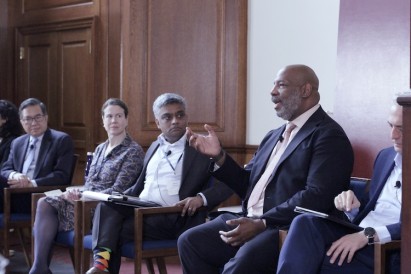
The deans’ panel offered a panoramic view of how Columbia’s 17 schools are approaching the moment. In a lively discussion, deans representing the Faculty of Arts and Sciences, Columbia Journalism School, Columbia Business School, Columbia University Irving Medical Center, and Columbia Engineering offered an honest accounting of the challenges and opportunities that have arisen since LLMs became widely available more than three years ago. The panel was moderated by Garud Iyengar, a professor of industrial engineering and operations research and the Avanessians Director of the Data Science Institute.
In addition to education, the panelists also described how AI is changing the workforce that students will join. Journalists, for example, can use LLMs to identify important moments in local government meetings that might otherwise go unnoticed. Physicians are using the same technology to relieve administrative burdens and interact with patients in a more human-to-human way than was possible just a few years ago.
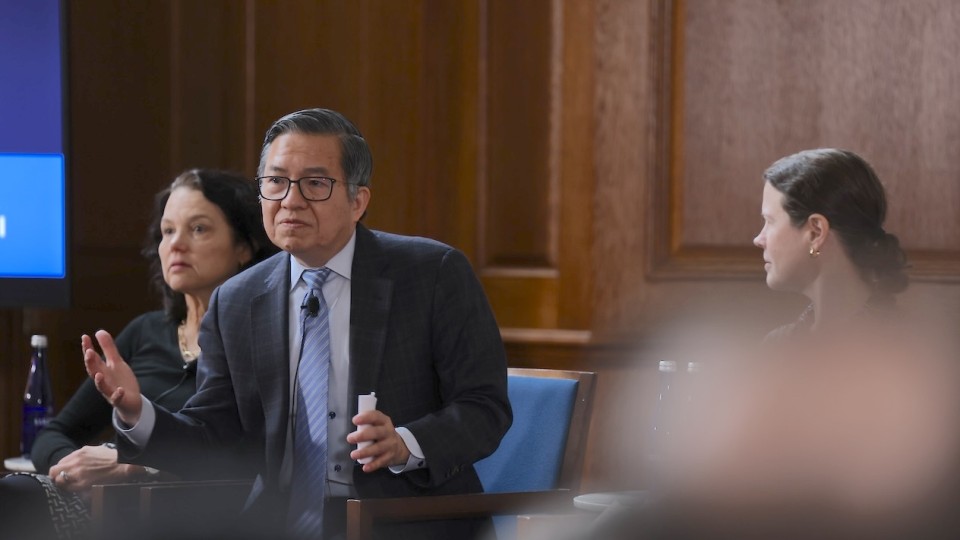
For Shih-Fu Chang, dean of Columbia Engineering and a celebrated AI researcher, the panel offered an opportunity to reflect on how today’s AI models are qualitatively different from previous advancements.
“In the past, engineers created technologies on a longer time scale,” he said. “Today’s AI is moving incredibly fast, and it’s leading us to strategically hire faculty members who are pushing the technological frontier as well as developing foundational theories.”
At the same time, the broad and swift impact of the technology has forced the field to focus on its ethical and societal impacts. To that end, the Engineering School has created courses that incorporate responsible use and ethical considerations, and leveraged expertise from across the University to help students understand the broader impacts of AI. One such course, called AI in Context, brings instructors from engineering and computer science as well as faculty from multiple domains to introduce students to computing and the history of data before looking more closely at the intersection of AI and literature, music, and philosophy.
Chang also emphasized the importance of teaching students to use AI as a learning companion, rather than an immediate source of answers.
“Critical thinking — independent critical judgement — is still the most important skill a student must learn,” he said. “We teach our students how to approach problems, decompose them into smaller logical pieces, and solve them in a systematic way.”
Preparing students for the workforce
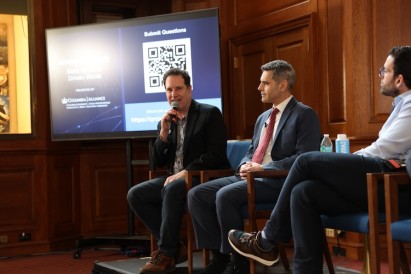
The afternoon discussion, Workplace Ready: Skills for an AI Driven World, featured panelists from across the University and guests from the French higher education system. The speakers discussed how universities should prepare students for a job market being reshaped by AI, with particular concern for entry-level positions that are apparently disappearing fastest.
The conversation was frank about the difficulty of curriculum design in a moment when the landscape shifts faster than syllabi can be thoughtfully rewritten. Across disciplines, the panelists agreed that teaching durable fundamentals and human judgment must take priority over training students to use tools that may well be obsolete by the time students graduate.
Hod Lipson, an AI expert and the James and Sally Scapa Professor of Innovation in the Department of Mechanical Engineering, said that AI had changed the role that universities should play in society.
“We have to move away from this idea that we’re going to teach students four years of core knowledge, then you’re done,” he said. “You have to study AI, and continue studying AI.”
Lipson, a sought-after AI expert, offered insight into what he’s teaching in the classroom.
“I think it’s really dangerous to think humans are good at critical thinking and AIs aren’t,” he said. “The soft skill that I find really useful is encouraging students to have the self-confidence to argue with AI.”
Lipson also recommended using multiple tools alongside one another.
“Never work with one AI,” he said. “Pit them against each other and watch how they argue — it’s amazing to see their politics.”
Demonstrating AI in Action
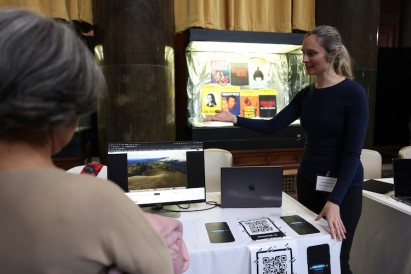
During the mid-day break, Forum attendees had the opportunity to hear directly from faculty who are implementing AI in their courses. The Demo Expo showcased experiments in using AI to deepen learning, reframe assessment, and reshape the student experience across disciplines. These demonstrations, which featured several examples from Columbia Engineering, explored AI as an asset in the learning process.
Lauren Heckelman, a lecturer in biomedical engineering, has been integrating AI into the junior-level BME Lab sequence. In the fall, she had students use generative AI to craft cover letters and resume sections based on lab topics, then submit the raw AI output alongside their own edited version and a reflection on what they changed.
When students told her they wanted more engineering-focused applications, Heckelman retooled. In the spring, students used ChatGPT and Google Gemini to generate scientific figures and critique them for accuracy, wrote MATLAB code with AI scaffolding, and compared AI-driven image analysis of fluorescence microscopy staining against their own manual results.
Tony Dear, a senior lecturer in computer science, whose courses enroll roughly 200 students, presented findings from three semesters using an AI-powered grading tool. The tool generates draft solutions and rubrics that instructors can edit, then grades submissions automatically. The tool’s accuracy, measured on the basis of re-grade requests, performed as well as human grading.
In addition to reducing time spent grading, the tool offered additional advantages. Dear’s AI can read a student's code and try to understand what it's doing, offering individualized feedback even when the code doesn't compile or produces nonsensical output — something rubric-based grading could never do.
For more information about the Forum, visit the event page here.
Lead Photo Caption: Dean Shih-Fu Chang sits on the panel, "Institutional Visions for AI in Education”
Lead Photo Credit: The Center for Teaching and Learning