Campus
What AI Still Doesn’t Know
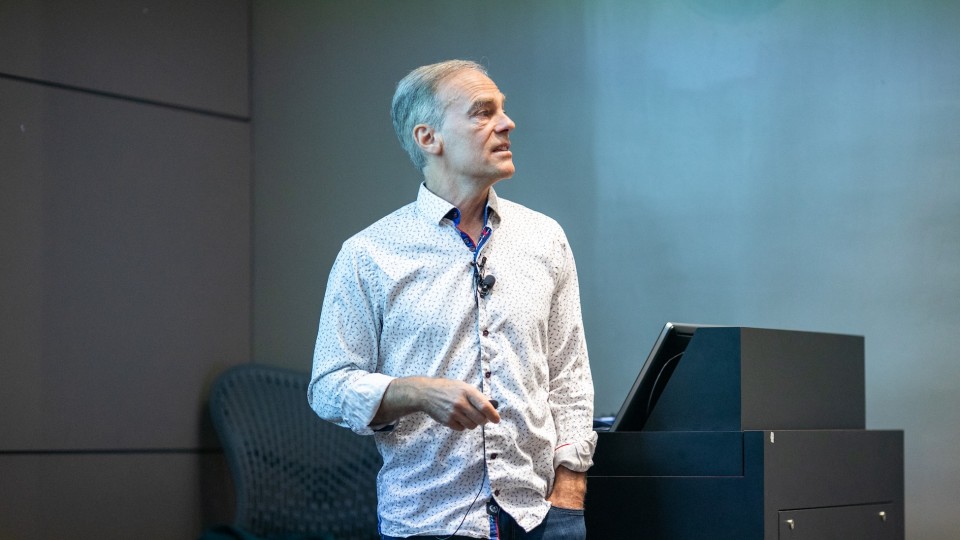
Richard Zemel highlighted how much remains to be understood about how AI systems learn over time.
When people talk about artificial intelligence (AI) today, it often sounds like we’re nearing the finish line. Models are writing essays, solving math problems, and even holding conversations that feel surprisingly human. But a very different picture emerges when you look closely at current research. In many ways, AI isn’t a completed story: it’s at its opening chapter.
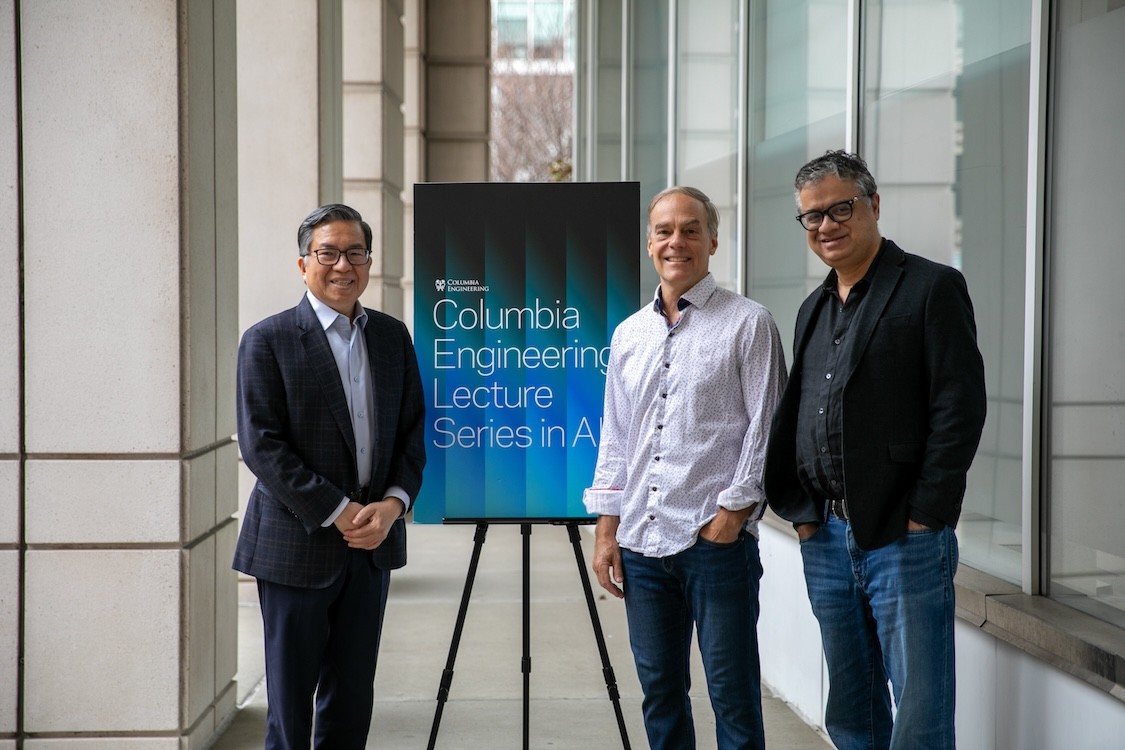
At the Lecture Series in AI held March 27 at Columbia’s Morningside campus, Richard Zemel made it clear that today’s most advanced AI systems are only scratching the surface, especially when it comes to learning and improving over time. Rather than having all the answers, the field is still grappling with fundamental questions about how to train AI to learn more as humans do.
“People are very good at continuously learning new things, accumulating and exploiting new goals,” said Richard Zemel, the Trianthe Dakolias Professor of Engineering and Applied Science at Columbia Engineering. “In machine learning, this idea is known as continual learning, and it’s considered one of the hallmark problems in artificial intelligence.”
Zemel leads a team of researchers who are tackling these big questions at the Artificial and Natural Intelligence Institute (ARNI), a National Science Foundation-funded initiative that brings together experts from AI, neuroscience, and cognitive science. Rather than treating artificial intelligence and the human brain as separate domains, ARNI is built on the idea that progress in one can inform the other. Its work focuses on uncovering the principles of intelligence, how systems learn, generalize, and adapt, by studying both biological brains and machine learning models side by side. In many ways, ARNI represents “a shift in how we approach intelligence, not as something we’ve already figured out, but as a shared mystery that requires collaboration across disciplines to truly understand.”
What the human brain can do that AI can’t (yet)
Humans are incredibly good at learning over time. We pick up new skills, adapt to new environments, and build on what we already know without completely forgetting it. AI systems, on the other hand, still struggle with this basic ability. When models are updated with new information, they often overwrite what they previously learned, a problem known as catastrophic forgetting. Today’s systems don’t truly “learn” in the fluid, ongoing way humans do. They are still, in many respects, snapshots, trained once and then carefully adjusted.
Even the tools we use to improve AI, like fine-tuning models, adding memory, or retrieving external knowledge, come with trade-offs, Zemel said. Making a system more adaptable can make it less stable. Helping it remember new things can cause it to forget old ones. Even something as simple as keeping information up to date (such as changing tax laws or recent events) turns out to be surprisingly difficult. These are fundamental questions about how learning systems should work.
Learning what matters and ignoring what doesn’t
ARNI researchers are investigating how learning works and how to train machines in new ways.
One of the projects explores how structuring training data into a meaningful sequence, from easier to more complex problems, can help AI models build skills more effectively and improve their reasoning over time. The research introduced a method for identifying “transitional problems” by measuring task difficulty relative to a model’s current ability, rather than relying on fixed or proxy difficulty scores. Using this approach, they showed that training models on a curriculum that progressively “levels up” from easier to harder problems leads to more efficient, interpretable improvements in performance across domains such as math and chess.
There’s also a growing realization that intelligence is about deciding what to learn and what to ignore. Humans do this constantly. We filter out irrelevant details, prioritize meaningful experiences, and adapt based on context. AI systems are only beginning to scratch the surface of this kind of selective learning. Zemel’s team is exploring how AI systems can be guided to selectively learn from continuous data streams, focusing on relevant information while ignoring outdated or sensitive content. Through Generalized Neural Memory (GNM), their work showed that instructions can effectively control what models remember, enabling more flexible and practical applications, such as handling patient records in healthcare.
We’re only at the beginning
All of these point to a “simple but powerful idea, we are still in the early stages of understanding intelligence itself,” Zemel said. The systems we have today are impressive, but they are far from complete. They hint at what’s possible, while also exposing how much we don’t yet know.
In addition to continual learning, an important question is how to build more efficient systems, both in terms of the data they need and the computation and energy required to train and run them. As AI systems take on more complex tasks, understanding what to remember and how skills transfer will be increasingly important.
This also means there’s plenty of room for students to get involved. The foundation is still rooted in core skills, like math, statistics, and machine learning, along with hands-on experience building AI systems. But just as important is curiosity about how learning works more broadly. Continual learning, in particular, is likely to become a central focus in the coming years, especially as AI moves toward more agent-like systems that need to operate, adapt, and improve across tasks rather than in isolated settings.
For those interested in the intersection of artificial and natural intelligence, Zemel said the path forward is refreshingly accessible: take courses across neuroscience and computer science, attend talks, and engage with ongoing research conversations. The future of AI will likely be shaped not just by advances in engineering, but by deeper insights into how intelligence itself, both artificial and human, actually works.
“An interdisciplinary engagement is key to understanding both AI and the brain,” said Zemel.