Alumni
Witnessing History — and Making It
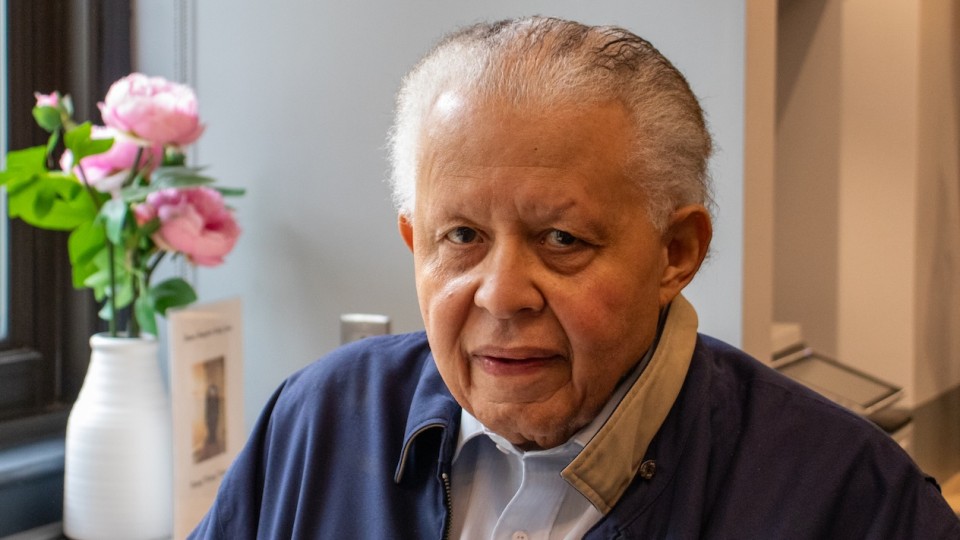
Henry Coshburn’s legacy stretches from engineering and business to civil rights and education.
Shortly after graduating from Columbia Engineering with a degree in chemical engineering, Henry Coshburn MS'64 was dispatched to a Mobil Oil refinery in Beaumont, Texas.
“You worked on platforms over open kettles of 250-degree grease,” Coshburn said. “If someone wants to push you in, you’re dead.”
For Coshburn, one of the School's earliest Black graduates, the danger was hardly an idle thought. When he first visited Beaumont in 1965, the plant remained segregated along racial lines. Coshburn would be the first Black person to give orders. Tensions were so high that his supervisor made the trip, too.
"We're not sure if you can stay in the hotels or not, so I'm going to go down with you," he told Coshburn. "If you have to stay out in the rice field, at least there'll be the two of us."
As it turned out, Coshburn and the foreman he was assigned to work with solved the problem Coshburn had been sent for.
"I couldn't understand a word he was saying to me, I'm sure he couldn't understand what I was saying to him, so we couldn't get into too much trouble," Coshburn said with a laugh. "We got along just fine and solved the problem. He told me, 'You all come down here anytime.'"
Coshburn–whose life spanned engineering, the high-stakes business of oil trading, and the vital work of social change–is full of stories like this one. "We didn't solve all the integration problems of the United States, but it's one small step and part of giant steps," he said.
Persisting against discrimination
Coshburn grew up on 153rd St. in Washington Heights, playing stickball on the same streets where Willie Mays had just a few years earlier. His father worked as an administrator for the Board of Education, and his mother was an assistant principal.
At age 14, Coshburn decided to continue the family legacy in education and teach history. His father told him, “You’ll starve as a history teacher,” and nudged him toward engineering. He followed his father’s advice about his professional career, but he also held onto that early desire to teach, learn, and guide young people. Throughout his life, Coshburn has tutored students in science, spoken to students and community groups, and mentored countless young people.
He also stayed deeply engaged in history and social change.
Coshburn attended DeWitt Clinton High School and entered the University of Pennsylvania in 1953, graduating four years later as one of eight Black graduates. He was a brother of the Black fraternity Alpha Phi Alpha, which his father’s cousin had helped found.
After graduating with a degree in chemical engineering in 1957, Coshburn was unable to find even a single employer willing to hire a Black engineer. He got by as a mail carrier and high school chemistry teacher.
A year later, he secured his first engineering job at the Army’s battery research division in Fort Monmouth. His group developed the battery packs for the rockets and missiles being developed by German scientists recruited after World War II.
“Back in those days, nobody cared about batteries very much,” he said. “Now they’re at the forefront.”
A short stay in Morningside Heights
Coshburn began taking graduate courses at Columbia while working for the Army, which gave employees two afternoons per week for continuing education and paid for tuition. He eventually enrolled as a full-time student in 1963.
Coshburn studied under legendary faculty like Edward Leonard and Elmer Gaden PhD'49, the “father” of biochemical engineering. He conducted research with Professor Henry Linford and doctoral student Mary Anne Farrell-Epstein, who would become an assistant professor of chemical engineering.
What most distinguished his Columbia years, however, was the timing: between earning his undergraduate degree in 1957 and his Columbia degree in 1964, the Civil Rights Movement had transformed the employment landscape.
“When I graduated from Penn, I had zero job offers,” he said. “When I graduated from Columbia, I had eighteen.” Columbia was excellent, he added, “but it was the Civil Rights Movement and all the brothers and sisters and what was done in that time period.”
“Just looking at the graduating class, I said to myself, ‘Whoa, this is Columbia University in Morningside Heights — but there is no representation of the community,” Coshburn recalls. He would go on to spend more than a decade helping recruit prospective STEM students, primarily for his undergraduate alma mater, the University of Pennsylvania, and also for Columbia.
Coshburn also began a family legacy at Columbia. In the late 1960s, his mother — then in her 60s — took courses at Teacher’s College, and his son, William, graduated from Columbia College in 2008.
Engineering across the globe
After earning his MS in chemical engineering in 1964, Coshburn joined Mobil Oil as a lubricant specialist in the company’s applied research division. The job marked the beginning of a career in petroleum that would take him from refinery platforms in Texas to corporate conference rooms across the U.S., Europe, and Africa.
Coshburn joined Exxon in 1968, transitioning to the commercial side of the oil business and entering the demanding world of crude and product trading. Across his roles at the company, Coshburn relied on his technical fluency, attention to detail, sound judgment, and interpersonal skills to execute complex, cross-cultural negotiations with enormous financial stakes.
At Exxon, Coshburn managed trading activities for Southern Europe, then Northern Europe, and eventually all of the continent and parts of Africa. Across offices in Rome, Rotterdam, Hamburg, and beyond, he built a reputation for fairness and professionalism. Years later, after leaving Exxon to become an independent broker, one longtime counterpart told him, “You were always cooperative with us — why would we not be cooperative with you?”
His work placed him at the center of dramatic shifts in global energy markets. He witnessed the rise of financial hedging, the post-war restructuring of European refining, and the first large-scale commercial transactions between Western companies and Soviet or Eastern Bloc producers. He bought his first cargo of Russian crude in the mid-1970s, navigating delicate and new geopolitical tensions on top of normal commercial considerations.
“If you were selling oil and buying oil for Standard Oil, everybody wanted to deal with you,” he said.
After leaving Exxon, Coshburn spent years advising companies in Western Europe, South America, and Canada on navigating newly open markets in Eastern Europe and the former Soviet Union. He worked closely with corporate legal teams, maintained strict compliance with U.S. regulations, and continued to bridge technical, commercial, legal, and cultural worlds. Coshburn would be included in Marquis Who's Who in Science and Engineering and Who's Who in Black America.
Looking back, he describes his career simply. “I’ve done a lot of things I found interesting and enjoyable — and I’ve met people from every corner of the world,” he said. “The amalgamation of the technical world and of history and social structures made the work fascinating.”
A life of service
Beyond his work in engineering and business, Coshburn’s life has been defined by public service. As a young man, he became involved in city- and state-level politics, campaigning for Mayor John Lindsay and Governor Nelson Rockefeller. During one period, Jackie Robinson, a fellow Rockefeller supporter, was a frequent presence in the campaign office where Coshburn worked.
“I would come in after-hours and sit at Jackie Robinson's desk,” he said.
Coshburn’s engagement deepened in the 1960s, especially around issues of representation in major institutions. Through contacts in city government, he joined the board of Harlem Hospital. It was a particularly vital institution at a time when Columbia’s hospital did not allow Black physicians to admit patients. Coshburn witnessed — and supported — the negotiations that changed this policy.
“There were all these battles of simply getting representation, simply getting the opportunity to be heard,” he said. “What I quickly found out was that probably the most important item was education.”
Education became one of the most consistent through-lines in Coshburn’s civic life. For years he volunteered with the Urban League, traveling to historically Black colleges to talk with students about engineering careers and the realities of entering corporate environments. His message was practical rather than motivational, explaining how to navigate large organizations, how to read unspoken expectations, and how to recognize that technical expertise could open doors that once seemed closed.
In New York, he supported tutoring programs that brought chemists and engineers into public high schools to help students with chemistry, physics, and advanced math.
“If a kid has a question, there may be no one in their neighborhood who can answer it,” he said. “Exposure matters because people need to see what’s possible.”
Across all of his endeavours, Coshburn says that his driving motivation has been seeing more students of color in science and engineering courses.
“Representation in the STEM field is still minuscule,” he said. “My life’s work has been to see representation increase.”
Lead Photo Credit: Bella Ciervo/Penn Engineering