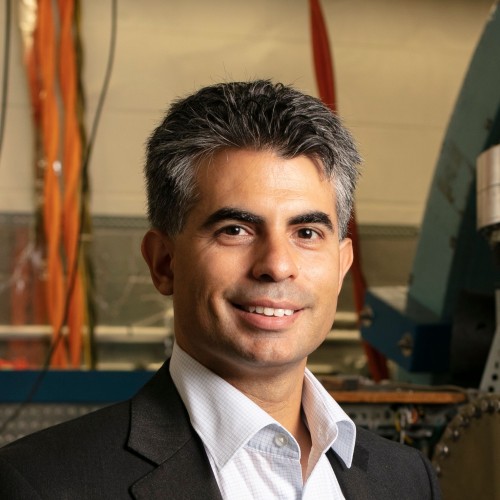
Carlos Paz-Soldan
Associate Professor of Applied Physics and Applied Mathematics
Carlos Paz-Soldan’s research interests are motivated by the desire to solve the scientific and technological challenges standing in the way of harnessing controlled fusion energy on earth.
Prof. Carlos Paz-Soldan’s work focuses on controlling the transient off-normal events that can prevent the reliable operation of magnetic fusion device concepts, especially the tokamak. He is interested in advancing the physical basis of various instability phenomena as well as developing the fusion technologies necessary to deploy feasible actuators to achieve control.
Paz-Soldan joined the Columbia Applied Physics and Applied Mathematics Department in 2021. Prior to that, he was a staff scientist in the Magnetic Fusion Energy Division at General Atomics, where he advanced the research program of the DIII-D National Fusion Facility as well as other experiments worldwide. Paz-Soldan has contributed to a broad range of problems in tokamak operation, stability, and control. These include: understanding the interaction of tokamak plasmas with non-axisymmetric fields used to control core and edge instabilities; the measurement and control of relativistic electron populations; and the conceptualization and design of novel actuators for transient control.
Dr. Paz-Soldan is the recipient of the Marshall N. Rosenbluth Outstanding Doctoral Thesis Prize in 2013 and the Thomas H. Stix Award for Outstanding Early Career Contributions to Plasma Physics Research in 2021, both from the American Physical Society.
Additional Information
-
Research Areas
- Plasma Physics (Controlled Fusion)
- Energy Science
-
Professional Experience
- Associate Professor, Applied Physics, Columbia University, 2021-Present
- Scientist, General Atomics, 2014-2020
-
Professional Affiliations
- American Physical Society
- American Nuclear Society
-
Honors & Awards
- Fellow, American Physical Society, 2024
- Thomas H. Stix Award for Outstanding Early Career Contributions to Plasma Physics Research, 2021
- Marshall N. Rosenbluth Outstanding Doctoral Thesis Award, American Physical Society, 2013
- Doctoral Fellowship, National Science and Engineering Research Council Canada, 2009
- Graduate Fellowship, American Nuclear Society, 2008
-
Education
- PhD, Physics, University of Wisconsin-Madison
- MS, Nuclear Engineering and Engineering Physics, University of Wisconsin-Madison
- BEng, Engineering Physics, Queen's University Canada
-
Select Publications
C. Paz-Soldan, et al, A novel path to runaway electron mitigation via deuterium injection and current-driven MHD instability, Nucl. Fusion 61 116058 (2021)
C. Paz-Soldan, Plasma Performance and Operational Boundaries without ELMs in DIII-D, topical review in Plasma Phys. Contrl. Fusion 63 083001 (2021)
C. Paz-Soldan et al, Recent DIII-D advances in runaway electron measurement and model validation, Nucl. Fusion, 59 066025 (2019)
C. Paz-Soldan et al, Spatio-temporal Evolution of Runaway Electron Momentum Distributions in Tokamaks. Phys. Rev. Lett., 118 255002 (2017)
C. Paz-Soldan et al, Observation of a Multimode Plasma Response and its Relationship to Density Pumpout and Edge-Localized Mode Suppression. Phys. Rev. Lett., 114 105001 (2015)
C. Paz-Soldan et al, Stabilization of the resistive wall mode by a rotating solid conductor. Phys. Rev. Lett., 107 245001 (2011)
Beyond the above, over 20 first-author and 140 co-author peer-reviewed publications. See profiles on: