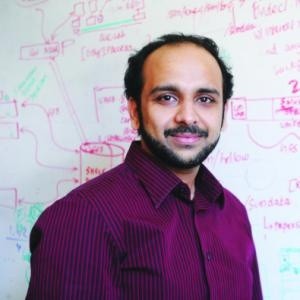
Simha Sethumadhavan
Professor of Computer Science
Simha Sethumadhavan’s research is focused on finding practical solutions to problems in area of cybersecurity.
Sethumadhavan is best known for his "hardware-up" principle for designing secure systems. This principle guides the design of computer and cyber-physical systems when security is a first-order design requirement; it teaches how foundations for security and trust can be built into hardware.
For decades, cybersecurity has been layered on insecure hardware and software foundations with unreasonable trust assumptions. Sethumadhavan has taken a long-term solution to this problem. His work has shown how to protect from hardware “backdoors” and faults and create security services rooted in the hardware that enable the development of lean security software. His hardware-up approach is a new way to engineer secure systems with full emphasis on the use of hardware to not only make security faster and more efficient, but also to improve the effectiveness of security solutions by improving security and trust of both hardware and software. Sethumadhavan has also made contributions towards improving the energy efficiency of computer systems, and the time required to create new computer systems.
Sethumadhavan received a PhD in Computer Science from The University of Texas at Austin in 2007, and a BE from University of Madras (with distinction) in 2000. He is a recipient of an Alfred P. Sloan Research Fellowship, the NSF CAREER award, an IBM co-operative research award, and best paper awards in computer security and computer architecture. His work has had substantial impact in a short amount of time; notably, his team's work on identifying new security vulnerabilities resulted in fixes to major products such as mobile phone processors and web browsers used by millions of users, and his ground-breaking work on hardware security is actively considered by standards organizations. He has served on the Federal Communications Commission Downloadable Security Technical Advisory Committee. He is the founder of Chip Scan Inc. a company that specializes in technology for producing trustworthy hardware.
Research Areas
- Security and Privacy
- Software Systems
- Computer Architecture and Engineering
- Networks and Distributed Systems
- Artificial Intelligence (AI) and Machine Learning (ML)
- Applied and Theoretical Machine Learning
- Computer Architecture
- Cloud Computing
- Design Automation
- Economics & Computation
- Generative AI & Large Language Models (LLMs)
- Operating Systems
- Programming Languages
- Robotics and Autonomous Systems
- Trustworthy Computing
- Cybersecurity
- Quantum Computing
Additional Information
-
Professional Affiliations
- IEEE
- ACM
-
Honor & Awards
- NSF CAREER Award (Trustworthy Hardware from Untrustworthy Components), 2011
- Alfred P. Sloan Foundation Research Fellowship, 2013 - 2017
- IEEE Micro “Top Picks in Computer Architecture”, 2017
- IEEE Micro “Top Picks in Computer Architecture”, 2013
- IEEE Micro “Top Picks in Computer Architecture”, 2004
- Best Student Paper Award at ACM Computer Communications Security Conference, 2013
- Best Poster Award at Hot Chips, 2015
- Distinguished Paper Award at Intl. Conference on Program Comprehension, 2016
- Best of CAL Paper Award for Short Paper on Hardware Support for Privacy, 2016
- IBM Open Collaborative Research Faculty Award, 2014
- Department of Computer Sciences at UT-Austin, Teaching Assistant Excellence Award, 2006
- Department of Computer Sciences J.C. Browne Fellowship, 2005