View the full talk
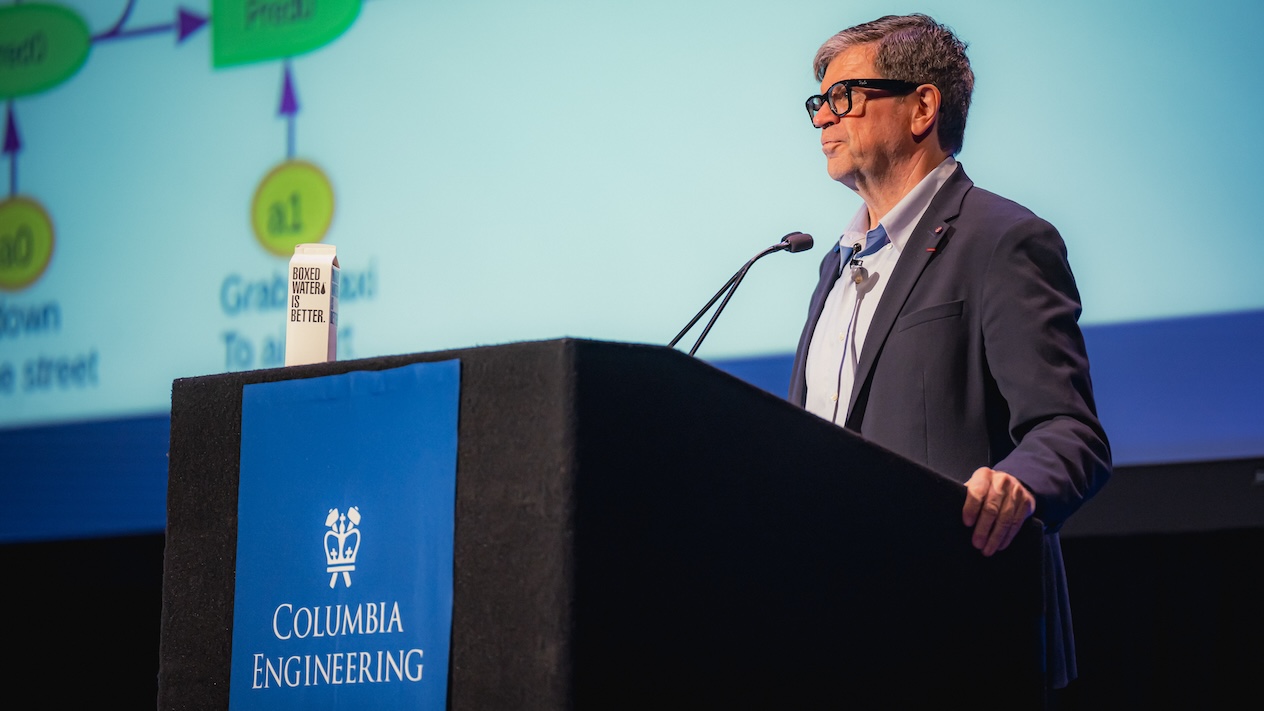
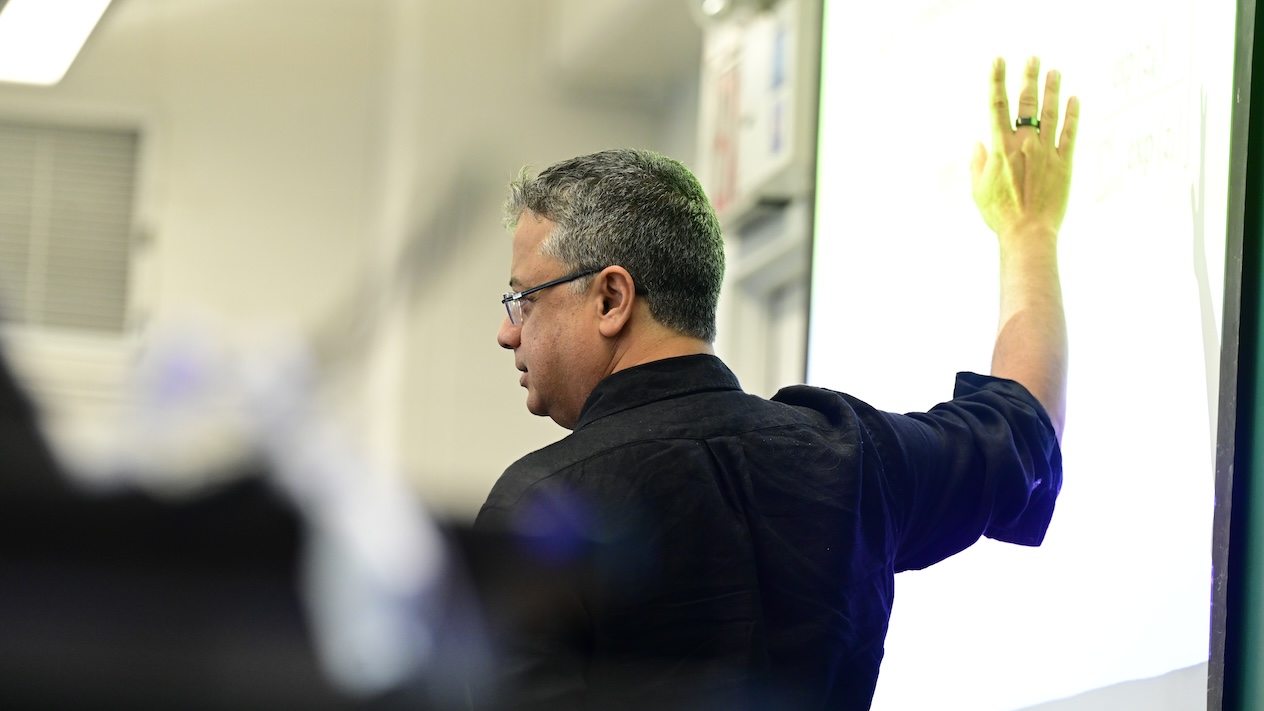
Shuchao Bi, researcher at OpenAI and co-founder of YouTube Shorts, presents "Advancing the Frontier of Silicon Intelligence: the Past, Open Problems, and the Future.” He discusses progress over the past 15 years, current open problems, and what the future could look like.
Lead Photo Caption: OpenAI’s Shuchao Bi delivered a distinguished lecture at Columbia Engineering on June 12
Lead Photo Credit: David Dini/Columbia Engineering
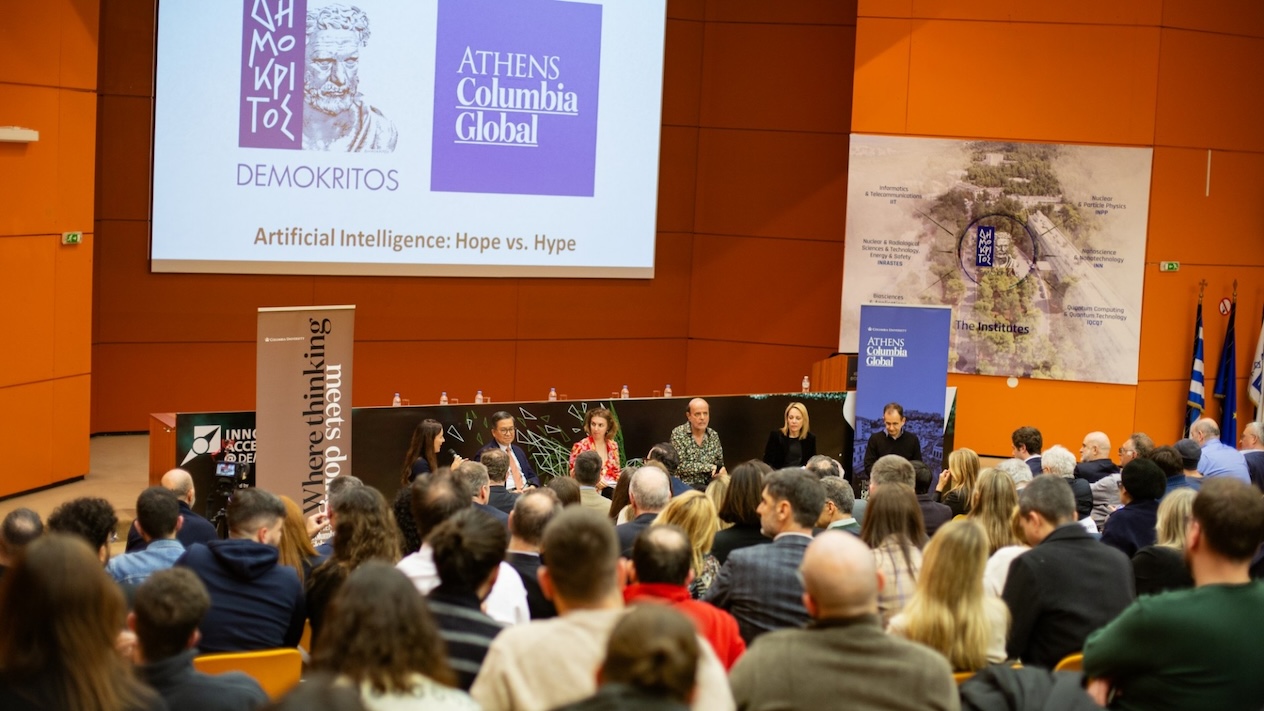
Opening remarks by Dean of Engineering Shih-Fu Chang, Prof. Rich Zemel, and Prof. Shafi Goldwasser
Lead Photo Caption: Richard Zemel, Trianthe Dakolias Professor of Engineering and Applied Science at Columbia Engineering; director of ARNI
Lead Photo Credit: David Dini/Columbia Engineering
Fresh from their win at the Millard Chan Tech Challenge, the team behind MilkShaker demonstrated a practical and science-backed solution to prevent mastitis, providing professional level care without sacrificing time or requiring special training. Another group of seniors in the Department of Mechanical Engineering showcased a prototype for the CareCruiser, a wheelchair-to-stroller attachment designed to give wheelchair-using parents and caregivers greater independence when navigating with strollers and carseats.
Several projects also tackled infrastructure design, including a civil engineering and engineering mechanics team that unveiled Rethinking Resilience. The project envisions a new sustainable, flood-resilient train station to replace the existing Ardsley-on-Hudson station along the MTA’s Metro-North Hudson Line.
And in the gaming arena, a team from the Department of Electrical Engineering demonstrated their physical tank game using modified remote-controlled cars. By reconfiguring the electronics of remote-controlled cars, the team enabled Bluetooth-based control of both the motors and onboard lasers. Players score by hitting opposing cars with laser pulses, while any car that gets hit is temporarily disabled with a five-second freeze penalty.
Dean Shih-Fu Chang greeted the students and commended them on their year-long efforts. “You all have started with an idea and brought it to life. That’s what engineers do! We bring ideas to life . . . Today’s showcase truly represents our Engineering for Humanity vision. This is a milestone in your Columbia experience and one I hope you remember for years to come.”
Each year, Columbia Engineering seniors work on a capstone project, aka Senior Design. They are challenged to solve real-world problems with innovative solutions, rooted in their foundational math, science and engineering courses.
Here’s a look at some of the students and their innovations at Senior Design Expo 2025.
Scenes from Senior Design Expo ‘25
Credit: Timothy Lee/Columbia Engineering
Masthead Caption: A student tries on LenScribe, a compact set of 3D-printed glasses designed for audio input, speech processing, and visual display
Masthead Credit: Timothy Lee/Columbia Engineering
Mayor's Cup Highlights
Credit: Diane Bondareff/Columbia Engineering
A day of innovation, teamwork, and STEM spirit
"We are so happy to have you here, and we hope to do more with New York City schools and our partners to share and promote our love of STEM,” said Dean Chang. “Columbia Engineering has a long history of supporting FIRST Robotics teams with mentors–we have hosted the FIRST Robotics kickoff for multiple years and plan to do so again in 2026.”
Dean Chang also noted that more than 40 students from the Engineering School had signed up to volunteer. “Many of our engineering students are FIRST alumni, as well. They have personally benefited from this program and they know the impact being on a robotics team in middle or high school can have on a young person's life.”
“Today’s competition is more than just a contest. It is a testament to the dedication, the creativity, and the hard work of each and every one of you,” said Ray while addressing the students. “The innovation and approaches you took to source materials and build your projects were truly remarkable – it’s very inspiring.”
To win the robot challenge, alliances of two teams would compete against another alliance–and challenge their robots with a series of tasks, from collecting blocks and disposing them in the team’s bucket, or retrieving hooked blocks to hang in the middle of the arena. The Mayor’s Cup came to an exciting conclusion when the last two teams of alliances competed for first place. Teams Saturn and Mercury, an alliance team took home the first place trophy. Both teams were made up of students from the Staten Island Technical High School.
Robotics demos and campus exploration
In addition to the full day of competitions, Columbia Engineering faculty members presented a series of robotics demos. Highlights included demonstrations from Hod Lipson’s Creative Machines Lab, Sunil Agrawal’s ROAR Lab, Yunzhu Li’s RoboPI Lab, and Matei Ciocarlie’s ROAM Lab. The School’s Office of Outreach also showcased a creation from their flagship program SHAPE (Summer High School Academic Program for Engineers), a summer program that offers college-level courses taught by Columbia faculty.
Additional demos were showcased by student groups representing the Engineering School, including Columbia Space Initiative, Columbia Robotics Club, Biomedical Engineering Society, and Columbia University Formula Racing. High school students participating in the competition also had a chance to tour the School and learn more about student clubs from Columbia students who shared demos of their past work.
“Thank you to the students for really putting in the effort to make this day a reality,” said Zigman at the competition. “Many of you will go on to careers in STEM, but for those of you who don’t, you’re going to be incredibly successful because of the mindset and skills you’ve learned that will serve you well in anything you choose.”
Lead Photo Credit: Diane Bondareff/Columbia Engineering
The evolution of engineering spans millennia, and present developments are ever more rapid … Engineering continues to hold great promise and potential to benefit humanity.
Zvi GalilDean Emeritus of Columbia Engineering
You were Dean at Columbia Engineering when the biomedical engineering (BME) department was founded. Tell us about those early days of BME.
The inspiration to create a Department of Biomedical Engineering preceded me as dean. Professor Van Mow, who was partly in mechanical engineering and partly at the Medical School (Vagelos College of Physicians & Surgeons), had this insight and brought it to Mike Crow, who was then the vice provost (now president of Arizona State University). Mike supported the idea immediately, and in my first month as dean they both discussed it with me. Mike was able to procure the initial funding, and Van commenced hiring for the planned department. The new department was established five years later in 2000. Today it is among the top BME departments in the U.S.
While at Georgia Tech, you led the creation of its hugely popular online Master of Science in computer science (OMSCS). Is this a model other schools should explore?
I believe universities—and in particular the very top ones—should provide more affordable distance learning. Without it they fail to fulfill their educational mission. Their admittance is limited to a miniscule percentage of applicants though many potential students are as good–Georgia Tech accepts approximately 80% of the applicants to its online program. Tuition, even in state universities, is prohibitively high and has led to $1.7 trillion student debt; the cost of our degree is under $7,000. This spring, the program enrolled 16,100 students, from 120 countries. So far 13,500 students have graduated. Apparently it is the largest degree program in the world in any subject online or not. Forbes described our program as the best degree program ever. We serve a large pool of non-traditional students. In fact, a majority of our students would not have pursued an advanced degree if not for OMSCS. More than 30 universities have followed Georgia Tech with over 50 highly affordable MOOC-based online programs. We have proven that it is possible to have online teaching of high quality for a lower price that is comparable to that of on-campus learning.
What are you up to these days? Still running marathons?
I ran about 20 marathons in the 1980s and 1990s–those were great fun– until I tore a meniscus! I love challenges, physical and mental. Professionally, after stepping down as dean of Georgia Tech’s College of Computing in 2019, I returned to the classroom. I enjoy teaching new generations of students, and I also serve as an ambassador for our online program. I have already given 121 talks in 18 countries; two in Japan this month and more are coming up.
As someone who has had a front-row seat to engineering’s evolution through the years, what excites you about what’s to come?
The evolution of engineering spans millennia, and present developments are ever more rapid. From artificial intelligence, robotics, and virtual-reality technologies to biomedical engineering — much was unattainable a century ago and is now operational and reshaping our lives. Engineering continues to hold great promise and potential to benefit humanity.
Lead Photo Caption: Zvi Galil served as dean of Columbia Engineering from 1995-2007 and chaired the Department of Computer Science from 1989-1994.
Lead Photo Credit: Courtesy of Georgia Tech College of Computing