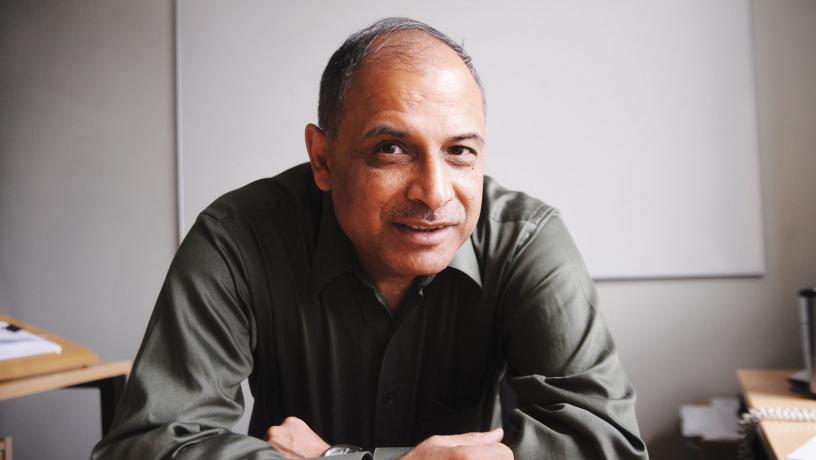
“The energy-air-water-food nexus is the existential question of our times,” says Sanat Kumar, the Bykhovsky Professor of Chemical Engineering.
Recognizing the interdependence of the earth’s resources, Kumar believes developing affordable, sustainable energy solutions will be at the heart of increasing access to pure air, clean water, and food security for developing countries.
Advanced membranes will play a key role in this undertaking. For decades, membrane technology has been driving efficiencies in water purification, gas separation for more sustainable energy production systems, and ion separation for energy storage and batteries. Yet, the separation capabilities of standard polymer-based membranes (plastic films) are limited.
Kumar’s research group focuses on developing novel hybrid materials that combine polymers with nanoparticles to gain desired properties and improve separating abilities while reducing plastics consumption. Membranes perform best when the dispersion of nanoparticle fillers is uniform in the polymer matrix. His team has developed a process to chemically bond polymer chains to the fillers in such a way that they self-assemble into regular arrays, exhibiting the evenness needed for better performance.
To date, Kumar has developed materials that perform two to five times better than existing technologies for gas separation and has ideas for further improvements that could translate these methods for commercial use.
In another research thrust, his group seeks to improve the mechanical or electrical properties of polymeric membranes by drawing inspiration from nature, particularly nacre, commonly known as mother-of-pearl. Further advances in this area could lead to more sustainable, composite materials that are durable enough to replace structural materials in buildings and infrastructure.
With the potential for climate change to exacerbate social inequalities, Kumar feels a sense of urgency in bringing about sustainable technologies that will benefit all.
“It is our responsibility, especially as a school dedicated to engineering for humanity, to focus on the poor and provide them with the means to live their lives with dignity.”
The Big Idea - Reimagining the Battery
Conscientious consumers are always on the lookout for ways to limit carbon footprints, whether driving hybrids, installing solar panels or purchasing sustainably-sourced goods. But those results can be a drop in the bucket beside massive systemic emissions—measured in hundreds of billions of tons—stemming from key industrial sectors like construction and big data. Just cleaning up these two fields could be a game changer in the fight against climate change.
Take your home, for instance. Better insulation and more weather stripping are decent ways to increase a building’s efficiency after the fact, but by the time it’s been built tons of carbon emissions have already been baked in: conventional processes for manufacturing cement and steel currently account for 11% of all anthropogenic greenhouse gas emissions, and that’s likely to double by 2050 absent urgent innovation.
Ah-Hyung (Alissa) Park, Lenfest Earth Institute Associate Professor of Climate Change in earth and environmental engineering, as well as an associate professor in chemical engineering and director of the Lenfest Center for Sustainable Energy, is also cofounder of the Columbia startup GreenOre CleanTech. The company utilizes her patented methods for harvesting carbon and valuable chemical products from iron and steel waste known as slag. In addition to deploying their methods in China, where they have a commercial plant in the works, she and her team are also partnering with the state of Wyoming to replace standard cement production with a greener approach recycling ash from power plants into a variety of useful materials.
With cement processing alone generating around five percent of humans’ greenhouse gas emissions, going carbon-neutral would be transformative—but carbon-negative could be revolutionary. Professors Daniel Esposito and Shiho Kawashima are working on a new cement alternative that could help lay the foundation for a greener urban landscape. Synthesized from seawater, their material can withstand as much weight as the industry standard while absorbing substantial amounts of CO2. They’re currently translating their research into scalable production processes for future construction.
“We’re getting promising results in the lab, so we plan to do lifecycle analysis and techno-economic analysis to demonstrate our technology’s environmental benefits and economic viability,” Kawashima says.
While less conspicuous, data infrastructure is on pace to become another enormous source of emissions. Moving, storing, and particularly processing the trillions of gigabytes so effortlessly at our fingertips requires a vast amount of energy. If present trends continue, the information economy could soon produce half as many greenhouse gases as the entire transportation sector, with cloud computing consuming a fifth of the world’s electricity. As is, data centers already cause nearly two percent of our total carbon output—and that’s while we’re still at the dawn of artificial intelligence. Training algorithms require gigawatts of power, and the energy costs of rapidly proliferating AI could be staggering.
That’s partially because our wireless lifestyles actually rely on a vast tangle of inefficient electronic wiring, fundamentally the same materials we’ve been using since the 1940s. Professors Keren Bergman and Michal Lipson, however, are reconceiving the mechanics of computation using a whole new framework: frictionless optical components. Fiberoptics already use this principle to transfer data over long distances—but such bulky systems have proved incompatible with today’s data centers. Lipson and Bergman’s “photonic” elements neatly sidestep that issue by encoding data in the form of light directly on the chip.
Lipson’s group recently had a breakthrough pairing an optical funnel with optical fiber to achieve highly efficient high-bandwidth transmissions even when components weren’t in perfect alignment, while Bergman’s group in the Lightwave Research Laboratory just won a $4.8 million DARPA grant to develop efficient optical interconnects for feeding high-bandwidth signals from chips to anywhere in a computing system. Such advances could one day soon allow artificial intelligence to reach unlimited potential without consuming unreasonable amounts of energy.