Columbia and Tau have been longtime partners. The two have collaborated through Preindl, a leader in designing next-generation power converters, and his Motor Drives and Power Electronics Laboratory (MPlab) to design modern power electronic converters and motor drive solutions that are not only high-performance, but also scalable. 

Their groundbreaking collaborative work has been recognized across academia and industry for pioneering the field of software-defined power conversion, dating back in part to Preindl’s NSF CAREER Award. The collaboration has been celebrated through a number of awards including Autotech Breakthrough’s V2X and V2I Innovation of the Year Awards, Fast Company World Changing Ideas recognition, and Fast Company’s Best Workplace for Innovators (2023, 2024). The Center provides a platform to further advance their work together at a new scale. 

“Our vision is to ‘electrify humanity,’” Preindl said. “Our Center will build advanced energy conversion technologies that enable electrification of energy systems and scale electrification at unprecedented levels.”

Focus of the Center

Image
Two Columbia Engineering students lean over a table to discuss a triangular robot.
Founder and CEO of Tau Motors Wesley Pennington (left) with Associate Professor of Electrical Engineering Matthias Preindl. Credit: Jane Nisselson

The Center will focus on research in electric energy conversion and leverage advanced power electronics, novel topologies for power converters, modern and distributed control, and machine learning/artificial intelligence to enable reliable and resilient solutions that facilitate a circular economy. In doing so, researchers are also actively working to limit the use of materials adversely affecting the environment, such as rare earth elements or critical minerals.

The Center will engineer solutions for sustainable electric transportation and energy systems. Target applications include electric drivetrains, propulsion systems, and electric supply infrastructure; distributed energy resources such as renewable energy and battery storage for the electric grid; and emerging electric loads including data centers and heating electrification.

The Center also intends to support the translation of outcomes to industrial applications to maximize the impact through strategic technology development and transfer. 

Finally, the Center plans to support the training of highly qualified engineers and scientists in the field and provide mentorship and career development for students and researchers engaging with the Center. 

“We are excited to deepen our partnership with both Columbia and Dr. Preindl through the founding of the Center alongside Tau,” said Wesley Pennington, Tau’s founder and CEO. “We have an established and celebrated history of leading research and innovation together with the university and look forward to deepening our collaboration to further accelerate the electrification of the world. The Center of Advanced Electrification in collaboration with Tau Motors will provide a larger platform to continue to invent, develop, translate, and deploy technologies that accelerate the energy transition, as well as train and build future leaders to extend our mission as we solve some of the world’s most pressing challenges.”

Future Center activities

The Center team is already planning a broad range of activities rooted in scientific innovation and technical advancement of the field. In addition to research and innovation activities, the Center is developing programs including the organization of an annual symposium to foster technical discussions and interactions between faculty and industry. They are also developing a seminar series with invited external speakers, as well as student activities, such as recruiting events.

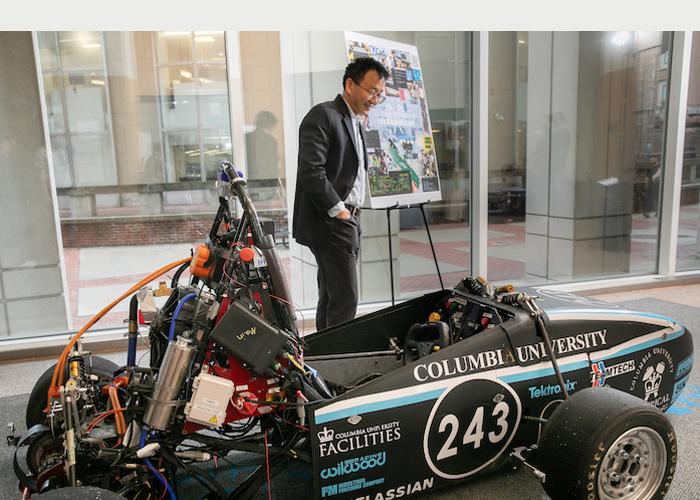
We celebrated our graduates’ senior design projects. We partnered with the dental school to launch a new program in dental engineering. Along with our colleagues at Columbia Business School, we graduated the first cohort of MBAxMS students. The Columbia University Formula Racing team made an impressive showing at the national competition, and the Columbia Space Institute’s rocketry team brought home a gold (and set its own records) at the inaugural FAR-OUT competition in the Mojave Desert. Our faculty partnered with collaborators across disciplines to teach courses on the social implications of AI and the political impact of algorithms and machine learning. Researchers in the storied Carleton Laboratory worked with the city to restore the pumps in the Morningside Park pond. 

Driving the Dialogue

Image
Photo of Myers and Hendon
Frequent collaborators Christine Hendon (left) and Kristin Myers are working to advance women's health reserach. (Credit: Chris Taggart)

We launched The Lever, a limited-series newsletter featuring faculty perspectives on global challenges. The first series explored solutions for storing renewable energy. We also kicked off the Lecture Series in AI. In one of the first talks, the legendary deep-learning researcher Yann LeCun, who is Meta’s chief AI scientist, delivered a talk to more than 1,000 attendees. Media outlets across the world tapped our researchers’ expertise in articles and video on topics from digital twins in biomedical research to desalination technology and intelligent robots— and every aspect of AI. Kristen Myers and Christine Hendon challenged us to imagine how engineers can improve women’s health, and Pierre Gentine asked if AI could save the environment. Tal Danino dazzled readers with an art book featuring research inspired images from his lab.

Celebrating Faculty Excellence

Image
Jingguang Chen
Marco Giometto's research advances the current understanding of nature and engineering systems and supports the development of effective policies to improve our interaction with the environment. (Credit: Jane Nisselson)

Columbia Engineering celebrated the election of faculty members Jingguang Chen and Jeannette Wing to the National Academy of Engineering and congratulated Marco Giometto, Alex Urban, and Brian Smith on their NSF CAREER awards. We commended Gordana Vunjak-Novakovic on winning a Chan Zuckerberg Biohub New York Investigator Award. We were pleased to share that Oleg Gang was named a 2024 Vannevar Bush Fellow, that Ke Cheng received the Coulter Award, that Christos Papadimitriou and Michael Weinstein were named Simons Society Senior Fellows. We congratulated Vishal Misra on his appointment to vice dean of computing and artificial intelligence and John Kymissis on being named vice dean of infrastructure and innovation, and Kymissis' election to the National Academy of Inventors.

Prof. Adam Sobel testified before congress yesterday, telling the House Science, Space, and Technology Committee that much of the evidence is in when it comes to linking global warming with increasingly extreme weather.

Sobel, a professor of applied physics and applied mathematics at Columbia Engineering, also heads up the University’s Initiative on Extreme Weather and Climate. Our colleagues over at State of the Planet have a great recap of the testimony, in which Sobel gives a clear picture of current understanding of the connection between climate change and extreme weather events like hurricanes and heat waves. From their piece:

He described heat waves as the best understood type of extreme weather event, and said research linking heatwaves to global warming is substantive. “When any heat wave occurs today, it is likely that global warming made it more likely, more intense or both.”

He also conveyed science’s understanding about the way climate change is impacting the intensity and frequency of hurricanes.

“Hurricane risk is increasing due to climate change,” he said. “Storm surge-driven coastal flooding is certainly becoming worse due to sea-level rise. We know little, though, about how hurricane frequency — the total number of storms per year — changes with warming.”

Sobel also touched on impacts to tornadoes, storm surge flooding, and coral reefs. Check out his full testimony in the video above.

A written transcript is available here.


Smarter Cities = Situationally Aware Vehicles 

Image
cosmos_816
COSMOS integrates multi-size nodes operating at the rooftop, street, and personal/vehicle level, and will enable piloting smart intersection and cloud-assisted vehicle technology. (Courtesy of Gil Zussman)

Underlying each of these applications is a central premise—the need for highly coordinated data collection from a huge network of widely distributed sensors. But with the advent of COSMOS—one of only two 5G-and-beyond testbeds currently being deployed in the United States—Columbia Engineering faculty are gaining access to an unprecedented outdoor lab. COSMOS enables not only more sophisticated analysis, but also new capabilities through performance enhancements such as millimeter-wave wireless communications, edge cloud computing, close integration of wireless and optical networks, and full-duplex radios that enable simultaneous two-way data transmission.

Occupying a square mile of Manhattan adjacent to Columbia’s Morningside campus, COSMOS is a National Science Foundation– funded effort composed of a consortium of universities, the local community, and industry. The initiative is led by Rutgers University, Columbia University, and New York University, plus the City of New York, Silicon Harlem, City College of New York, University of Arizona, and IBM.

Image
zussman_and_kostic
Gil Zussman and Zoran Kostic (Photo by Timothy Lee Photographers)

According to Electrical Engineering Associate Professor Gil Zussman, Columbia’s PI on the project, the testbed’s infrastructure will include several large wireless nodes—or base stations— containing software-defined radios to be located on top of buildings such as Columbia Engineering’s current home in Mudd. About 40 medium-size nodes will be placed at street level at building sides or on light poles, and some 200 experimental mobile devices will be hooked into the network. Edge cloud computing—servers integrated into the wireless access network—will speed up the data processing and response time.

The project leverages the talents of several Columbia engineers, including Harish Krishnaswamy, associate professor of electrical engineering, and Henning Schulzrinne, a professor of computer science and electrical engineering. Electrical Engineering Associate Professor Zoran Kostic has tapped into COSMOS to study the busy intersection at 120th Street and Amsterdam Avenue. Here, Kostic is piloting technologies designed to enable the future of smart-city traffic—where swarms of autonomous vehicles move seamlessly around crowds of pedestrians. To achieve such intricate synchronization, these vehicles must share data between cameras, optical radars, positional sensors, and infrastructure using ultrafast millimeter-wave radios with miniscule latencies. Harmonizing the movement of vehicles and pedestrians without human intervention requires real-time learning systems deployed by on-site edge computing nodes. “Places like Manhattan will require assisted vehicle autonomy, facilitated by infrastructure to vehicle and vehicle to infrastructure communication,” Kostic points out.

For the elderly and visually impaired, in particular, that level of situational awareness will become crucial for safely navigating driverless intersections. But this work will lead not just to better coordination between cars and pedestrians; it’ll also enable smoother traffic flow overall. In fact, Mudd’s 12th floor currently houses several 3D bird’s-eye video cameras that are already accumulating data to help train a deep learning model for traffic control, while more cameras at the second-floor level collect data on pedestrian movements. In the next phase, slated for the winter, University vehicles will be equipped with sensors and transmitters. Initial experiments will explore the ways human drivers can benefit from real-time data about potential hazards and about the real-time activity of other vehicles. To implement and emulate use cases representative of the most challenging traffic conditions, the team has built a miniature model of the 120th Street and Amsterdam Avenue intersection at Winlab, hosted at Rutgers’ New Brunswick campus.

Smarter Cities = Climate-proofed Infrastructure

Image
shiho_kawashima_816
Shiho Kawashima (Photo by Timothy Lee Photographers)

Unchecked, the cost of climate change could severely impact a city’s bottom line. This is particularly true for the vast majority of urban centers that sit near coastal areas. A new methodology using Lower Manhattan as a test case is being designed to compute the optimal protective strategy for buffering coastal infrastructure subject to storm surge combined with rise in sea level. Developed by civil engineer George Deodatis, optimization expert Daniel Bienstock, and applied mathematician Kyle Mandli, this smart decision scheme factors in prescribed budgets to help municipalities consider various measures—including seawalls, artificial islands/reefs, wetland restoration, raising infrastructure, strategic retreat, and others—in order to implement solutions that are ultimately cheaper than taking no action.

To ensure long-term sustainability, cutting emissions remains another crucial piece of the climate-proofing equation. Today, between 5 percent and 8 percent of man-made carbon emissions derive from cement manufacturing. Burning enough current raw material—typically, quarried limestone—to produce one ton of cement also releases one ton of CO2.

In a bid to dramatically increase the sustainability of our infrastructure’s core building blocks, Shiho Kawashima, associate professor of civil engineering, investigates new manufacturing techniques for alternative binders—building a new intelligence into the system from the ground up.

In her search for abundant, inexpensive, sustainable alternatives to source raw materials for clinkers and binders, Kawashima is collaborating with colleagues from the chemical engineering department. Associate Professor Daniel Esposito is developing a technique for electrochemically harvesting metal hydroxides from seawater, which can replace cement and significantly reduce the CO2 associated with concrete.

With Ah-Hyung (Alissa) Park, an associate professor in both earth and environmental engineering and chemical engineering as well as director of the Lenfest Center for Sustainable Energy, Kawashima is also examining techniques to utilize materials derived from upcycling of wastes and carbon sequestration as alternative binders.

Ultimately, the kind of convergence illustrated in each of these projects is precisely what leads to smarter outcomes, by marrying a specific vision with diverse strategies and a flexible approach—one that respects natural resources while balancing the needs of government, industry, and communities.

“You don’t create technology just to have technology,” says Culligan. “You create technology to serve people. Our school’s vision for smarter cities is one that aims to improve the lives of urban inhabitants.”


New York, NY—May 6, 2019—Hypersaline brines—water that contains high concentrations of dissolved salts and whose saline levels are higher than ocean water—are a growing environmental concern around the world. Very challenging and costly to treat, they result from water produced during oil and gas production, inland desalination concentrate, landfill leachate (a major problem for municipal solid waste landfills), flue gas desulfurization in fossil-fuel power plants, and effluent from industrial processes.

If hypersaline brines are improperly managed, they can pollute both surface and groundwater resources. But if there were a simple, inexpensive way to desalinate the brines, vast quantities of water would be available for all kinds of uses, from agriculture to industrial applications, and possibly even for human consumption.

A Columbia Engineering team led by Ngai Yin Yip, assistant professor of earth and environmental engineering, reports today that they have developed a radically different desalination approach—“temperature swing solvent extraction (TSSE)”—for hypersaline brines. The study, published online in Environmental Science & Technology Letters, demonstrates that TSSE can desalinate very high-salinity brines, up to seven times the concentration of seawater. This is a good deal more than reverse osmosis, the gold-standard for seawater desalination, and can handle approximately twice the seawater salt concentrations.

Image
yip img 9413
Amine solvents (top phase) extracting water from hypersaline brines (bottom phase).

Currently, hypersaline brines are desalinated either by membrane (reverse osmosis) or water evaporation (distillation). Each approach has limitations. Reverse osmosis methods are ineffective for high-saline brines because the pressures applied in reverse osmosis scale with the amount of salt: hypersaline brines require prohibitively high pressurizations. Distillation techniques, which evaporate the brine, are very energy-intensive.

Image
cover-tsse-yip-1600
Illustration showing fresh water production from hypersaline brines by temperature swing solvent extraction

Yip has been working on solvent extraction, a separation method widely employed for chemical engineering processes. The relatively inexpensive, simple, and effective separation technique is used in a wide range of industries, including production of fine organic compounds, purification of natural products, and extraction of valuable metal complexes.

“I thought solvent extraction could be a good alternative desalination approach that is radically different from conventional methods because it is membrane-less and not based on evaporative phase-change,” Yip says. “Our results show that TSSE could be a disruptive technology—it’s effective, efficient, scalable, and can be sustainably powered.”

TSSE utilizes a low-polarity solvent with temperature-dependent water solubility for the selective extraction of water over salt from saline feeds. Because it is membrane-less and not based on evaporation of water, it can sidestep the technical constraints that limit the more traditional methods. Importantly, TSSE is powered by low-grade heat (< 70 C) that is inexpensive and sometimes even free. In the study, TSSE removed up to 98.4% of the salt, which is comparable to reverse osmosis, the gold standard for seawater desalination. The findings also demonstrated high water recovery (>50%) for the hypersaline brines, also comparable to current seawater desalination operations. But, unlike TSSE, reverse osmosis cannot handle hypersaline brines.

“We think TSSE will be transformational for the water industry. It can displace the prevailing practice of costly distillation for desalination of high-salinity brines and tackle higher salinities that RO cannot handle,” Yip adds. “This will radically improve the sustainability in the treatment of produced water, inland desalination concentrate, landfill leachate, and other hypersaline streams of emerging importance. We can eliminate the pollution problems from these brines and create cleaner, more useable water for our planet.”

Yip’s TSSE approach has a clear path to commercialization. The heat input can be sustainably supplied by low-grade thermal sources such as industrial waste heat, shallow-well geothermal, and low-concentration solar collectors. He is now working on further refining how TSSE works as a desalination method so that he can engineer further improvements in performance and test it with real-world samples in the field.

Columbia Engineering

Columbia Engineering, based in New York City, is one of the top engineering schools in the U.S. and one of the oldest in the nation. Also known as The Fu Foundation School of Engineering and Applied Science, the School expands knowledge and advances technology through the pioneering research of its more than 220 faculty, while educating undergraduate and graduate students in a collaborative environment to become leaders informed by a firm foundation in engineering. The School’s faculty are at the center of the University’s cross-disciplinary research, contributing to the Data Science Institute, Earth Institute, Zuckerman Mind Brain Behavior Institute, Precision Medicine Initiative, and the Columbia Nano Initiative. Guided by its strategic vision, “Columbia Engineering for Humanity,” the School aims to translate ideas into innovations that foster a sustainable, healthy, secure, connected, and creative humanity.

About the Study

The study is titled “Membrane-less and Non-evaporative Desalination of Hypersaline Brines by Temperature Swing Solvent Extraction.”

Authors are: Chanhee Boo,† Robert K. Winton,† Kelly M. Conway,† and Ngai Yin Yip*,†,‡ 
† Department of Earth and Environmental Engineering, Columbia Engineering
‡ Columbia Water Center, Columbia University

The authors declare no financial or other conflicts of interest.

Subscribe to Sustainability &amp; Climate