University Leadership Series: Climate Change and the Transition to Net Zero
Climate Change and the Transition to Net Zero with Dean Boyce and Dean Costis Maglaras
To mitigate the effects of climate change, the world needs not only innovative technological solutions to reduce emissions, but economic and business incentives to ensure widespread global adoption and implementation.
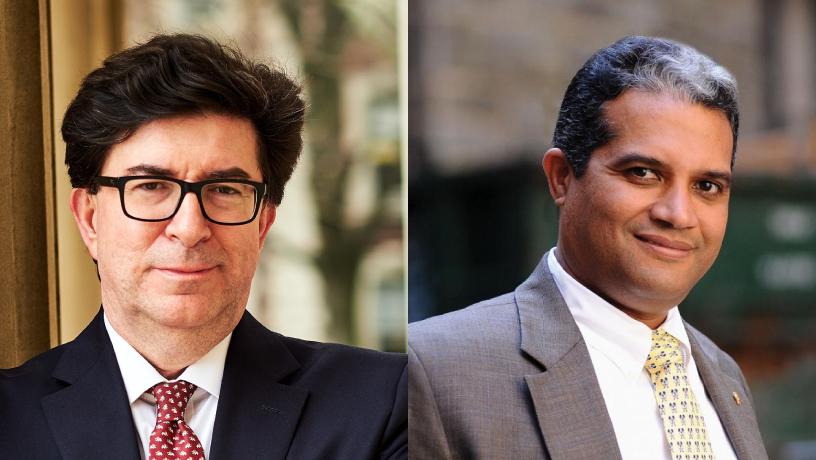
This natural alignment between engineering and business in the fight against climate change was the inspiration behind a recent conversation on “Climate Change and the Transition to Net Zero,” hosted by the Columbia Global Centers and featuring Engineering School Dean Mary Boyce and Columbia Business School Dean Costis Maglaras. The discussion—which also included Safwan Masri, executive vice president for Global Centers and global development, and Julie Kornfeld, vice provost for academic programs—highlighted the collaborative, pan-disciplinary work taking place at Columbia around this era-defining issue, and looked forward to the future engineering, business, and policy breakthroughs needed to facilitate a transition to carbon neutrality.
Safwan Masri opened the discussion by underscoring the urgency with which scientists and policymakers must take up the challenge of addressing climate change. “We must acknowledge that we are actually talking about survival, for ourselves and for the planet,” he said, citing the growing incidence of severe drought, flooding, and natural disasters worldwide, as well as their harmful effects on global migration, food supply, and housing. “Where once we focused on sustainable practices, we now inquire about planning, design, and resilience--because this issue is no longer one we can confine to future generations. It has collapsed into one that is immediate,” he warned.
Both Dean Boyce and Dean Maglaras began by emphasizing that climate change is a core issue for both the Engineering and Business Schools, and that their students and faculty are naturally suited to tackle these issues. Citing the “Engineering for Humanity” ethos, Dean Boyce underscored that the Engineering School’s focus on climate solutions—from decarbonization to clean chemicals processing—derives from its guiding mission to produce a more sustainable, connected, healthy, secure, and creative world. Dean Maglaras, meanwhile, stressed that the Business School views climate change as one of the most important challenges facing this world—one that will transform virtually every industry and impact every Business student’s career path.
The sheer number of collaborations taking place at Columbia across academic disciplines is reflective of the truly interconnected nature of the challenges and solutions around climate change, Dean Boyce and Dean Maglaras emphasized. As an example, Dean Boyce noted how partnerships on climate modeling research have brought together physics- and chemistry-based researchers with computer science experts to produce artificial intelligence-powered predictions on our changing climate. That modeling, she said, is used to guide policymakers and business leaders looking to drive solutions. “As all of these pieces start to knit together, it creates more and more collaborations from one school to another to another.” The recently announced Climate School, she said, will act as a force multiplier to these existing collaborations by bringing together even more disparate climate initiatives across the broader University to dramatically accelerate their impact. And, deepening the Engineering and Business Schools’ commitment to interdisciplinary climate research, Dean Boyce highlighted a forthcoming degree program at Columbia that will combine a Master of Science in Engineering with an MBA and empower students to maximize their impact on sustainability studies.
Beyond collaborations at the University, driving climate solutions requires translating academic developments into real-world impact. “Producing and distributing innovative sustainable technologies at scale and at low cost is still a pending problem if we’re going to do it in a timely manner, in a way that is equitable, and in a way that the world’s population can absorb,” Dean Maglaras said. That’s where initiatives like Columbia Technology Ventures—which helps to transfer inventions from academic research to outside organizations—can play an integral role in transforming engineering ideas and technologies into new businesses. Dean Boyce also highlighted the Engineering School’s efforts to provide more support to “tough tech” by accelerating the licensing of intellectual property into start-up companies—or license it to existing companies—in order to help some of the school’s best innovations get off the ground.
In addition to this partnership between engineering and business to bring solutions to scale, widespread adoption of sustainable technology will also require bold commitments at the policy level, including transformative changes in regulatory frameworks. As an example, Dean Maglaras noted that the cost of producing solar energy has fallen by a factor of 100 in the last 20 years and by tenfold in the last ten years. “That happened because we had engineering breakthroughs and because there were incentives put down by governments, in Europe and then in the U.S., to support the installation,” he stressed. “We need to do that in other areas of climate change as well.”
Policies to provide greater support for engineering research, Dean Boyce and Dean Maglaras said, are also a scientific and economic imperative for the United States. Given the potential for job creation, investing in green infrastructure is “strategically important” for the U.S., Dean Malgaras said. “It’s smart policy for climate change, but it’s also smart policy domestically.” Another policy imperative is the need to bring down prices of sustainable technologies so that it becomes feasible to deploy them worldwide. “Policy at the global level will be key to facilitate that,” Dean Maglaras said.
This focus on ensuring academic breakthroughs are translated into real-world impact is one of the ways Columbia attracts students and faculty with a passion for social responsibility, the panel noted. “No matter what field a student is pursuing, there’s a sense of wanting to have a positive impact on society,” Dean Boyce said. In that regard, she highlighted an Engineering School initiative that produces decentralized solar energy grids to bring energy to developing parts of the world. “[This project] really brought together policy and business solutions to make this sustainable over the long-term in small villages,” she said. “We need to do this at a bigger scale….to bring people out of poverty.” But aside from working on readily deployable climate solutions, Dean Boyce said one of the most important ways students can prepare to have a long-term impact on climate change is by working on the scientific foundations that may one day lead to revolutionary technology. “Just as we were prepared globally to create these [COVID-19] vaccines because of all the foundational work on mRNA and lipid bilayers,” she said, students today can help lay the groundwork for future breakthroughs.
The Business School, Dean Maglaras said, also seeks to produce socially responsible business leaders who will “pursue economic opportunity with a transformative impact.” Take Ethan Brown (MBA ‘08), the founder of Beyond Meat, a plant-based meat substitute company valued at over $10 billion. Maglaras said Brown had a vision to attack what he viewed as climate change’s “cattle problem,” and ended up producing one of the most successful climate companies to have come out of Columbia. “We need hundreds of these socially-minded leaders to attack other questions” related to climate change, Dean Maglaras said.
The bottom line about the world’s transition to net zero, according to Dean Maglaras? “Solutions exist and are being developed daily, weekly, monthly in breakthroughs in academic and corporate labs. Capital exists in abundance to implement these solutions at scale. We should be optimistic, but we need to work.”
Structured Bubbles
In this video, Chris Boyce, assistant professor of chemical engineering, and his colleagues explain how vibrating particles can help control the motion of bubbles, which could help lead to more sustainable mining practices.
New York, NY—August 23, 2021—A new way to control the motion of bubbles from researchers at Columbia Engineering might one day help separate useful metals from useless dirt using much less energy and water than is currently needed.
When mining for metals such as the copper used in most electronics and the lithium used in many batteries, only a small fraction of the material that is mined is useful metal, with the vast majority just useless dirt-like particles.
"We have to separate the useful metals from the useless particles, and we do this by blowing air bubbles up through them," said Chris Boyce, assistant professor of chemical engineering at Columbia Engineering. However, "this process utilizes a large amount of energy and water, causing climate change and water shortages, thus creating problems we are trying to prevent. We have this issue in part because we currently cannot control the motion of these bubbles."
Now Boyce and his colleagues reveal that if they vibrate these particles while blowing air up through them, the normally chaotic motion of these bubbles becomes orderly and controllable. The vibrations cause the particles to quickly shift between solid-like to fluid-like behavior, which in turn helps structure the bubbles into regularly spaced triangular arrays.
"I think the simple addition of vibration to go from chaos to order is beautiful," Boyce said. Their study appears August 23 in the journal Proceedings of the National Academy of Sciences.
Having a way to control the behavior of these bubbles can help scale up and optimize separation techniques. "We expect that the ability to create structure in flows can reduce energy and water use in mining as well as improve the efficiency of many clean energy processes," Boyce said.
The researchers now aim to apply this structured bubbling to sustainable mining separation techniques.
Columbia Engineering
Columbia Engineering, based in New York City, is one of the top engineering schools in the U.S. and one of the oldest in the nation. Also known as The Fu Foundation School of Engineering and Applied Science, the School expands knowledge and advances technology through the pioneering research of its more than 220 faculty, while educating undergraduate and graduate students in a collaborative environment to become leaders informed by a firm foundation in engineering. The School’s faculty are at the center of the University’s cross-disciplinary research, contributing to the Data Science Institute, Earth Institute, Zuckerman Mind Brain Behavior Institute, Precision Medicine Initiative, and the Columbia Nano Initiative. Guided by its strategic vision, “Columbia Engineering for Humanity,” the School aims to translate ideas into innovations that foster a sustainable, healthy, secure, connected, and creative humanity.
About the Study
The study is titled "Dynamically structured bubbling in vibrated gas-fluidized granular materials."
The study appeared in the journal Proceedings of the National Academy of Sciences on August 23, 2021.
Authors are: Qiang Guo, Yuxuan Zhang, Azin Padash, Kenan Xi, Thomas M. Kovar, and Christopher M. Boyce.
Department of Chemical Engineering, Columbia Engineering.
The researchers received support from the China Scholarships Council and the Bakhmeteff Fellowship for Fluid Mechanics.
Can you tell us a bit more about compound rain clusters and why is this happening?
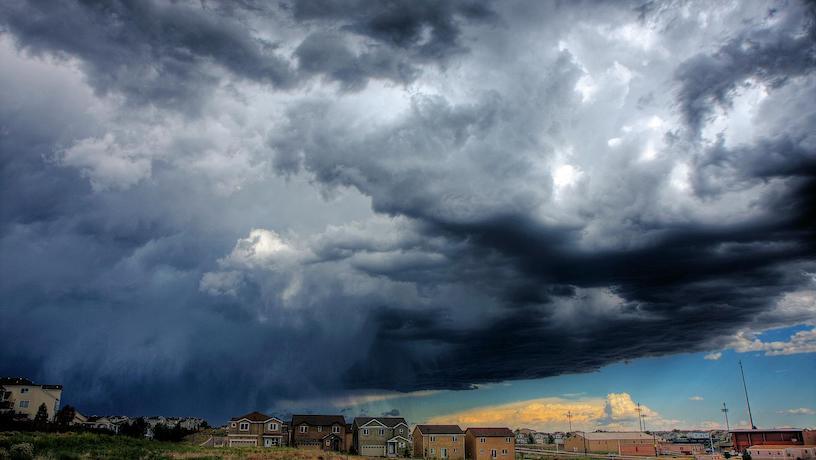
An open question has been whether the climate will become “stickier” or more random as it warms - stickier meaning that the wind patterns just persist for longer periods of time, random meaning things get disorganized. It seems that there are modest but detectable changes -- at least over the United States -- where the incidence of persistent patterns in which waves of moisture are repeatedly directed to the same places is increasing. Each wave brings rain that starts to fill up dams and then, if a bigger rain event happens and the reservoir is vulnerable, there is the potential for failure.
Our study is the first analysis of rainfall sequences and events associated with recent
hydrologic failures of 552 dams in the U.S. We found that persistent atmospheric circulation patterns that lead to recurrent rainfall events, rather than just more moisture in the atmosphere, are a possible reason. The probability of these compound precipitation risks has increased across part of the country. With over 90,000 aging dams still in service, the increasing likelihood of intense rainfall sequences raises urgent concerns about future dam failures.
What are the near-term solutions?
We need to visit the portfolio of more than 90,000 dams in the U.S. and check not just their state of maintenance but also how they are being operated to decide which ones should be demolished, which ones repaired, and which ones given better strategies to hold on to water they already contain while we improve our predictions of floods or droughts. We need to improve the near-term prediction of persistent rainfall patterns. It’s urgent that we do a portfolio risk analysis that considers the climate, fragility, and operational risk factors with a mapping to potential impacts from dam failure so that we can better understand the collective risk of cascading failure of critical infrastructure that would be triggered by dam failure and its socio-economic impacts.
Is this happening across the globe, not just in the U.S.?
Yes, we see similar behavior in the data in many places around the world, especially in the higher latitudes (>30), where the storm tracks organize and then persist. But a more comprehensive study is needed.
What have been some of the successes out of this collaboration to date?
Our work has generated the first air pollution data from highly populated cities such as Kinshasa, Democratic Republic of the Congo. We are leading the state of the science in low-cost sensor applications, building relationships with local decision makers and informing policy in India, and increasing capacity among thousands of local practitioners on air quality management and air pollution science.
Dams in which areas of the U.S. are more prone to collapsing and why?
We have concerns with older dams that are not being maintained; these are primarily concentrated in the Northeast, Upper Midwest, and Southeast. And while Western dams tend to be newer and larger, in 2017 the tallest U.S. dam operated by the State of California -- Oroville -- nearly failed, and 200,000 people had to be evacuated. Persistently high, but not extraordinarily high, rainfall was implicated. The reservoir was full because the operators wanted to hang on to the water in case they lapsed back into drought, and a modest amount of rain forced them to use the overflow spillway (which was in poor repair), and it failed - the concrete just ripped off as the water went over it. They switched to the emergency spillway, which also failed.
Are hurricanes playing a major role in these scenarios?
Hurricanes are really concerning since the amount of water that they can drop could easily overwhelm the capacity of local reservoir managers to cope with. In 2015, 52 dams failed in South Carolina in just one hurricane event–Hurricane Joaquin. With Hurricane Harvey, the Addicks and Barker Reservoirs in Houston were very vulnerable to failure, and a last-ditch effort to release water from them and flood downstream areas– in the middle of the night–prevented a more catastrophic failure.
There has been a concern that hurricanes will be more frequent and stronger with global warming, and evidence has been presented in favor of and against this argument. Harvey persisted in place and kept on raining longer than any prior hurricane in the region, so the emerging question is whether we will see more of that. If we do, the vulnerability of dams may go way up since they may not be able to handle the resulting deluge.
What do you think about all this?
This seems to be a silent crisis so far. Since 2000, we’ve had a dam failure due to overtopping, on average every two weeks in the U.S. Luckily, most of these have been small dams, and the loss of life and immediate impact have not been catastrophic. But if a large dam were to fail above a major population center or a power plant or a super fund site or a bridge, the impacts could be devastating and long-lasting. The silence would be broken with a bang.
Lead Photo Credit: Kirk Fisher/Shutterstock