Image

Allen H. Boozer

Professor of Applied Physics

Image

Ken Shepard

Lau Family Professor of Electrical Engineering and Professor of Biomedical Engineering

Student achievements 

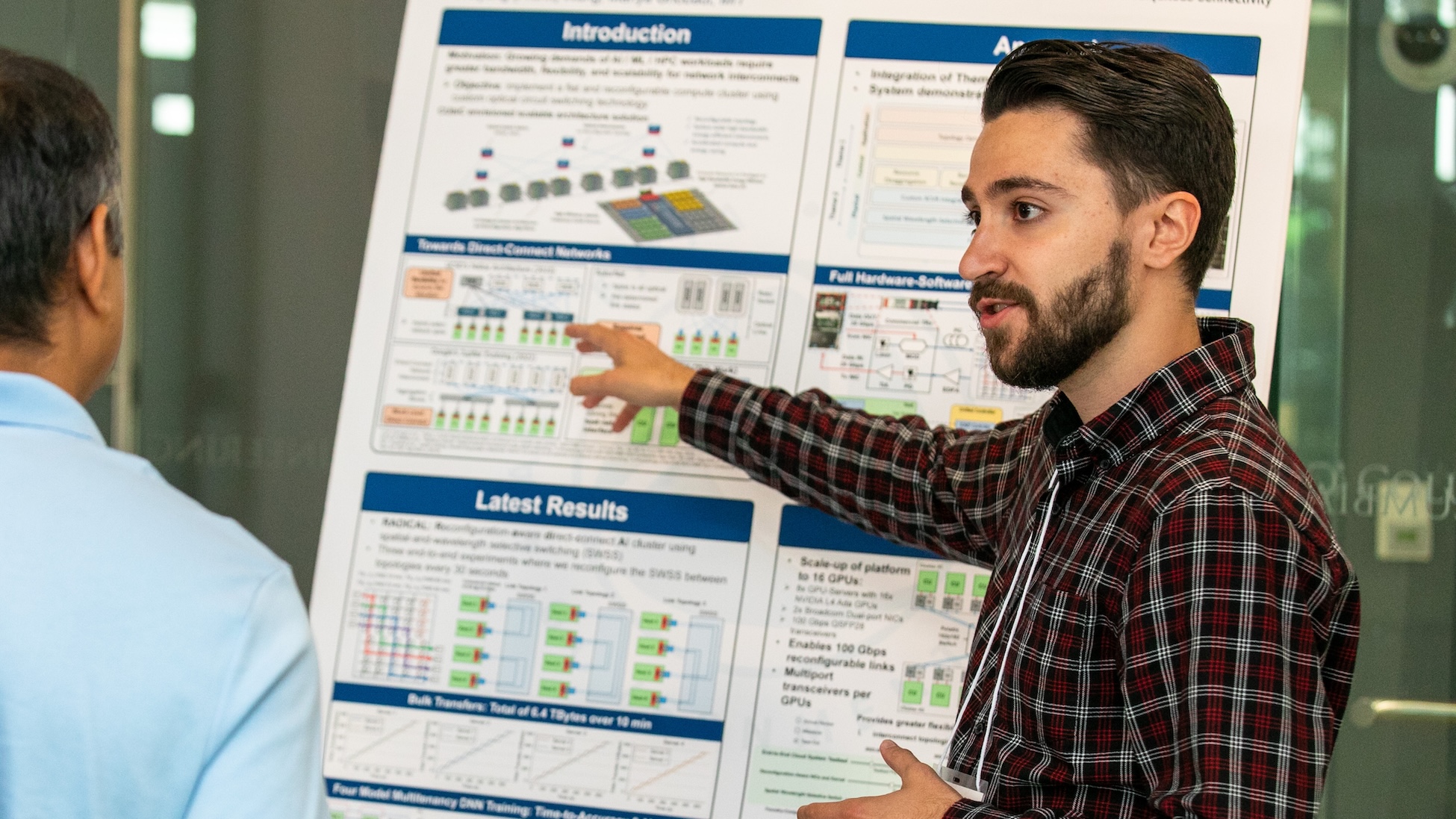
The annual review also commemorated the student research being done across the three themes of CUbiC. Theme 1 is research that takes a systems-level approach to improving bandwidth and connectivity. 

The first award went to Michael Cullen, a fifth-year PhD student at Columbia. He’s been working with CUbiC since the start of the center on the incorporation of photonics to improve bandwidth for AI training systems. His project tested photonic and electronic architectures to test how the two could work together in a simulated environment. 

“We can leverage the best of our photonic design and marry it with the best of other circuit designs and achieve really nice results in hybridized communications,” said Cullen. 

Anriban Banik, a third-year PhD student from UC Santa Barbara, took home the next award for Theme 1. Banik worked on a framework to improve millimeter-wave radar networks, a system that uses electromagnetic waves to map spaces.

“We wanted to utilize multiple views and introduce multiple radars so we can scale up to a huge network,” he said. Banik’s research leveraged techniques including real-time processing and one-shot fusion to improve calibration of the radar networks. 

CUbiC’s second theme is improving bandwidth by developing more efficient electric and photonic links. The first award went to Yunping Wang, a PhD student from UC Berkeley. His project tested a new photonic chiplet for high-bandwidth connectivity with a host system. 

Omar Bekdache, a third-year PhD student from the University of Illinois, also won the award for Theme 2. He tested a new framework for compute connectivity. “My biggest takeaway was the set of new insights that emerged from our COCO working group discussions and experiments, such as modeling the COCO fabric and recognizing that compute energy often dominates connectivity energy,” Bekdache said.

The third theme for CUbiC research is improving wireless connectivity, including developing the technology that could lead to next-generation wireless networks. 

Jurui Qi, a PhD student from UC San Diego, won an award for Theme 3. He presented a hybrid reconfigurable intelligent surface (RIS). Qi describes his hybrid RIS as a “hardware platform for future communications.” This technology could be used in future 6G networks, and Qi reported promising results indicating that his hybrid RIS could enable real-time device localization. 

The second award for Theme 3 went to Nagesh Patle, a fifth-year PhD student at UC Berkeley. His project was tackling limits in power delivery for eventual use in data centers.

 “We can shrink the inductors, make our transients really fast, and increase our efficiency,” he said. “The trade-off, of course, is higher cost and more complexity.” Patle proposed a hybrid switch capacitor that could deliver high voltage in a design only a few millimeters tall. 

The CUbiC annual review concluded after the awards ceremony. In the next year, the team of researchers, students, and industry partners will continue to develop the connectivity solutions. At the conclusion of her opening remarks, Bergman summed up the last year of CUbiC. “We’ve delivered,” she said. “We've delivered these immensely energy-efficient, bandwidth-dense connectivity solutions at the system level. We have this new technology now.”

“The challenge in the quantum industry is no longer a science challenge: it’s becoming an engineering challenge.”

Xuanjing Chu

How was the process to figure out your method?

I’m an experimentalist, but we had to go pretty heavily into theory and modeling for this paper. Usually, you think a theory is out there in the literature, even if it’s a few decades old, and that if there isn’t a supporting theory, you’ve done something wrong in your experiments. But there was no theory for our specific experimental case! I had to learn about microwave engineering, and we had to do all the modeling and simulations ourselves. That’s a unique challenge!

What brought you to quantum, and to Columbia originally?

I did my undergraduate degree at Fudan University in Shanghai. I was leaning towards more traditional solid-state physics, but it became really exciting to see quantum computing concepts emerge. I started seeing more and more papers pop up, and I wanted to help make the impossible possible: to go from pure laboratory demonstrations to industry-level, practical techniques. I’m a superfan of science fiction, and we’re seeing the transition from the classical to the quantum world in everyday life. I want to be part of it. 

I was aware of Jim’s SuperVan collaboration with Kin Chung Fong to explore novel qubits, and I also love New York City. I love to bike around the five boroughs and feel the architecture, the people, and the cultures change. It can feel like you are in different cities. I’ve loved being exposed to the complexity of New York, which gives me a nice break from the lab.

What does the quantum future hold?

The challenge in the quantum industry is no longer a science challenge: it’s becoming an engineering challenge. That will take a lot of people from different backgrounds to overcome. We live in a classical world, so quantum mechanics can feel intimidating, but don’t be afraid. Now is the time to jump in! 


Xuanjing Chu is mentored by James Hone, Wang Fong-Jen Professor of Mechanical Engineering and a Columbia Quantum Initiative faculty member.

Subscribe to Materials, Sensors & Devices