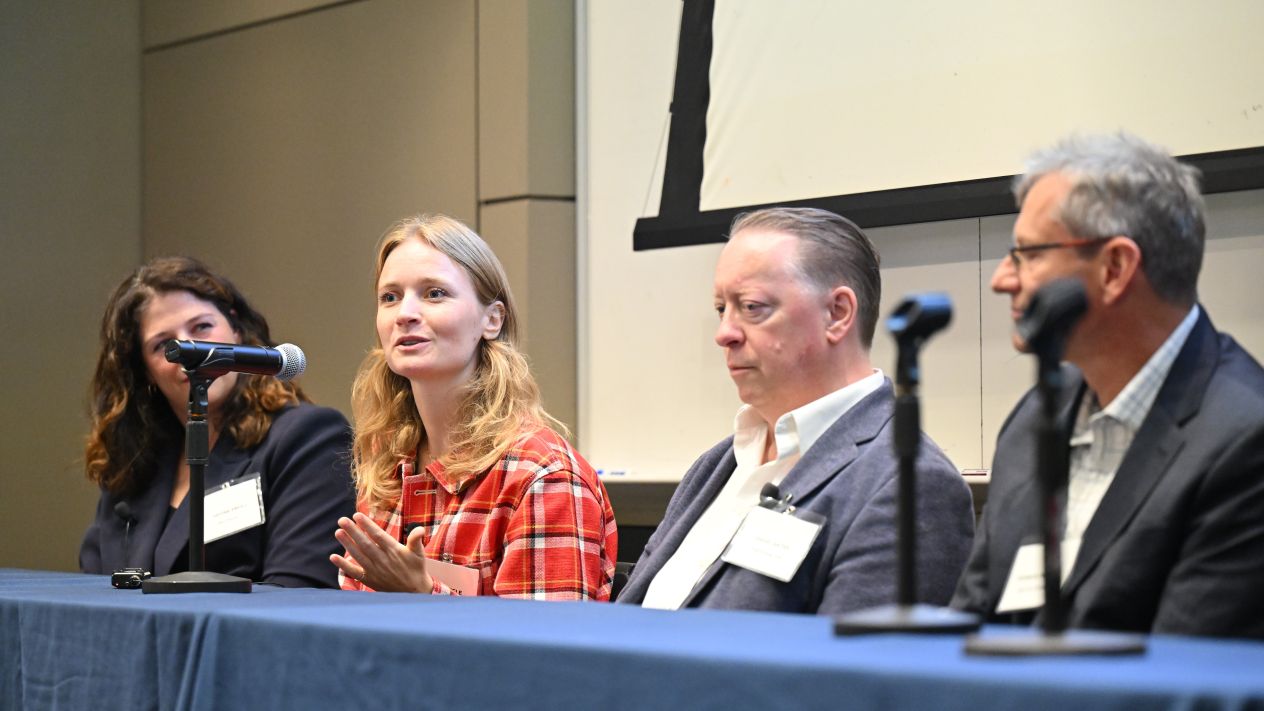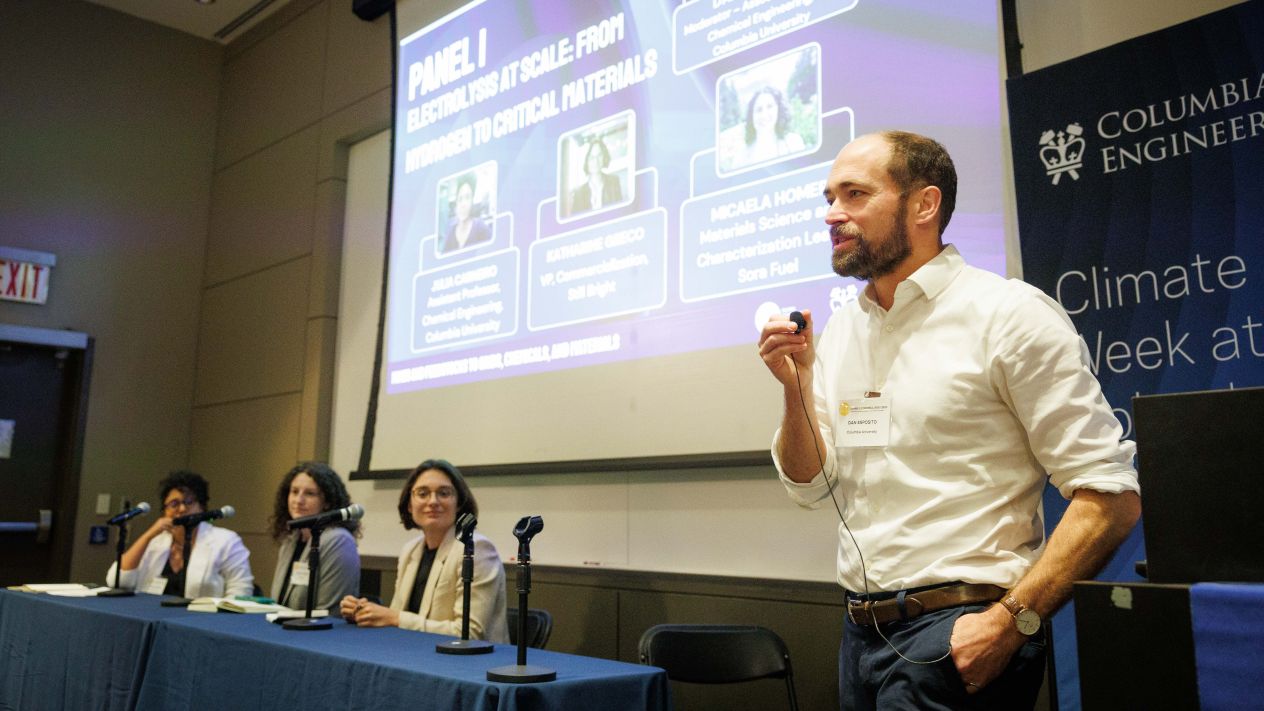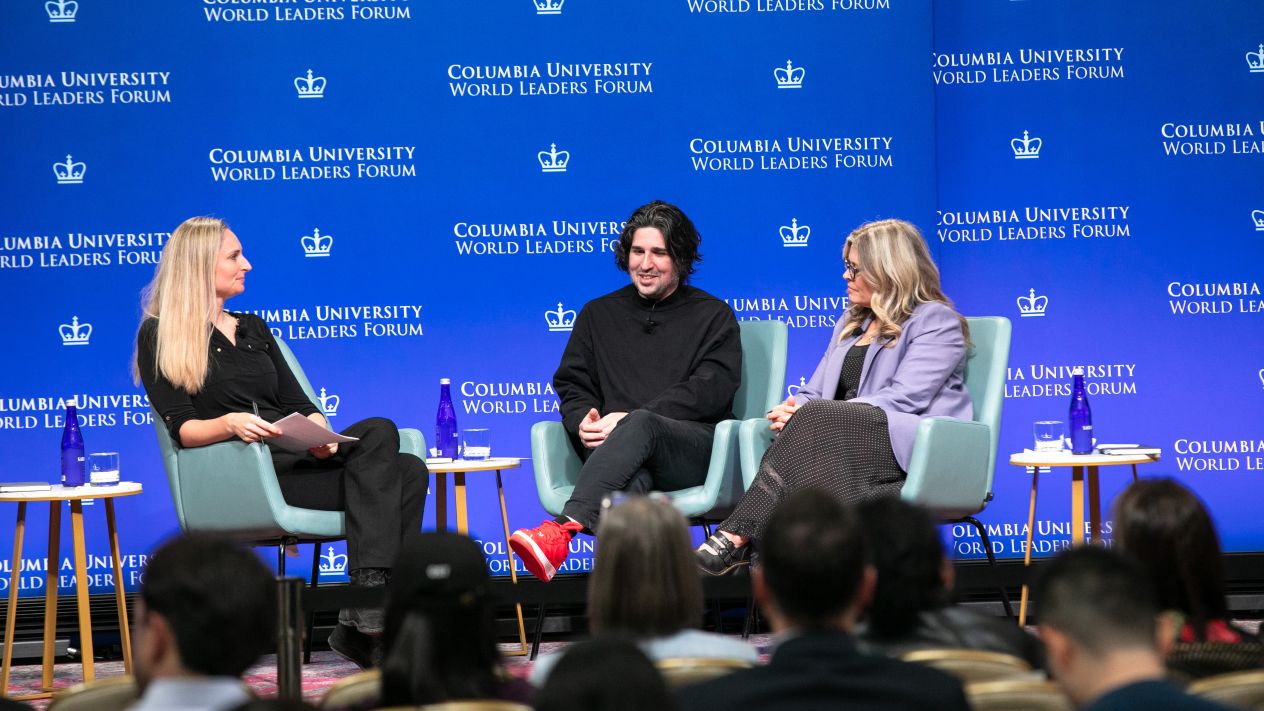
Dean Shih-Fu Chang recognized Raymond P. Daddazio BS'75, MS'76, EngScD'82 with the Thomas Egleston Medal for Distinguished Engineering Achievement. Daddazio is chairman of the Thornton Tomasetti Foundation and former president of Thornton Tomasetti. Dean Chang also recognized Azmi T. Mikati BS'94, the CEO of M1 Group, with the Samuel Johnson Medal for Distinguished Achievement Beyond Engineering and Applied Science.

Over the weekend, alumni and guests attended lectures from Columbia Engineering faculty, including a talk on AI and neural intelligence with Richard Zemel, Trianthe Dakolias Professor of Engineering and Applied Science and professor of computer science; as well as a presentation on energy, transition, and mining with Dan Steingart, Stanley-Thompson Professor of Chemical Metallurgy, professor of chemical engineering, and chair of the Department of Earth and Environmental Engineering

On Friday, attendees toured the Plasma Physics Lab and the Robotics and Rehabilitation (RoAR) Lab. They also mingled at a general All Class Reception and recognized classes celebrating their 50- and 25-year anniversaries. Members of the Class of 1976 received Golden Lions pins, while the Class of 2001 members received Silver Lions pins to commemorate the milestone and their entry into the Golden and Silver Lions Societies. The day ended with a Reunion Lawn Party for alumni of Columbia Engineering, Columbia College, and the School of General Studies. 

Image
Harry West stands behind a podium in a bright room with large windows, speaking between two tall banners featuring carved lion figures during a Columbia Engineering alumni reunion program.
Professor Harry West was recognized with the Great Teacher Award by the Society of Columbia Graduates. Credit: Brandon Vallejo

Dean Chang gave attendees an overview of Columbia Engineering news highlights and research updates on Saturday at the Dean’s Breakfast. The Engineering School also hosted a special reception for alumni of its master’s and doctoral programs. The Society of Columbia Graduates sponsored the Great Teacher Awards reception to recognize the 2026 honorees. Harry West, professor of professional practice in the Department of Industrial Engineering and Operations Research, received the Great Teacher Award for the Engineering School. Caterina Pizzigoni, associate professor of history, was the Columbia College recipient. The day closed with receptions and dinners for the classes and a Starlight Celebration on Low Plaza featuring a live band, dessert, and champagne.


Costis Maglaras, dean of Columbia Business School, opened the event in a room where he spent more than two decades as a faculty member. "The program that we just launched is interesting and valuable, both to us here at Columbia and back in Athens," he said. Maglaras described how the program came about, first as an informal exchange that turned into a WhatsApp conversation and, eventually, into a collaboration spanning institutions and continents.

"Most of the time in academia you come up with good ideas and nothing happens," he told the audience. "We're executing, and we're actually getting it off the ground."

Dora Varvarigou, professor of electrical and computer engineering at NTUA, emphasized that the collaboration had been a long time coming. "I thought you were never going to ask us to start this thing," she told the Columbia organizers with a laugh before explaining the vital mission of HIAS, which aims to draw on the talents of Greek scientists across the world to foster scientific excellence to advance knowledge and support human well-being.

The afternoon's speakers traced paths from research bench to commercial product in three of the program's focus areas: AI, health technology, and sustainable materials.

Elisa Konofagou, the Robert and Margaret Hariri Professor of Biomedical Engineering at Columbia, described two decades of work developing focused ultrasound techniques that can open the blood-brain barrier to deliver drugs directly to the brain. Her lab's technology has been spun out into a company called Sono Therapeutics.

"You are the first inaugural class, so you are our guinea pigs," she told the student audience, urging them to use the week to reflect on what the program had given them. Her broader message to aspiring founders: expect the journey to take longer than you think.

Antonis Lazanas, head of portfolio and index research at Bloomberg, offered a view from quantitative finance, arguing that the real entrepreneurial opportunity in AI lies in building the tools that make agents faster, cheaper, and more reliable. After noting that ethics was his least favorite course at NTUA, Lazanas struck a more philosophical chord, saying, "We need ethics, we need philosophy, so that we can make use of all this power in a way that's going to renovate us, not destroy us.” 

Kostis Kaffes, an assistant professor of computer science at Columbia and an NTUA alumnus, presented his lab's work on AI agent infrastructure, including techniques for reducing latency and token costs in multi-step agent workflows. He echoed Lazanas’ point about where opportunity lies. 

"The verification and the reliability of agents will be a major infrastructure issue, and that's extremely hard — no one has solved it yet. If you have good ideas on that, you might make a lot of money." His advice to the room was direct: stay out of hardware and foundation models, and look for deep-tech problems at the infrastructure layer where a genuine moat is possible.

Helen Lu, Percy K. and Vida L.W. Hudson Professor of Biomedical Engineering and senior vice dean at Columbia Engineering, closed the technical portion with a 20-year account of engineering synthetic ligaments and degradable scaffolds for orthopedic repair. Her most memorable lesson came not from a success but from a regulatory stumble: years into developing a tissue scaffold, her team discovered the solvent they were using for manufacturing fell into the wrong FDA safety class.

Rather than see it as a setback, she reframed it. "I turned the safety issue into an opportunity to actually improve the product," she said. Her takeaway for the NTUA founders: "Think of the end first."

A panel of Columbia Lab to Market alumni — Fotis Tsitsos, Parth Gami, and Chrisha Nario — shared firsthand perspectives on navigating the startup landscape, while a second panel gave the NTUA participants, including Elpida Oikonomou, Stavros Mouratidis, and Anna Maria Papakonstantinou, a forum to offer feedback on the program itself. The event closed with a reception where student teams presented their work. 

Meet the winners

In first place, winning $25,000, was Routerr Health, a smart logistics platform for mobile at-home healthcare, pitched by Brendan Stec MBAxMS’26. Routerr Health, Stec explained, was born from a gap in the $70 billion at-home care market. The number of U.S. adults who are 65 or older is driving demand for at-home care. Providers are struggling to match patients with at-home clinicians, causing delays in care.

Routerr Health streamlines the process, helping teams organize hundreds of incoming orders from patients and match the right staff to the right patient. Routerr Health also uses AI to automate dispatching decisions.

“This helps teams serve more patients, right-size their clinical staff, and eliminate the daily dispatching errors that cause so many issues for patients and the clinicians,” Stec told the judges.

Coming in second place, with a prize of $15,000, was MariStarboard, pitched by Yuta Morimoto MBAxMS’27, Nat Suwattananon MBAxMS’27, and Andy Pasricha MBA’26BUS. MariStarboard plans to use autonomous underwater robotics to solve what the founders described as an inefficiency problem in global maritime infrastructure. 

In their pitch, the team explained that barnacles and other organisms get stuck on a ship’s hull, increasing drag. The reduction in fuel efficiency costs the shipping industry upwards of $200 billion annually. Before a ship’s hull can be cleaned, a specialist must conduct an inspection, which is costly and time-consuming. MariStarboard’s software streamlines the costly and time-consuming process of hull inspection by using drone-captured video and an AI model. The system allows ship owners to conduct this inspection on demand, making it easier and cheaper to clean ship hulls. 

Third place went to Plasmole, an AI research partner for molecular biology, pitched by Aditya Kulkarni MS’26 and Paul Yoo MS’22, who won $10,000 for the project. The platform provides AI tools to assist biologists at every stage of research, from hypothesis to publication, streamlining research and documenting it in one app. The beta version has already been a hit with scientists at Cornell and NYU.

Subscribe to Events