Columbia MBAxMS Program: Robotics Challenge
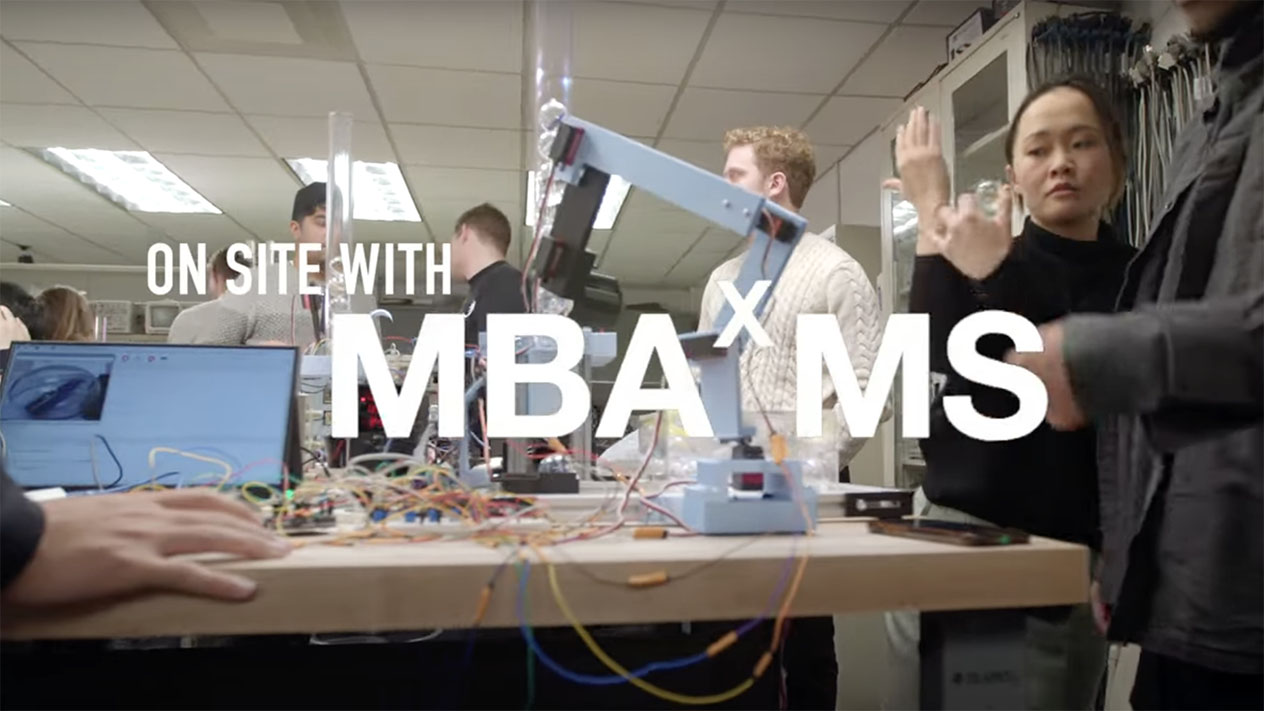
The Fundamental Design Tools course turns business students on to state-of-the art robotics.
Lead Photo Caption: The inaugural graduating class from the MBAxMS dual degree program
Mayor's Cup Highlights
Credit: Diane Bondareff/Columbia Engineering


A day of innovation, teamwork, and STEM spirit
"We are so happy to have you here, and we hope to do more with New York City schools and our partners to share and promote our love of STEM,” said Dean Chang. “Columbia Engineering has a long history of supporting FIRST Robotics teams with mentors–we have hosted the FIRST Robotics kickoff for multiple years and plan to do so again in 2026.”
Dean Chang also noted that more than 40 students from the Engineering School had signed up to volunteer. “Many of our engineering students are FIRST alumni, as well. They have personally benefited from this program and they know the impact being on a robotics team in middle or high school can have on a young person's life.”
“Today’s competition is more than just a contest. It is a testament to the dedication, the creativity, and the hard work of each and every one of you,” said Ray while addressing the students. “The innovation and approaches you took to source materials and build your projects were truly remarkable – it’s very inspiring.”
To win the robot challenge, alliances of two teams would compete against another alliance–and challenge their robots with a series of tasks, from collecting blocks and disposing them in the team’s bucket, or retrieving hooked blocks to hang in the middle of the arena. The Mayor’s Cup came to an exciting conclusion when the last two teams of alliances competed for first place. Teams Saturn and Mercury, an alliance team took home the first place trophy. Both teams were made up of students from the Staten Island Technical High School.
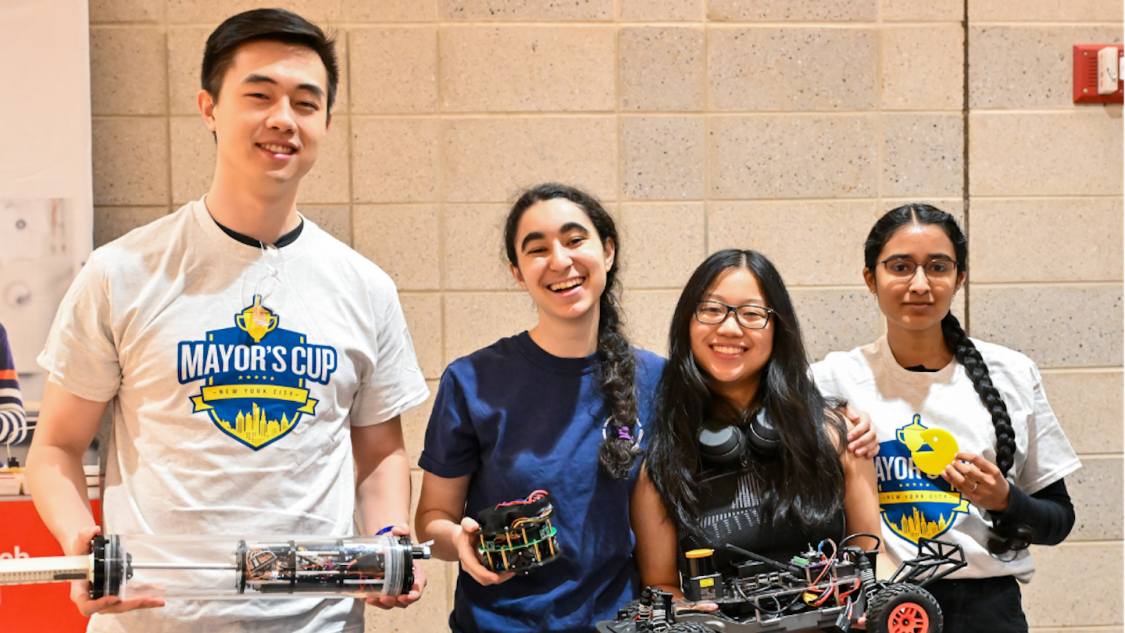
Robotics demos and campus exploration
In addition to the full day of competitions, Columbia Engineering faculty members presented a series of robotics demos. Highlights included demonstrations from Hod Lipson’s Creative Machines Lab, Sunil Agrawal’s ROAR Lab, Yunzhu Li’s RoboPI Lab, and Matei Ciocarlie’s ROAM Lab. The School’s Office of Outreach also showcased a creation from their flagship program SHAPE (Summer High School Academic Program for Engineers), a summer program that offers college-level courses taught by Columbia faculty.
Additional demos were showcased by student groups representing the Engineering School, including Columbia Space Initiative, Columbia Robotics Club, Biomedical Engineering Society, and Columbia University Formula Racing. High school students participating in the competition also had a chance to tour the School and learn more about student clubs from Columbia students who shared demos of their past work.
“Thank you to the students for really putting in the effort to make this day a reality,” said Zigman at the competition. “Many of you will go on to careers in STEM, but for those of you who don’t, you’re going to be incredibly successful because of the mindset and skills you’ve learned that will serve you well in anything you choose.”
Lead Photo Credit: Diane Bondareff/Columbia Engineering
Kathryn (Kate) Lampo has always aimed higher than most—literally. “I was the kid who wanted to be an astronaut,” she said.
As a senior majoring in mechanical engineering, she’s inching even closer to achieving that childhood dream. After graduation this spring, Kate, the current co-president of Columbia Space Initiative (CSI), will soon begin her professional journey in the aerospace field.
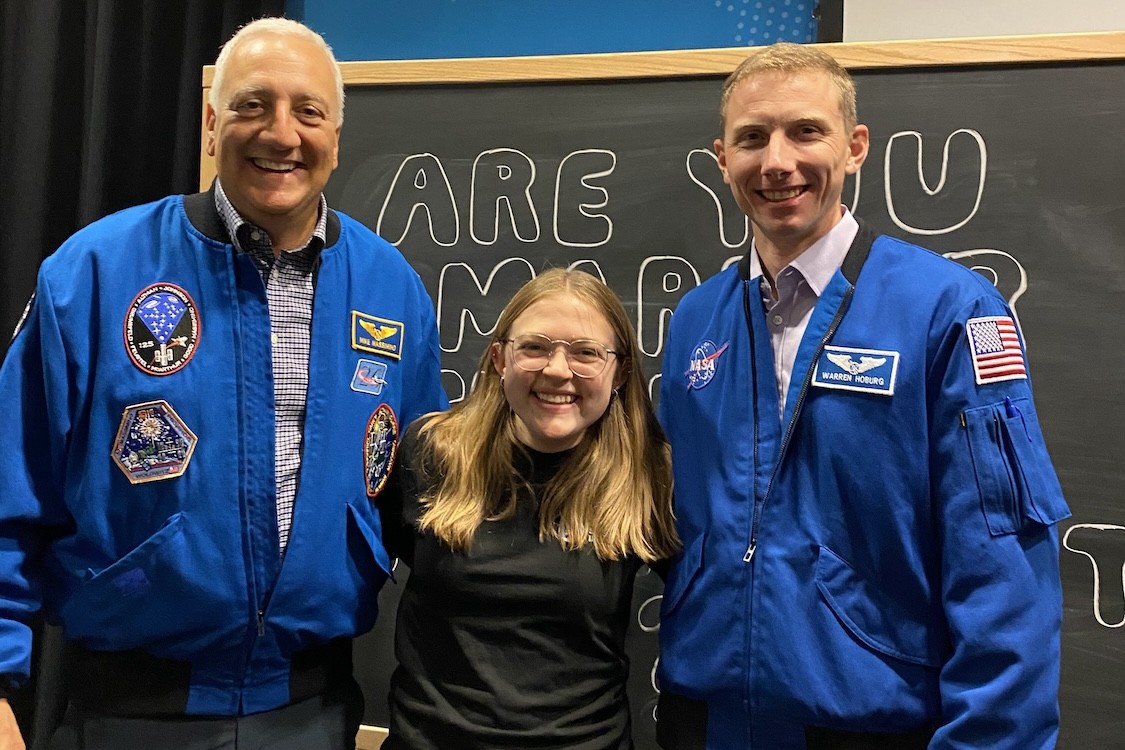
Kate has recently been named a recipient of the 2025 Campbell Award, an honor presented to a graduating student who shows exceptional leadership and Columbia spirit as exemplified by the late Bill Campbell ’62CC, ’64TC. She has received numerous accolades this past year, including a Marshall Scholarship and was honored with Aviation Week Network’s 20 Twenties Class of 2025 award. Advised by Mechanical Engineering Professors Mike Massimino and Matei Ciocarlie, Kate conducts research in Ciocarlie’s Robotic Manipulation and Mobility Laboratory, where she works on designing and building robotic manipulators. She will be continuing her studies in space robotics at the University of Oxford following graduation.
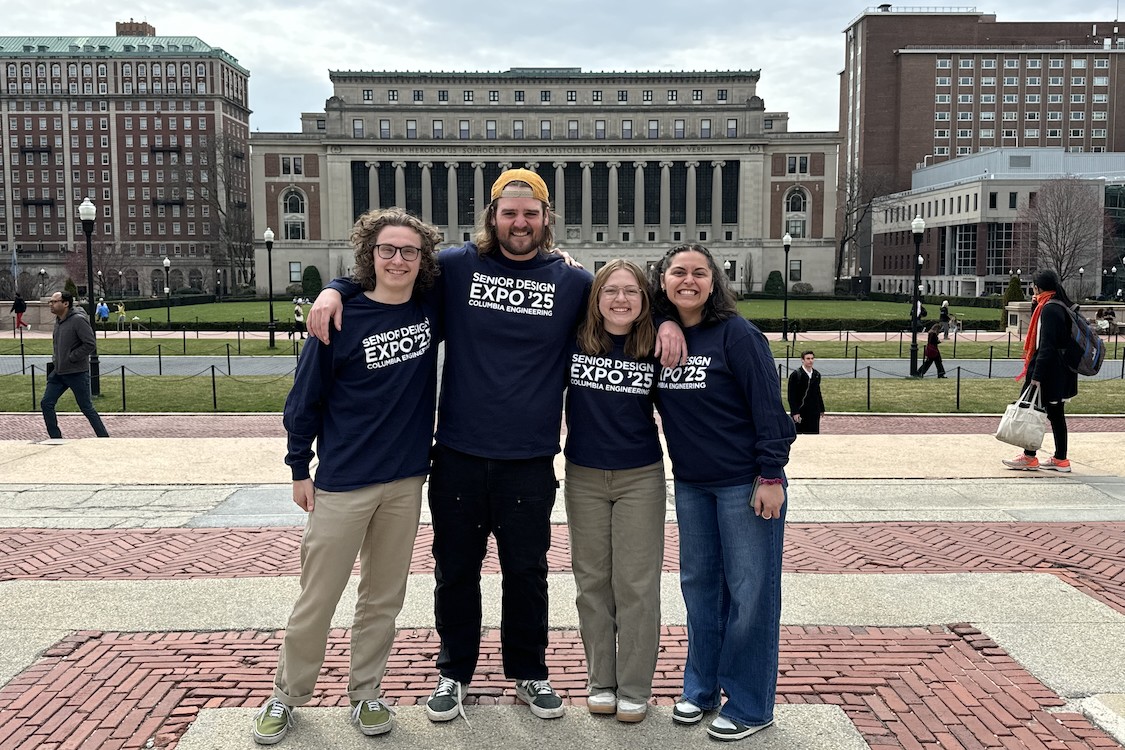
Thinking back — what first drew you to Columbia Engineering?
Honestly, the city! I grew up in the suburbs of Denver, and while I loved Colorado (and still do), I knew that I wanted to move somewhere completely different for college. Columbia also seemed like a place brimming with opportunity, and I knew that I would grow in significant ways at Columbia Engineering.
Did you always know you wanted to get into the aerospace engineering field?
I did! When I was younger, I was the kid that wanted to grow up to be an astronaut. I’ve always been fascinated by the scientific potential inherent in exploring our universe, and as my aspirations developed throughout middle and high school, I became more and more interested in building the vehicles that allow us to do so. To me, aerospace engineering has always been a great way to combine my love for space with my enjoyment of designing and building things. I’ve been able to refine those aspirations further here, and am now focused on robotics for space applications.
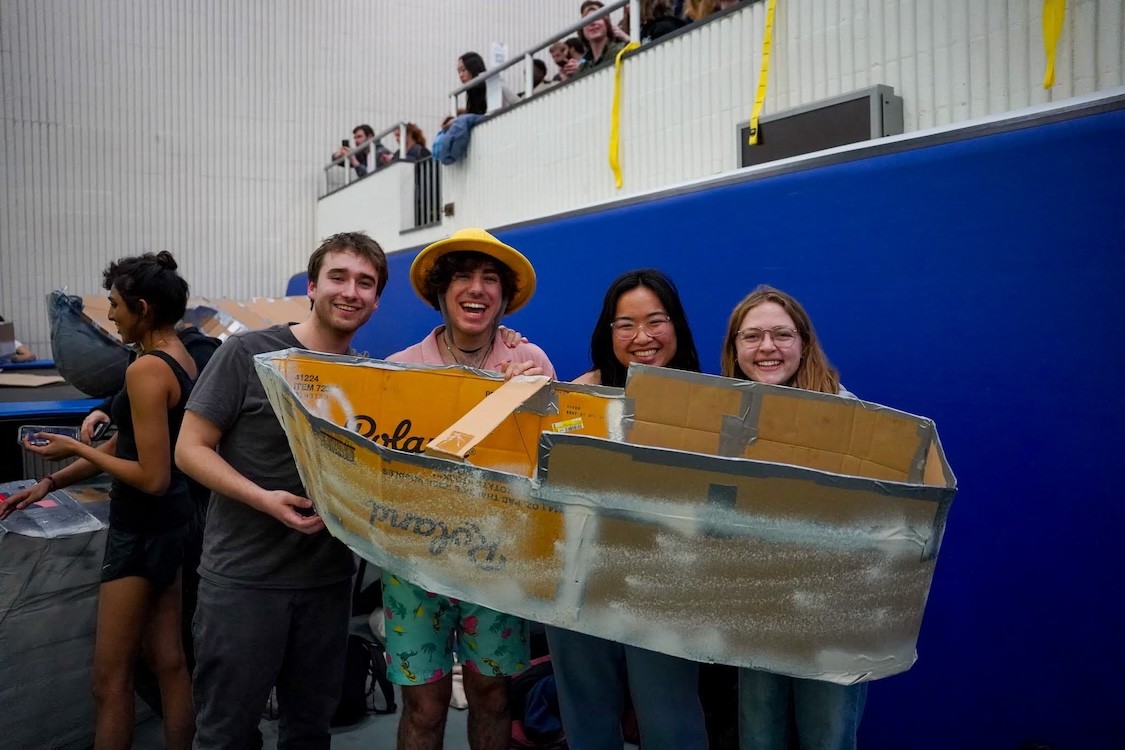
What’s a moment at Columbia that shifted how you see yourself—or your future?
I think the most valuable thing that Columbia has taught me is to believe that anything is possible.
My freshman year, I worked in a team as a part of the Columbia Space Initiative (CSI) that built a lunar gripping and anchoring tool for a NASA competition. After being selected as national finalists, we got to travel to the Johnson Space Center in Houston, TX to test the tool in the Neutral Buoyancy Laboratory, which is a microgravity astronaut training center.
To have that opportunity so early on was a phenomenal experience, and it made me realize that I could do serious engineering as early as my freshman year. That has inspired me to pursue every outlandish opportunity since, and while plenty of my efforts have been unsuccessful, my penchant for trying has opened up many other doors for me throughout college.
“The most valuable thing that Columbia has taught me is to believe that anything is possible.”
Kathryn LampoBS'25
How has the School’s guiding principle, Engineering For Humanity, resonated with your experience at Columbia?
I’ve been lucky enough to have had many teaching opportunities that embody the concept of Engineering for Humanity to me. I’ve spent a lot of time working on educational STEM outreach in Title I middle schools across the city, developing and delivering lessons on space science and engineering to thousands of kids. I’ve also been a teaching assistant for first-year students for the last two years, which is something that I’ve found to be incredibly rewarding.
In my mind, a big part of Engineering for Humanity is making STEM opportunities accessible to anyone that wants to pursue them. Coming up with creative and novel solutions that benefit humanity requires integrating diverse perspectives, which is something that Columbia has made clearly evident to me.
If you could send one piece of advice to your first-year self, what would it be?
Relax! My first-year self (like many first-years) was overly stressed and trying to do way too much. Four years is a long time, and I would encourage her to authentically explore her interests instead of trying to join every extracurricular she came across. There’s no rush—and taking time for rest is important!
Share some words to live by or a message to your fellow grads?
While I often think the phrase is used in a negative way, I really like the expression “throw everything at the wall and see what sticks.” I’m a big believer in trying things with the understanding that not everything will work out, but something is bound to stick. I think it’s worthwhile to be open to new and unfamiliar experiences, and to pursue things that seem improbable.
What are your plans this summer and after Columbia?
This summer, I’m excited to spend some time resting at home in Colorado with my family and friends. In the fall, I’m off to Oxford to start my MSc in Engineering! I’ll be studying robotic planning for space environments.
What will you miss the most about your time at Columbia Engineering?
Easily the Columbia Space Initiative (CSI)! CSI has been such a home for me during my four years at Columbia—I joined the first week of my freshman year, and I haven’t left since. From the jump, the club provided me with truly phenomenal aerospace opportunities, from testing a lunar gripping tool in NASA’s Neutral Buoyancy Laboratory to calling an astronaut on the ISS to building a pair of satellites to launch in the next couple of years. Beyond that, CSI has also given me some of my closest friends and my strongest community here. I’ll miss it very dearly!
Event highlights
Credit: Diane Bondareff/Columbia University


Recognizing the importance of open conversations about career journeys, Columbia Engineering Dean Shih-Fu Chang and Columbia University Interim President Katrina Armstrong, both joined the event; Dean Chang gave introductory remarks and President Armstrong kicked off the discussion and shared her own experience as a woman in STEM.
Armstrong talked about her unconventional career path– from studying architecture as an undergraduate to completing medical school and ultimately rising through the ranks in higher education in leadership roles at the University of Pennsylvania, Harvard, and now, at Columbia. She encouraged attendees to regularly check in with themselves, emphasizing the importance of making changes before reaching burnout. She also highlighted the value of finding what works for each individual. She shared a personal anecdote about how she became known for letting her kids sleep in their school clothes instead of pajamas—a simple adjustment that made hectic mornings a little easier.
“The best advice I ever received was to be yourself because you're not going to change who you are,” Armstrong said. “And if you try to be somebody else, you're going to be so much less effective than just being who you are.”
Building connections
The second half of the event consisted of breakout sessions between small groups of students and women faculty members from across Columbia. With cups of coffee in hand, students and professors–women in STEM– exchanged stories, laughter, and insights.
A common theme professors shared with students was the importance of advocating for yourself and pursuing what you're passionate about. University Professor and Mikati Foundation Professor of Biomedical Engineering Gordana Vunjak-Novakovic emphasized that when you truly love what you do, it never feels like work—even when challenges arise. Christine Hendon, associate professor of electrical engineering, encouraged students to believe in themselves, even when others doubt their ideas.
"If someone says it won’t work, figure it out, run some simulations, test for tolerance analysis, and if it looks feasible—go for it," Hendon said. "When you finally get to the point where it works, it’s the best feeling ever.”
In this relaxed setting, conversations flowed and what started as casual chats soon turned into meaningful discussions about careers, research, and personal experiences.
“This event showcases the magic of Columbia,” said Githika, “and how there is a community that wants to not just collaborate with each other, but grow with each other.”
Lead Photo Caption: Columbia faculty, students and staff gathered in Carleton Commons March 7 for a special networking opportunity for women in STEM.
Lead Photo Credit: Diane Bondareff/Columbia University