Photo highlights
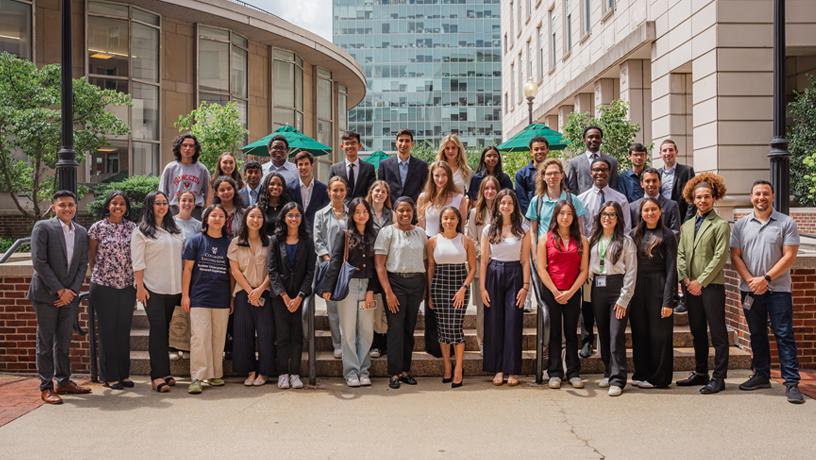
Images from the 2024 SURE Program
ABOUT COLUMBIA ENGINEERING
Columbia Engineering, based in New York City, is one of the top engineering schools in the U.S. and one of the oldest in the nation. Also known as The Fu Foundation School of Engineering and Applied Science, the School expands knowledge and advances technology through the pioneering research of its more than 200 faculty, while educating undergraduate and graduate students in a collaborative environment to become leaders informed by a firm foundation in engineering. The School’s faculty are at the center of the University’s cross-disciplinary research, contributing to the Data Science Institute, Earth Institute, Zuckerman Mind Brain Behavior Institute, Precision Medicine Initiative, and the Columbia Nano Initiative. Guided by its strategic vision, “Columbia Engineering for Humanity,” the School aims to translate ideas into innovations that foster a sustainable, healthy, secure, connected, and creative humanity.
ABOUT COLUMBIA BUSINESS SCHOOL
Columbia Business School is the only world-class, Ivy League business school that delivers a learning experience where academic excellence meets with real-time exposure to the pulse of global business. Led by Dean Glenn Hubbard, the School’s transformative curriculum bridges academic theory with unparalleled exposure to real-world business practice, equipping students with an entrepreneurial mindset that allows them to recognize, capture, and create opportunity in any business environment. The thought leadership of the School’s faculty and staff members, combined with the accomplishments of its distinguished alumni and position in the center of global business, means that the School’s efforts have an immediate, measurable impact on the forces shaping business every day. To learn more about Columbia Business School’s position at the very center of business, please visit www.gsb.columbia.edu.
Club Life: Columbia University Formula SAE
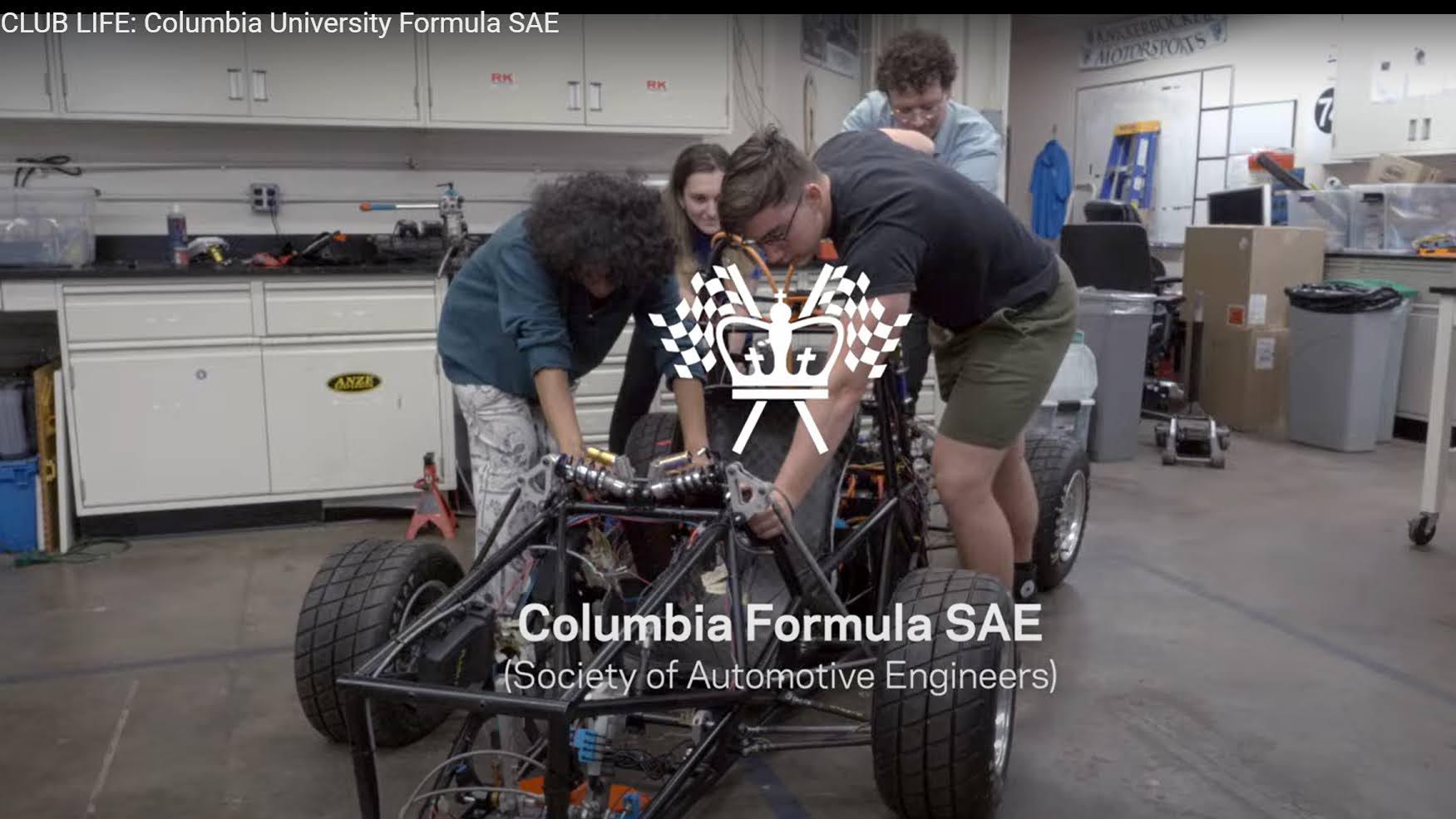
Build an electric race car from scratch? Go behind the scenes to see Columbia’s Formula Racing club assemble the key components of their racing vehicle.
Safety first
Back in the basement workshop, the club’s president, Sophia Ladyzhets BS’22, and Catherine “Calee” Schmidtberger BS’22, the club’s chief mechanical engineer, stand surrounded by car parts, from v-shaped suspension rods to the braking system to the hub and uprights assembly holding these components and the tires. The team has already run dozens of tests on each system, checking and double checking that all fail safes are in place and functional. The group has even created a full-sized model of the car’s front end to study how well it can withstand heavy impact.
Every aspect of the design process needs to be timed and executed with precision. Ben Felson BS’24, the team’s vice president of technical operations, pulls out an Excel spreadsheet containing a long list containing hundreds upon hundreds of FSAE rules about vehicle systems, subsystems, and subsystems for those subsystems.
“I have these little rules readings on the weekends where we literally go through and read each one, talk about it and what it’s about, then establish who is in charge of knowing it and when we reviewed it,” Felson said. Because the motor, high voltage battery pack, and other integral electrical components sit right behind the driver, “the rules are more high stakes for the EV because parts of the system can be a real danger to the driver if handled incorrectly.”
But the beating heart of any car is the motor, and, in an electric vehicle, that’s where things get particularly interesting. Hovering over the open accumulator, Partida described the internal functions of the car’s powertrain, from the battery pack, the relays and electronics to the motor controller and the electric motors, with surgeon-like detail. The battery pack is a layer cake of power, with each battery segment containing multiple clusters of cells. Members hope that those cells will take their car upwards of speeds of 120 kilometers per hour.
That’s not just about raw power; it’s also about engineering an incredibly effective use of it.
“The efficiency of the motor inverter [the EV component that converts direct current to alternating current] is upwards of 90%,” Schmidtberger said. “So the power efficiency is very high, especially compared to internal combustion cars, where the standard efficiency of an engine is around 35%.”
Indeed, it’s never as simple as taking the bones of a combustion car and swapping in a few electric parts.
“Our first iteration of this prototype used an old chassis, the old bones that were from an old internal combustion car,” Schmidtberger said. “In that case, several of our parts were wonky and ended up having a horrible shape that would have never worked. Our new chassis is designed to be an electric car that can fit the accumulator in the back to maintain a low center of gravity, preserving its handling capabilities.”
A new generation of car designers
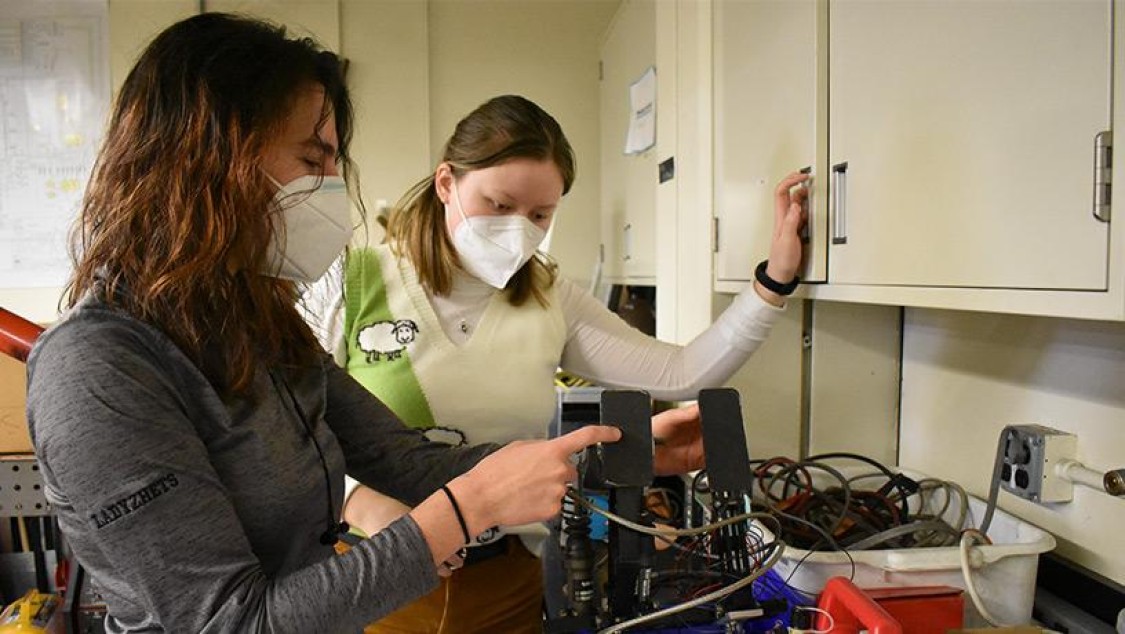
The push toward electric design had the side benefit of attracting a wide range of students, not just the stereotypical motorhead crowd of yesteryear, noted Professor of Mechanical Engineering Jeffrey Kysar, another of the club’s faculty advisors. “The refocus is attracting students not just from mechanical and electrical engineering, but from chemical, civil, and earth and environmental engineering—as well as from other schools and laboratories at Columbia such as the Lamont-Doherty Earth Observatory,” he said. (Test drives are conducted in the parking lot of Lamont-Doherty, thanks to its director Maureen Raymo.)
“Sustainability is a global problem that attracts everyone,” said Preindl.
Ladyzhets noted there have been several non-engineering students joining the club, such as Elaine Kharbanda ’24, the club’s vice president of business affairs and a linguistics student at Columbia College. At the competition, the team’s inclusivity efforts were recognized by General Motors’ “Everybody In” award, which is presented to the team that best reflected the company’s Everybody In campaign. As part of their prize, GM will cover the group’s registration fees for next year’s competition.
Browne added that the team’s diversity is starting to be reflected within the wider industry, citing GM’s own Mary Barra, who was named CEO in 2014. He also acknowledged Mary Boyce, now provost of the University, who ramped up funding for the club and also completely renovated the FSAE’s workshop back when she was dean of the engineering school. Browne said it was her interest in FSAE that made the transition to EV possible.
Transitions are much on the minds of club members, as summer marks the end of another academic year. Ladzyzhets is pursuing her integrated master’s degree in mechanical engineering at Columbia, and is planning for an upcoming internship with Tesla. Schmidtberger, on the other hand, wants to follow her childhood dream and build energy-efficient amusement park rides, or also get involved in other sustainable projects.
But most importantly, the legacy they want to leave behind is one of inclusivity, where everyone can feel like they’re building the future together.
“With the electric car, we’ve tried to make it a lot more welcoming—there’s no experience needed—we don’t do interviews, and we’re trying to put a lot more work into our teaching and mentorship,” Ladyzhets said. “We’re all trying to figure out these problems together, and that’s the most important thing.”