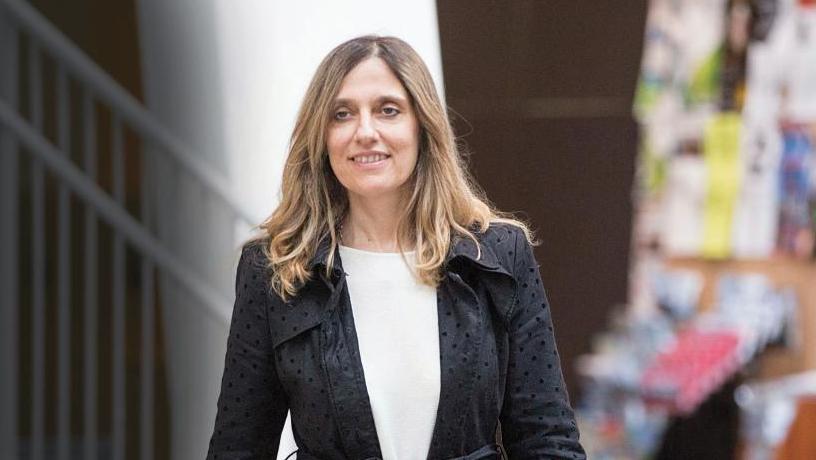
Allie Obermeyer, assistant professor of chemical engineering, is among this year’s Camille Dreyfus Teacher-Scholars for 2023. The award is given by the Camille and Henry Dreyfus Foundation for faculty within five years of their academic careers who have created an outstanding independent body of scholarship, and are deeply committed to education. 

Obermeyer, who joined Columbia Engineering in 2017, focuses on developing novel protein-based materials to address problems in biomedicine, biotechnology, and synthetic biology. In recent years, Obermeyer has teamed with Helen Lu, Hudson Professor of Biomedical Engineering, on the development of bioengineering sustainable textiles. The Columbia Engineering professors partnered with Theanne Schiros, a Columbia research scientist and an associate professor at FIT, on the startup Werewool, which uses protein structures in place of plastics to make fibers that can biodegrade and return nutrients to the soil, making the clothing supply chain more sustainable. Werewool recently won the ELLE & Polestar Design Towards Zero Award for innovators who use new and circular materials within the fashion industry, and has also raised $3.7 million in seed funding from investors. 

Prior to Columbia, Obermeyer was a postdoctoral fellow at MIT, and obtained her PhD in chemistry and chemical biology from the University of California, Berkeley and her BS in chemistry from Rice University. She has won an NSF CAREER Award, the Distinguished Faculty Teaching Award from the Columbia Engineering Alumni Association, and the Andrew D. Morsey Memorial Award for Teaching Excellence from the Chemistry Department at the University of California, Berkeley. 

As a Camille Dreyfus Teacher Scholar, she and the 18 award winners will receive an unrestricted research grant of $100,000. Established in 1946 by chemist, inventor, and businessman Camille Dreyfus, the foundation’s stated mission is to advance the science of chemistry, chemical engineering, and related sciences as a means of improving human relations and circumstances throughout the world. 

An engineer from the start

When Smoot was five years old, his dad came home one day with a battery, a bell, lightbulbs, and some wire.

“He was an itinerant inventor, not a professional,” Smoot said. Despite not having any training, he could fix TVs and build gadgets to use around the house. 

Before long, Smoot’s dad had the bell ringing and the lights shining.

The experience, which is his earliest memory, “lit my entire career,” Smoot said.

Smoot would always take things apart but unlike many other nascent engineers, he wasn’t trying to figure out how they worked. Instead he wanted to build new things. One of his proudest boyhood creations was a unicycle built from an old tricycle and the seat from a bike.

Unicycling is something he’s maintained to this day.

“If I’m proud of something here at Disney, it’s that I don’t need a lot of money to create pretty cool prototypes of new inventions.”

From telecommunications to the Magic Kingdom

During the summers during his undergraduate years, Smoot worked at Bell Labs, eventually working his way up to designing complex circuits and systems. “It wasn’t just a summer job, it was actual work contributing to telecommunications.”

After graduating from Columbia Engineering, Smoot went full-time at Bell Labs, where he designed some of the first fiber-optic transmission systems that were used widely in the Bell System. He would later design some of the first broadband systems and early videoconferencing systems. 

His career at Bell Labs spanned 22 years. In 1997, while attending a trade show in Las Vegas, Smoot was approached by an inquisitive man. Smoot showed him one of his latest inventions: a system that would let viewers control which camera angles they saw on their home TV. The man said he was interested in using the system to view animals in their enclosures.

When Smoot asked what company could possibly need to do that, the man replied that he was from the Walt Disney Company. 

“Turns out, he was actually talking in the code we use at Disney to make sure we don’t give away what we’re really doing,” said Smoot.

In fact, the company was interested in using the technology with free-roaming animals at Disney’s Animal Kingdom theme park in Florida.

“Disney liked the invention, but they liked the inventor more,” Smoot said. He joined Disney in 1998 and ran Disney’s research facility in East Hampton, Long Island. When his research and development group relocated to Glendale, CA, a couple of years later, Smoot moved to the west coast. 

A legendary engineer with Columbia roots

Smoot has fond memories of the community he built during his time at Columbia. A resident of John Jay Hall, he enjoyed the company of a tight-knit group of friends, including fellow Class of ’77 alumni, Doug Rowe, Gary Foster, Craig Thompson, and Sam Scipio. They spent time in the restaurants on Broadway and studied at McIntosh, a student center that used to stand on the Barnard campus. 

“The folks I happened to mention were Black, and were great scholars. We wound up doing our physics and our electronics and our computer science courses together,” Smoot said. “Having those supporting folks no matter what was amazing there.”

Today, Smoot is a Disney Research Fellow and the company’s patent leader. Some of Smoot’s most recognizable inventions include the technology that makes Madame Leota’s head fly around the Haunted Mansion attraction in her crystal ball and the water harps found in the Journey of Water attraction at EPCOT. He also holds the patent for the extendable lightsabers used recently in Disney attractions. 

After 25 years with the company, Smoot isn’t slowing down. In fact, he’s more excited than ever about his latest project: the HoloTile Floor

“It’s the world’s first omnidirectional treadmill floor,” he explains. “Every part of the floor can move anything or anybody that’s on it. It can counter your walking movement, so you could walk on it forever.”

When someone uses a virtual reality headset — whether at home or at a Disney attraction — Smoot’s invention will ultimately allow them to move through virtual space without having to worry about the physical space around them. 

“We finally have the thing that was always missing from virtual reality,” he said. “I think it’s going to change the world.”

Subscribe to Awards & Honors