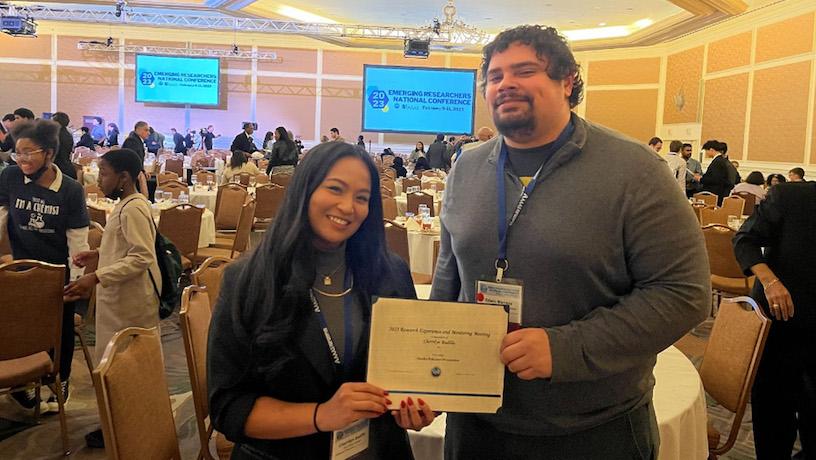
NSBE Celebration
Photo highlights from the event
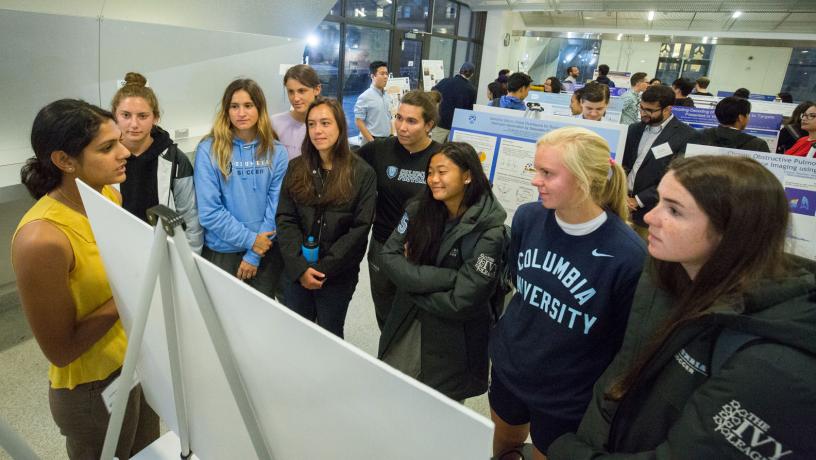
Columbia Engineering’s Class of 2023 showcased their inventive solutions to challenging problems at the 8th annual Senior Design Expo. Projects varied from an approach that aims to reinvent IV (intravenous) administration for NICU patients to a novel capture system to remove space debris. More than 50 teams spanning eight departments presented their innovations and research at a packed showcase held May 4 at Roone Arledge Auditorium to a crowd of peers, professors, alumni, and STEM enthusiasts.
The biomedical engineering team behind NuJet (Anjali Nair, Isa Nuñez, Athena Pagon, Vish Rao, Elías Tzoc-Pacheo), attempted to solve the need for a cost-effective vaccine delivery to make vaccines more accessible, sustainable, and sanitary.
“Syringes and needles are the most common form of vaccine delivery, despite many of the components being single-use,” said Pagon.
On top of this, there are strict storage, transportation and disposal requirements, leading to a high-cost model that is typically only accessible in high resource centers. Their solution, a low-cost needle-less injector, generates a pressurized fluid stream that delivers the vaccine right below the skin while reducing cross-contamination, waste, and cost.
Inspired by individuals who suffer from overstimulation and anxiety, the electrical engineering students behind Musical Meditation (Tess Fallon, Alexandr Petuhov, Leonardo Arvan, Madeline Denis) developed a pair of headphones that reads the user's heart rate, while playing calming music that adjusts itself in an attempt to slow down the person’s heartbeat.
Some designs focused on improving existing solutions. AMPF, also known as the Automated Pothole Filler (Jose Chanchavac, Phillipe Dumeny, Javier Lopez, Jerry Qu, Justin Tucker) aimed to simplify the process of filling potholes, which typically requires work from a large team of workers, typically five to 10 people at a time. “Our solution greatly reduces the number of people needed to about one to two workers,” said Javier Lopez, who recently received a degree in mechanical engineering. While AMPF focused on earthly solutions, DEMI (Miles Huntley-Fenner, Christina Wrightm Yidi Reiss, Leon Aharonian, Nicolas Aldana) focused on safely securing space debris, also known as space junk, which poses a serious threat to the welfare and sustainability of orbital activities. Their two-stage capture system encloses the debris and seals it in a storage chamber, which is something that other solutions lack.
Sustainability was a common theme among many projects, with the expectation of improving systems that currently affect the environment. AQUA4 (Anton Deti, Emily Milian, Itai Savin, Kennedi Wade) developed a water rerouting system that repurposes water used in the bathroom. Students from the Department of Earth and Environmental Engineering researched how best to treat contaminated soil in New York City, with hopes to rid the soil of harmful metals such as lead and arsenic (Mantjita Camara, Emily Lord, Dane Miller).
Many civil engineering models were built this year with sustainability in mind, from re-designing Dam systems to better serve the flora and fauna of the surrounding area (Ruben Bazalar, Caroline Cailloux, Kevin Cardenas, Yunus Kovankaya, Zhihao Liu, Ariana Novo) to cost-effective Brooklyn housing made entirely of recycled shipping containers (Charlie Henry Renner, Abraham Oh, Katherine Koziol, Amin Mojarad, Isabella Citera, Tes S DeJaeger).
Other visionary projects aimed to improve skills, through games and physical exercise. With focus on creativity, the students behind ZyloZinger (Sienna Brent, Alex Yu, Haris Zia) created an interactive xylophone game that challenges hand-eye coordination. In an effort to improve athletic training, Deadliftr (Yelaman Sain, Kyrie Lorfing, Matt Klenk, Sam Wustefeld, Will Hamilton) aimed to develop a device to help weightlifters on their deadlift training, creating a wireless device that gives athletes real-time feedback on their form.
“I feel inspired and energized by all of the inventive projects on display here today and I know the rest of you feel the same,” said Dean Shih-Fu Chang in his address preceding the event. “It truly shows how creative our field of engineering and applied science is and our commitment to being engineers for humanity.”
Generative AI Symposium Highlights
Photo Credit: David Dini
Workshop Highlights
Gallery Highlights from the CryptoEconomics Workshop.
Blockchains and the applications they support raise new challenges for economics, computer science, and game theory.
At the 2023 Columbia CryptoEconomics (CCE) Workshop, held December 6-7, practitioners, researchers, and academics gathered at the University’s Manhattanville campus to discuss challenges, recent progress, and opportunities in the economics of blockchain protocols. In keynote presentations, contributed talks, and panel discussions, leading experts discussed topics including proposer-builder separation, MEV, layer 1 security rehypothecation/restaking, and roll-ups.
The workshop, which was co-hosted by the Briger Family Digital Finance Lab at Columbia Business School, Columbia Engineering, and the Ethereum Foundation, underscored Columbia’s commitment to interdisciplinary research that seeks impact beyond the walls of the University.
“We advocate for the convergent collaboration among academics, practitioners, and industry,” said Shih-Fu Chang, dean of Columbia Engineering and Morris A. and Alma Schapiro Professor of Engineering, in his opening remarks.
“As interest in the crypto space waxes and wanes, support at various universities has come and gone,” said co-organizer Tim Roughgarden, professor of computer science at Columbia Engineering and the head of research at a16z Crypto. “Columbia has been fairly unique among its peer institutions by having unflagging support for the advancement of this technology and the science behind it.”
Details about the event and a full lineup are available here.
Full recordings of all sessions are available here.